
Filter by categories
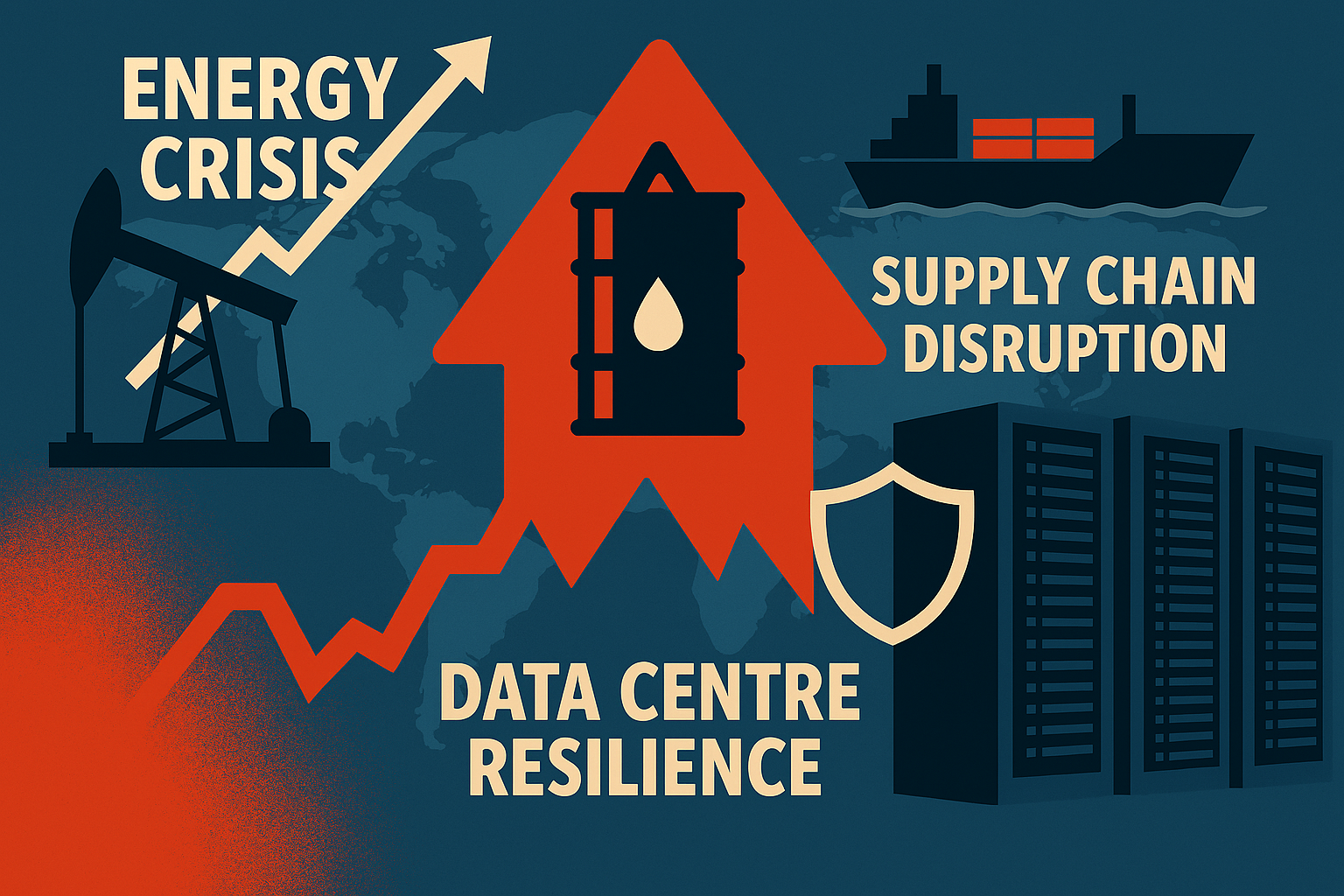
Beyond the Headlines: Why the Iran War Makes Operational Sustainability a Strategic Imperative
Energy Crisis & Operational Sustainability: Why the Iran War Changes the Game
Global energy markets are volatile, and the recent Iran‑related conflict has pushed price stability and supply security to the forefront for Australian critical infrastructure operators. In this environment, relying on carbon offsets alone is not enough—resilience starts with facility and IT efficiency.
As the Uptime Institute’s 2025 article The Two Sides of a Sustainability Strategy makes clear, operators must prioritise operational fundamentals: optimising PUE, reducing water and energy use, and building fuel flexibility. These measures directly insulate facilities from energy shocks, while ecosystem initiatives alone do not.
To build this capability, skilled teams and disciplined processes are essential. The Uptime Institute’s 2014 Operational Sustainability framework provides the proven blueprint.
Climate Resilience Is Now a National Priority: What the 2026 Uptime Institute Survey Means for Australia’s Data Centres
Australia’s climate is shifting fast - 2025 brought simultaneous record drought in the south and severe flooding that cut off more than 50,000 people in NSW, while early 2026 delivered brutal heatwaves with temperatures reaching 50°C in SA. These extremes highlight why global operators are responding, with 69% now conducting climate‑resilience assessments and over half reporting weather events that threatened uptime.
As climate volatility intensifies, skilled operations teams are essential. Ecanet Engineers is meeting this need by bringing Uptime Institute’s Accredited Operations Specialist (AOS) training to Australia this June - equipping data centre professionals to operate reliably in a climate‑challenged future.

Navigating the New Era of Data Centers: Key Takeaways from the Uptime Institute 2025 Survey
The 15th annual Uptime Institute Global Data Center Survey reveals an industry at a crossroads. With AI driving unprecedented density demands, power outages remaining the top cause of disruptions, and nearly two-thirds of operators struggling with skills shortages, the pressure on digital infrastructure has never been greater.
The path forward requires a dual commitment: intelligent engineering to optimize existing assets and continuous workforce education to close the skills gap.
Taming the AI Power Spike: New UPS Controls for High-Performance Computing
Achieving power stability in the AI era requires a shift in strategy. By implementing features like Battery Shield to prevent unnecessary micro-cycling, and Input Power Smoothing to buffer upstream infrastructure, data centers can protect backup reserves, extend equipment life, and maintain harmony with the grid - proving that intelligent software controls are just as critical as hardware capacity.
A Commitment to Certainty: Ecanet Earns Triple ISO Accreditation
We’re proud to announce that Ecanet Engineers has achieved ISO 9001 (Quality), ISO 45001 (Health & Safety), and ISO 14001 (Environmental) accreditation—formalising our commitment to delivering certainty, not just promises. These certifications mean your projects benefit from consistent quality, safer execution, and responsible environmental management.

The False Economy of Cheap UPS: Why "Bargain" Backup Costs More in the Long Run
When you buy a no-name UPS, you aren't saving money - you're just postponing the cost.
The true cost of cheap power protection isn't the price tag; it's the downtime when an inferior inverter fails or a degraded battery dies mid-outage. Without a service regime, battery autonomy decays silently—that promised 20 minutes of runtime can vanish without warning.

Electrical Contracting build on Engineering Precision
At Ecanet Engineers, electrical contracting is not an add‑on service - it’s a natural extension of our engineering capability. As a licensed Electrical Contractor (EC17372), we deliver electrical works with the same technical discipline, attention to detail and system‑level thinking that define our engineering projects.

Why You Need to Master pPUE and WUE
Power Usage Effectiveness (PUE) may be the gold standard but true industry leadership requires looking beyond a single metric.
How Distributed Batteries Amplify Critical Power Resilience
A distributed battery architecture decentralises energy storage, aligning perfectly with modular UPS design. This synergy is a game-changer for resilience.

How to Position Yourself as an Asset in Australia’s Tech Boom
The cost of failure is clear.
Expertise in operational reliability is no longer a niche skill, it has become critical skill within these mission-critical environment.
Beyond Uptime: Engineering Resilience for the Long Haul
Apply the conditions that equipment will face in real-world scenarios for longevity and resilience to minimize weaknesses of products, services, and applications that can lead to premature failures.