Navigating the New Era of Data Centers: Key Takeaways from the Uptime Institute 2025 Survey
The digital infrastructure landscape is at a pivotal moment. The 15th annual Uptime Institute Global Data Center Survey 2025 paints a clear picture of an industry that is simultaneously resilient and under immense pressure. With the explosive growth of AI, rising energy costs, and persistent staffing shortages, the way we design, build, and manage data centers is evolving faster than ever.
At Ecanet Engineers, we specialize in bridging the gap between complex engineering challenges and the skilled workforce needed to solve them. Here are the key takeaways from this year’s report and what they mean for your operations.
1. The Density Dilemma: Preparing for High-Performance Workloads
The survey confirms that average server rack densities are finally on the move. While extreme liquid-cooled racks remain rare for now, there is a significant shift toward the 10kW to 30kW per rack range. This is a direct response to the demands of AI and high-performance computing (HPC).
What this means for you:
Legacy infrastructure is struggling to keep up. Higher densities expose weaknesses in traditional cooling architectures and power distribution. As an engineering consultancy, Ecanet Engineers helps clients navigate this transition. Whether it’s retrofitting existing facilities for higher density or designing new builds with scalability in mind, the focus must be on future-proofing thermal management and electrical capacity today.
2. The People Problem: Skills Gaps Persist
For over a decade, staffing has been a headache for operators, and 2025 is no different. The Uptime Institute survey reveals that nearly two-thirds of operators struggle to find qualified candidates or retain existing staff. Crucially, while hiring from competitors is common, it's a short-term fix that drives up costs and fuels worker turnover. The industry needs to grow the talent pool, not just shuffle it.
What this means for you:
This is where Ecanet's education, delivered in partnership with Uptime Institute and Vertiv, becomes a strategic asset. The widening skills gap - particularly in electrical and mechanical trades and operations management - requires a commitment to professional development, not just recruitment.
Our upcoming Accredited Operations Specialist (AOS) Masterclass is specifically designed to address this gap. This intensive 4.5-day course goes beyond theory to focus on the practical realities of managing mission-critical data center operations. It covers essential areas such as:
Operational Sustainability: Balancing reliability with efficiency goals.
Risk Management & Maintenance: Identifying vulnerabilities and implementing best-practice procedures.
Staffing & Alignment: Ensuring your team operates with a unified strategy to reduce human error—a primary cause of outages cited in the survey.
For Employers: Partnering with us for this Uptime Institute accredited training ensures your current team is not just certified, but deeply aligned with global best practices. An investment in AOS transforms institutional knowledge into a managed, measurable asset, directly reducing risk and improving uptime across your facility lifecycle.
For Professionals: Upskilling is no longer optional. As AI takes over basic monitoring, human expertise is needed for the configuration, troubleshooting, and strategic management that machines cannot handle. Our courses, including the AOS Masterclass (next session planned for May 2026), are designed to turn operators into leaders, equipping them with the credentials and confidence to advance their careers.
Contact us today to secure your place or discuss how we can upskill your team. Early bird offers are available.
3. Efficiency Has Stalled: PUE Stagnation
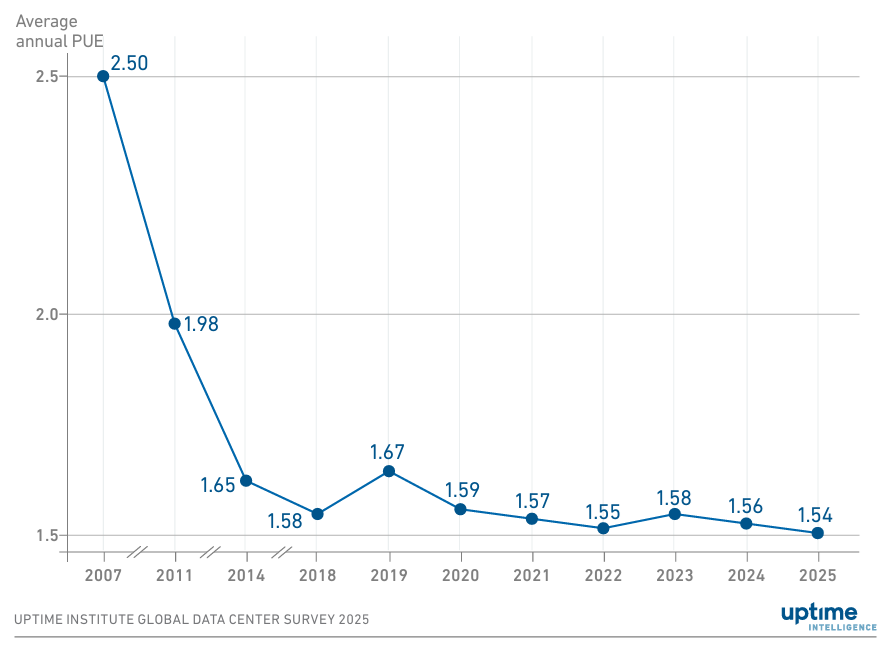
The industry average Power Usage Effectiveness (PUE) has hovered around 1.54 for six consecutive years. The "low-hanging fruit" of efficiency improvements has been picked. The remaining gains are blocked by legacy infrastructure and regional constraints.
What this means for you:
Moving the needle on efficiency now requires deep engineering intervention. Improvements are no longer about simple airflow management; they require holistic assessments of cooling systems, electrical losses, and integration with smarter controls. Ecanet Engineers, with field proven experience, can provide the deep-dive analysis needed to break through the PUE plateau, ensuring your facilities remain competitive on cost and sustainability.
4. The Resilience Reality: Power Still Fails
Despite significant investments in redundancy, the Uptime Institute's 2025 survey confirms that power issues remain the leading cause of outages (45%) , with UPS failures being the primary culprit. While it is positive news that the frequency of impactful outages is slowly declining, the cost and operational impact of each failure continue to rise.
This reality underscores a critical industry shift: resilience can no longer be viewed as a one-time certification or a static state. As we explore in our recent article, "Beyond Uptime: Engineering Resilience for the Long Haul", true reliability requires a proactive, forensic approach to design and operations. It’s about building fault tolerance directly into systems - using methodologies like Design Failure Mode and Effect Analysis (DFMEA)—to ensure critical pathways, such as UPS systems, maintain continuous operation even under stress.
With power grids becoming less stable due to renewable intermittency and extreme weather, the onus is on facility design to compensate. Reactive fixes are no longer sufficient. Ecanet’s engineering consultancy focuses on embedding this "long-haul" resilience, ensuring that when the utility wavers, your critical load remains online - not just today, but for decades to come.
5. The Future is (Still) Hybrid: Why Knowing Your Facility Matters
The Uptime Institute survey confirms that rumors of the data center's death are greatly exaggerated. Currently, 45% of IT workloads remain in on-premises corporate facilities, a figure that underscores the enduring importance of private infrastructure. Hybrid IT is the reality, and for many organizations, their own data center remains the foundational venue for mission-critical operations.
However, simply owning the facility is not enough. The survey highlights that capacity planning is a top management concern, with forecasting future requirements becoming significantly harder. This uncertainty, combined with the pressure to improve efficiency (amidst six years of stagnant PUE improvements), means operators cannot afford to rely on assumptions.
This is where a professional energy and operations audit becomes essential. You cannot fix what you do not measure. A comprehensive audit provides the forensic baseline needed to understand your facility's true performance. It moves beyond theoretical design to answer critical questions:
Where is power actually being consumed or wasted?
How effective is your cooling strategy under real-world, variable loads?
What is the actual capacity and health of your legacy systems?
Where are the single points of failure that your daily operations have masked?
For the 45% of workloads staying on-prem, this insight is invaluable. An audit identifies the specific, actionable corrections needed to optimize for today's demands—whether that's rebalancing loads, upgrading controls, or planning for higher densities - while also extending the life and reliability of your asset. At Ecanet Engineers, our team will be able to provide these deep-dive assessments, translating raw data into a strategic roadmap for corrective action and future-proofing.
Our Perspective
The 2025 Uptime Institute survey delivers a clear message: data centers are becoming more powerful, more complex, and more critical than ever. To thrive in this environment, organizations must move beyond reactive fixes and invest in two strategic areas: intelligent engineering design and continuous workforce education.
At Ecanet Engineers, we provide both. From forensic energy audits that optimize your on-premises assets to Uptime Institute accredited courses like the AOS Masterclass that turn operators into leaders, we are your end-to-end partner for resilience.
Contact us to discuss how we can future-proof your digital infrastructure.