
The False Economy of Cheap UPS: Why "Bargain" Backup Costs More in the Long Run
First published 19 Feb 2026, updated 28 Jul 2026.
In the world of critical infrastructure, the Uninterruptible Power Supply (UPS) is the silent sentinel. When the mains power flickers and dies, it is the only thing standing between your operations and a catastrophic crash.
When budgeting for power protection, the allure of a "bargain" or a no-name brand is strong. Why pay a premium for a known manufacturer when an off-brand unit costs a fraction of the price? The answer lies in a hard truth: when it comes to backup power, you don't actually own the hardware - you own the future problems.
Here is why gambling on cheap, unsupported UPS units is a perilous strategy for your business.
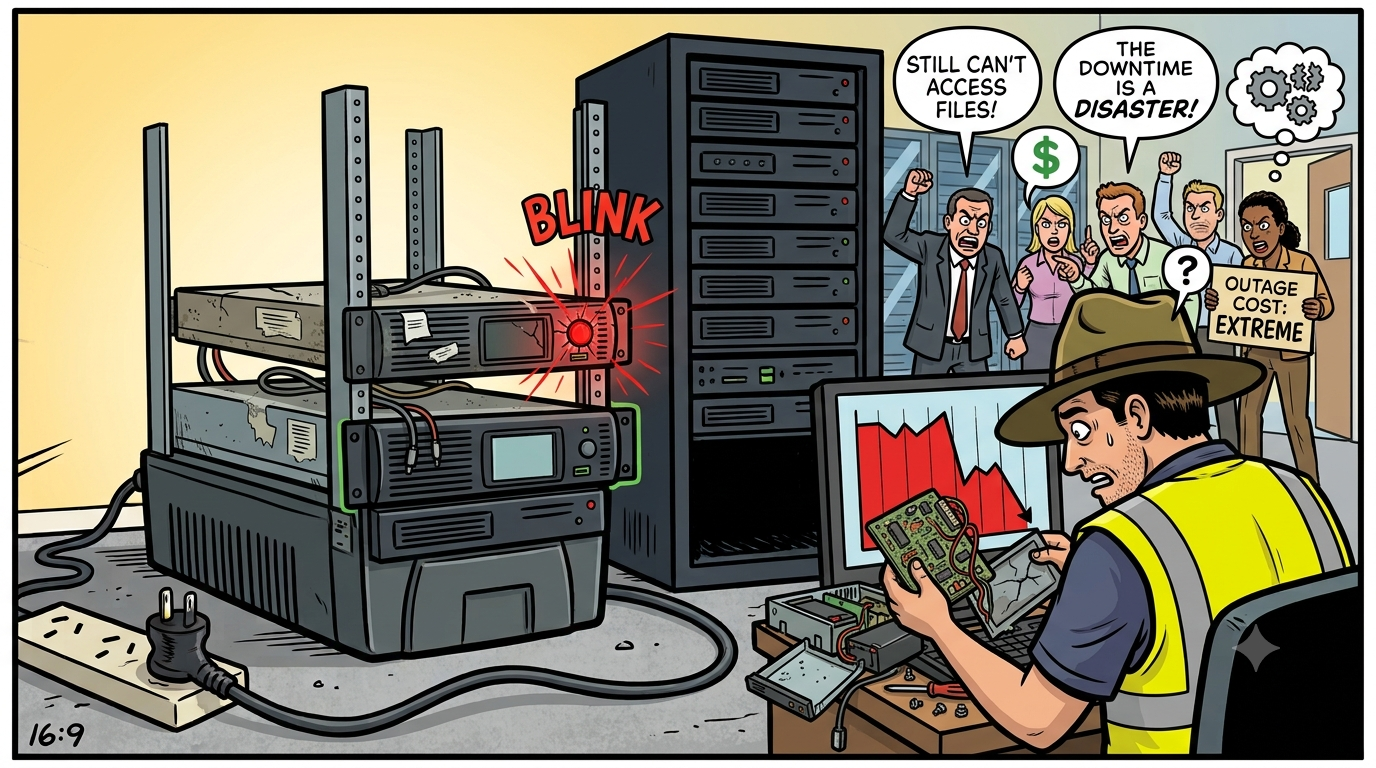
UPS failure: The cost of downtime…
The Peril: The Hidden Cost of "Cheap"
An upfront discount on a UPS is quickly erased the moment the device fails to perform. The primary peril of buying no-brand hardware isn't just the potential for the unit to die - it is the cost of downtime.
If your "bargain" inverter fails to transfer to battery during a surge, or if the internal components overheat and shut down, your servers crash. In today's economy, downtime costs thousands per minute. Furthermore, without a service regime, you are flying blind regarding Battery Autonomy.
Have you considered battery autonomy over the lifetime of the battery?
A lead-acid battery does not simply work one day and stop the next; it degrades. A cheap UPS might have promised 20 minutes of runtime on Day 1. But batteries are chemical devices; as they age, heat cycles, and discharge, their capacity decays. Without a service regime to test and validate the battery health, that 20 minutes of runtime might have dropped to 5 minutes -or zero - without you knowing. When a long-duration outage hits, you won't discover your battery is dead until the lights go out.
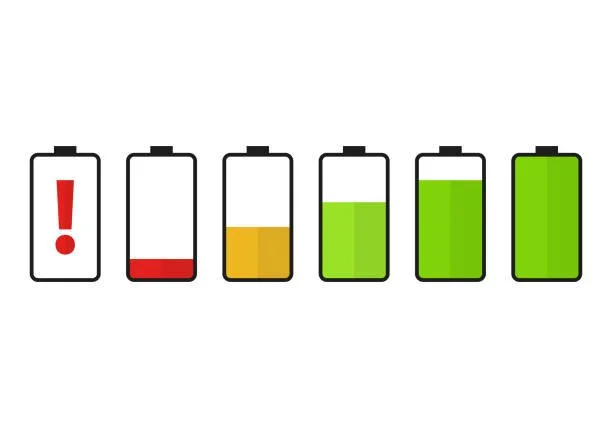
Batteries are chemical devices; as they age, heat cycles, and discharge, their capacity decays.
The Technology: Knowing Your UPS Type
To understand the risk, you must understand the protection level. Not all UPS units are created equal. There are three primary topologies:
Offline / Standby UPS: This is the most basic type. The equipment normally runs on mains power. When the power fails, a switch activates to run the equipment off the battery. There is a brief transfer gap. Suitable for non-critical equipment like routers or basic workstations, but the transfer time can crash sensitive IT gear.
Line-Interactive UPS: The standard for most business IT. It includes a special transformer that can correct minor power fluctuations (under-voltages and over-voltages) without tapping into the battery. This preserves battery life for when you really need it.
Double-Conversion (Online) UPS: The gold standard for critical infrastructure. Here, the AC power is rectified to DC and then inverted back to AC. The equipment is always running off the inverter, never directly off the mains. This creates a perfect, clean power bubble, isolating your gear from all input nastiness. There is zero transfer time when mains fail.
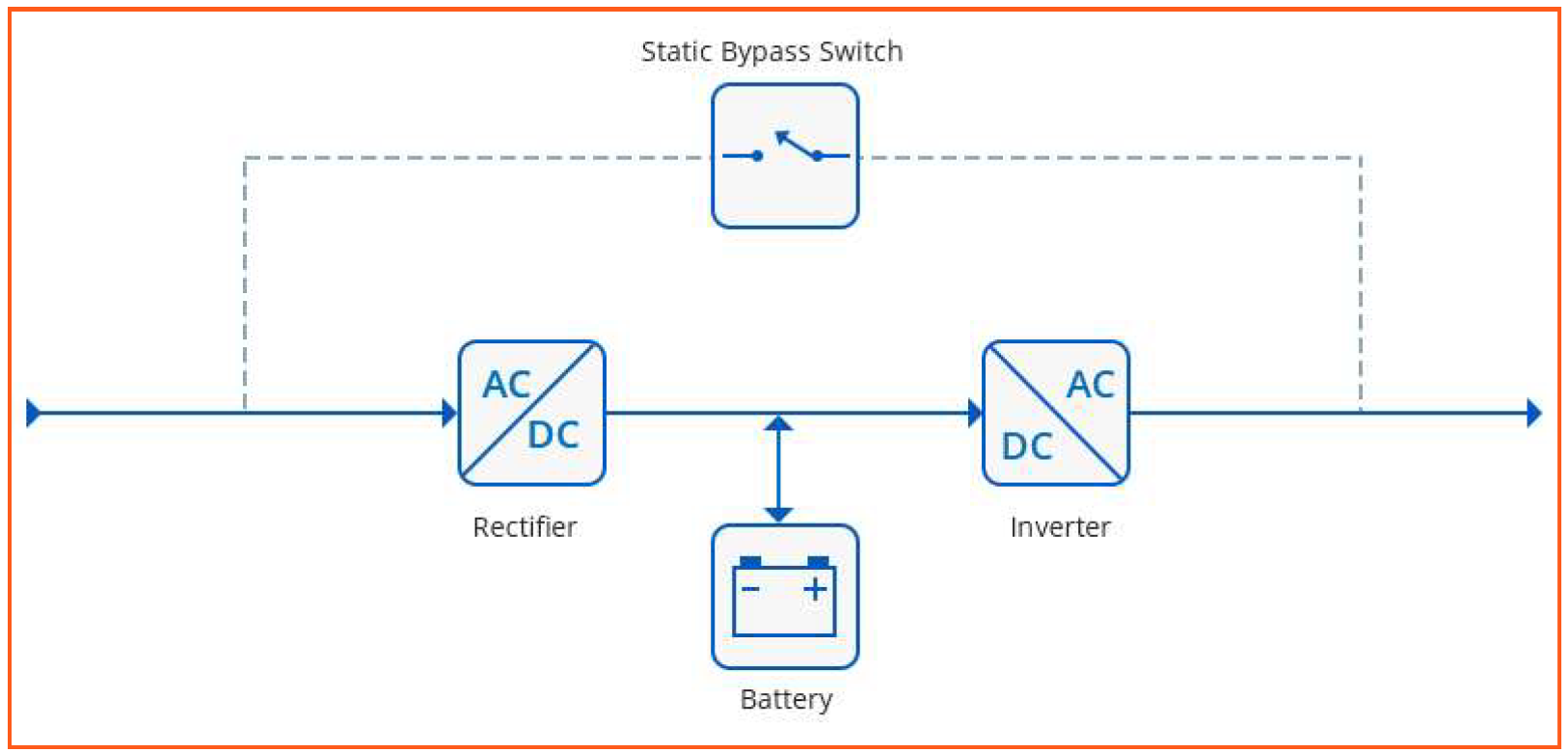
Double-conversion UPS topology
The Hidden Trap: Power Factor and the kW vs. kVA Mismatch
Beyond topology, there is a critical specification that many buyers overlook - power factor (PF) . Power factor describes how effectively electrical power is converted into useful work: Power Factor = kW (Real Power) / kVA (Apparent Power) . The real power (kW) is what actually powers your servers and does the work. The apparent power (kVA) is what the UPS and electrical infrastructure must deliver, including reactive power that does no useful work.
Historically, many UPS systems were rated at 0.8 power factor. A 10 kVA UPS with a 0.8 PF could only deliver 8 kW of usable real power - meaning 20% of the UPS capacity was stranded and unusable for actual IT load.
Modern IT equipment, however, operates much closer to unity power factor. This is where PF 1.0 (Unity Power Factor) UPS systems become essential. A 10 kVA UPS rated at PF 1.0 delivers the full 10 kW of usable real power. That is 25% more usable capacity from the same footprint and the same kVA rating.
Why this matters for your business:
No stranded capacity - every dollar you invest in UPS capacity delivers usable power.
Better match for modern IT loads - modern server power supplies draw current close to unity PF and expect the UPS to deliver real power, not just apparent power.
Improved energy efficiency - lower power factor increases RMS current and I²R losses in cables and transformers.
Simplifies growth planning - with unity PF, 1 kVA ≈ 1 kW, making capacity planning cleaner and more predictable.
If you buy a cheap UPS with a low PF rating, that UPS becomes the bottleneck - even if your servers are efficient. You may find yourself needing to buy multiple UPS units to deliver the desired kW, erasing any upfront savings.
The Silent Killer: The Critical Need for Battery Monitoring
The battery is the most vulnerable part of any UPS system - and the leading cause of load loss. In fact, up to 65% of UPS failures are battery-related. A cheap UPS typically offers little more than a basic "battery low" alarm - a reactive measure that only tells you there's a problem after it's too late.
What proper battery monitoring delivers:
Proactive health detection: Continuous monitoring allows you to identify potential problems before they result in unplanned battery failure. Real-time monitoring ensures the battery is always operating in optimal conditions, minimizing unnecessary wear and tear.
Condition-based maintenance: Instead of guessing when to replace batteries - which often leads to premature disposal of healthy batteries or missed detection of early failures - monitoring enables predictive maintenance and replacement.
Early warning of failure: Trends in resistance testing results can provide early warning of damaged or weakened battery blocks. This allows you to replace batteries before they fail, ensuring the UPS system continues to operate smoothly without interruptions.
Reduced maintenance costs: By replacing batteries only when necessary - rather than on fixed schedules - you avoid both premature replacements and costly emergency repairs.
Without robust battery monitoring, that "bargain" UPS is a ticking time bomb. You won't discover your battery is dead until the lights go out.
The Maintenance Nightmare: Why You Need a Bypass Option
Even a high-quality UPS requires periodic maintenance, upgrades, or replacement. Without a maintenance bypass switch, your organization faces an impossible choice: either power down your entire critical load to service the UPS, or accept the risk of running a system that may be failing.
A maintenance bypass switch allows the UPS to be electrically isolated - taken out of the critical power circuit - for safe maintenance or replacement, without any disturbance to the connected load. The load continues to run directly off utility power while the UPS is serviced.
The business case for a maintenance bypass:
Zero-downtime maintenance: You can perform scheduled maintenance, swap batteries, or even replace the entire UPS unit without interrupting operations. This turns routine power maintenance from an operational risk into a strategic advantage.
Safe service access: The bypass provides total isolation, allowing technicians to work safely on the UPS without live parts or the risk of back-feeding.
Cost avoidance: Downtime costs can exceed $100,000. A maintenance bypass eliminates the need to schedule costly after-hours maintenance windows or accept the financial hit of unplanned outages.
Space efficiency: Modern UPS systems with integrated maintenance bypass switches consolidate these functions into a single unit, eliminating the need for a separate bypass cabinet that consumes valuable rack space. This reclaimed space can be reallocated to revenue-generating or mission-critical equipment.
Cheap UPS units rarely include maintenance bypass capability - or even the option to add one. When they fail or require service, the only option is to shut everything down.
The Intelligence Gap: Handling Poor, Moderate, and Good Power with Efficiency
Beyond the hardware specifications of power factor and battery chemistry lies a more subtle - and equally critical-capability: how intelligently the UPS responds to the actual quality of the power coming in.
Mains power is rarely perfect. It fluctuates between three broad states:
Good power: Voltage and frequency are stable and within nominal ranges. The UPS has little work to do.
Moderate power: Minor sags, swells, or harmonic distortion are present. The UPS needs to condition the power but not necessarily run full-time on battery.
Poor power: Severe undervoltage, overvoltage, frequency deviations, or transients threaten connected equipment. The UPS must intervene decisively.
A cheap UPS typically offers a one-size-fits-all response: it either runs in double-conversion mode constantly - delivering perfect power but at the cost of significantly lower efficiency (often 90–93%) - or it is an offline unit that does nothing until the power fails entirely, leaving your equipment exposed to every flicker and surge in between.
The smarter approach: Adaptive efficiency modes.
Modern, high-quality UPS systems are designed to balance protection with efficiency based on real-time power quality. They can automatically switch between operating modes:
Double-Conversion Mode (Active): When power quality is poor, the UPS runs in full online double-conversion mode, isolating your equipment from all input disturbances. This delivers the highest level of protection.
Efficiency-Optimized Mode: When power quality is good or moderate, the UPS can shift to a high-efficiency mode -sometimes exceeding 98-99% efficiency - significantly reducing energy waste and cooling costs without compromising protection.
Active Filtering: Even in efficiency mode, the UPS continues to actively filter harmonics and correct power factor, ensuring your sensitive IT equipment receives clean, stable power.
This intelligent adaptability means you are not forced to choose between protection and operating cost. The UPS makes that trade-off dynamically, moment by moment, based on the actual conditions of your mains supply. A cheap, fixed-mode UPS cannot do this - it either wastes energy constantly or leaves you vulnerable when you need protection most.
The Monitoring Mandate: From Reactive to Proactive
Even the most intelligent UPS is only as useful as your ability to see what it is doing. A UPS that cannot communicate its status, alerts, and health is a black box—and black boxes have a nasty habit of surprising you at the worst possible moment.
This is where network management cards and monitoring software transform a UPS from a dumb battery box into a visible, manageable, and proactive part of your IT infrastructure.
The Advanced Communication Card
At the heart of modern UPS visibility is the optional network management card. These intelligent cards install directly into the UPS and provide a rich suite of enterprise-grade capabilities:
Real-time visibility: A built-in web interface delivers a real-time view of parametric data and system status from any standard browser.
Environmental intelligence: Many support optional external sensors for monitoring temperature, humidity, leak detection, and door closures - giving you a complete picture of the physical environment around your UPS.
Flexible communication: Data is available via SNMP, Modbus, and BACnet, making integration with Building Management Systems (BMS), Data Center Infrastructure Management (DCIM), or existing network monitoring platforms straightforward.
Enterprise security: Industry-standard cybersecurity certifications with Secure Boot, HTTPS web connectivity, SNMP v3, and remote authentication protocols ensure your power infrastructure does not become a network vulnerability.
Alarm notifications: Email, text messaging, and SNMP trap alerts ensure you know about issues the moment they occur.
Whether you need to feed UPS data into a central BMS via BACnet or Modbus, or simply want SNMP traps sent to your network monitoring system, a proper communication card provides the connectivity and protocol support to make it happen.
Free Monitoring and Shutdown Software
Not every deployment requires enterprise-grade BMS integration. For smaller installations or distributed edge environments, many reputable UPS manufacturers offer free software tools that deliver powerful monitoring and protection without additional licensing costs.
Web-based monitoring applications (equivalent to industry tools) are complimentary applications designed for users with distributed infrastructure who need a way to manage multiple devices. They typically provide:
Alarm notifications via email, SMS, and on-screen icons
Auto-discovery of devices across the network
Dashboard views of key data: capacity load percentage, output current, battery percentage charge, and battery time remaining
Sequential server shutdown to extend runtime for the most critical loads
Integration with Microsoft Hyper-V, VMware, and major hyperconverged platforms for coordinated virtual machine shutdown
Desktop shutdown utilities are free applications used to gracefully shut down IT devices when the UPS battery backup encounters a threatening condition. They notify users of an event, display key metrics, and log historical data. Easy to install, they protect computers from damage and data loss during a power event.
Cloud-Based Fleet Management
For organisations managing multiple UPS units across distributed sites—branch offices, retail locations, remote data centres—on-premise software quickly becomes insufficient. You need centralised, cloud-based visibility across your entire fleet.
Modern cloud-connected fleet management platforms deliver exactly this capability. These web-based solutions provide:
Multi-site visibility - see all devices at a glance, in real time, from a single dashboard
Instant email and SMS alerts - take action before issues escalate
Remote firmware updates - keep your entire fleet secure and up to date without site visits
Centralised fleet management - manage your entire infrastructure without stepping on-site
Secure multi-tenant access for team collaboration
Better still, many quality UPS vendors include a free introductory license for their cloud platform when you purchase eligible units, covering cloud-based monitoring across dozens or even hundreds of devices. A UPS without monitoring is reactive—cloud-enabled fleet visibility makes it proactive.
The Integration Ecosystem: Putting It All Together
The true power of these monitoring options lies in their ability to integrate with your existing management stack. A single advanced communication card can simultaneously:
Report to your central BMS via BACnet or Modbus.
Send SNMP traps to your network operations centre.
Be monitored through the free web-based management interface.
Be included in a cloud-based fleet view for remote oversight.
Cheap UPS units typically offer no communication options at all - or at best, a rudimentary USB port with proprietary software that works only on a single connected PC. When you need to know what is happening across a distributed infrastructure, that is not monitoring - that is flying blind.
The Solution: UPS as a Service (UaaS)
So, how do you get the protection of high-end, double-conversion gear without the massive capital outlay or the risk of battery decay? This is where our UPS as a Service model provides undeniable value. Instead of selling you a box and walking away, we sell you assurance.
Our service model delivers the three critical capabilities that cheap UPS solutions lack:
1. PF 1.0 rated UPS systems - ensuring you get the full usable capacity you pay for, with no stranded kW, improved efficiency, and seamless compatibility with modern IT loads.
2. Comprehensive battery monitoring - proactive, real-time health tracking that catches degradation before it becomes failure, enabling condition-based maintenance that extends battery life and eliminates surprises.
3. Integrated maintenance bypass - zero-downtime servicing and replacement, keeping your operations running 24/7/365 while we keep your UPS in peak condition.
The Lithium-Ion Advantage
While traditional UPS units utilize Valve-Regulated Lead-Acid (VRLA) batteries, the landscape of power protection is shifting. Our service models can now integrate Lithium-Ion UPS systems, offering a host of benefits that enhance the value proposition of a service contract:
Extended Battery Lifespan: A VRLA battery typically lasts 3–5 years. A Lithium Iron Phosphate (LiFePO4) battery can last 8–10 years or more under similar conditions. This longevity aligns almost perfectly with the lifespan of the UPS.
Reduced Maintenance Frequency: Fewer battery replacements mean lower total cost of ownership and less disruption.
Better Performance in Heat: Lithium-ion batteries tolerate higher operating temperatures better than VRLA, reducing cooling costs.
Conclusion: The True Cost of "Cheap"
When you plug a $10,000 server or a critical network switch into a cheap, no-name UPS, you aren't just saving money - you are effectively betting your business continuity on a device built with the cheapest capacitors and thinnest copper available. A $2,000 bargain UPS that fails and causes 30 minutes of downtime doesn't cost $2,000 to replace - it costs whatever your business loses in those 30 minutes, plus the cost of damaged hardware, data recovery, and lost productivity.
The false economy of cheap UPS is simple: you save a little upfront, and you risk everything downstream.
Choose wisely. Choose a UPS that delivers PF 1.0 rated capacity, intelligent efficiency modes, comprehensive battery monitoring, maintenance bypass, and enterprise-grade monitoring and management - whether on-premise or in the cloud.
Choose assurance. Choose UPS as a Service.
Contact us today to discuss how our UPS Maintenance as a Service - with options for cutting-edge Lithium-Ion technology - can guarantee your uptime from installation to responsible retirement.
Browse our UPS products here. The Liebert GXT5 and ITA2 are double-conversion UPS with Lithium-Ion option.