
Data Centre Engineering
A 2-Part Series on Lifecycle Strategy.
Part 2: The Blueprint vs The Machine - Physical Layout, Thermal Futures, and Lifecycle Obsolescence
In Part 1, we tackled the financial, human, and procurement realities. Now, in Part 2, we leave the spreadsheets and look at the concrete, the copper, and the cooling pipes. We tackle the brutal physics of 2N redundancy, the cost of poor equipment placement, and how to design a shell that won't strangle the next generation of IT hardware.
5. The 2N "Efficiency Tax": Physics Doesn't Care About Redundancy
Tier IV gives you fault tolerance, but it charges a permanent toll on your power bill.
The Transformer & UPS Hit: Iron losses (core losses) and copper losses (winding losses) are load-dependent. In a 2N architecture, each path carries roughly 50% of the total load. A transformer operating at 50% load might sit at 94% efficiency, whereas at 80% load it hits 97%. With two transformers running half-loaded, your combined losses are always higher than a single unit carrying the full load.
The Chiller Penalty: Centrifugal chillers achieve peak Coefficient of Performance (COP) between 60% and 90% load. In a 2N setup, running chillers in parallel at 40-50% load drops them into an inefficient "surge" zone.
The Workaround: Don't just split the load 50/50. Utilise an "N+1 Active" strategy—let one set of plant carry the entire dynamic load while the standby plant is completely de-energised (cold standby). This keeps the active gear in its sweet spot and eliminates the parasitic losses of the idle gear.
6. Equipment Placement: The "Maintenance Access" Reality Check
This is where facility managers lose their minds. A chiller fits through the plant room door during construction (with a crane), but when the tubes need replacing in year 5, there is no clearance to slide the bundle out.
The 1-Metre Rule: All rotating equipment (pumps, compressors, fans) requires a clear maintenance lane equal to the length of the removable component + 1 metre. If you don't have 2.5 metres in front of your chiller evaporator, you cannot pull the tube bundle.
Battery Replacement Path: UPS battery rooms are notorious for tight squeezes. If a 35kg battery block has to be carried sideways through a 700mm gap, you are setting your team up for manual handling injuries. Design battery aisles for a pallet jack or trolley—minimum 1.2 metres clear width.
BIM for Maintenance, Not Just Installation: During Building Information Modelling (BIM) coordination, we run a "maintenance clash detection" separate from the install clash. We check if a maintenance worker can access a valve stem or a breaker panel with a torque wrench without hitting a structural column.
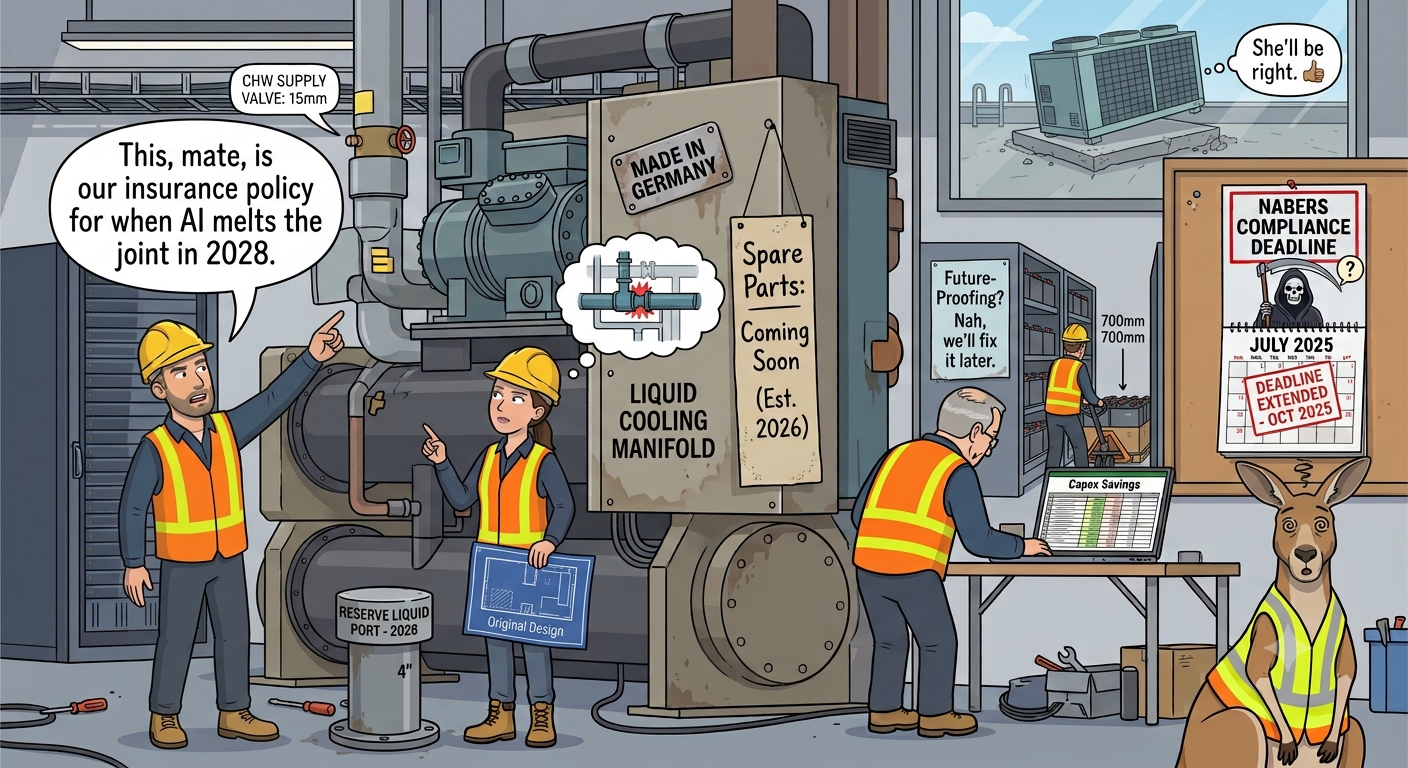
7. Physical Upgradability: Stubbing Out for Liquid Cooling
Australian data centres are waking up to 15kW–30kW per rack for AI and HPC workloads. Retrofitting liquid cooling is a nightmare if you didn't plan for it.
Structural Loading: Specify the floor slab for maximum foreseeable weight (1,800kg+ per rack) during the initial shell build. Laying a raised floor rated for 1,200kg today means a costly demolition later.
The "Stub-Out" Strategy: Even if you aren't installing liquid cooling on Day 1, install capped 4-inch pipe penetrations (stub-outs) from the mechanical plant room to the white space. Run empty conduit for the fluid detection cabling. The cost of a few pipe sleeves during the concrete pour is negligible; the cost of core-drilling through a live facility is astronomical.
Roof Reserve: Design the roof structure to take the weight of additional dry coolers or cooling towers. A concrete pad and structural steel reinforcement are cheap at construction; they are cripplingly expensive to retrofit.
8. DCIM Granularity: Designing the Data Layer from Day 1
You cannot bolt on operational intelligence after the switchboard is energised. Sensor placement must be mapped during the Single Line Diagram (SLD) phase.
The Granularity Debate: Pod-level metering (main busways) is cheap but masks "stranded capacity." Rack-level metering (intelligent PDUs) gives you the truth but generates massive data overhead.
The Hybrid Solution: We design for pod-level CTs for building PUE (efficiency reporting), but deploy busway stub zones with submeters for every 6 racks. This gives you actionable capacity planning data without flooding your DCIM database with per-outlet polling noise. Crucially, we define the polling frequency (1-second for alarms, 5-minute for logging) in the electrical spec before the DCIM vendor is brought in.
9. Lifecycle Obsolescence: Planning for the 10-Year Cliff
Switchgear chassis last 25 years. The digital controls inside them last 8–10 years.
The Space Premium: When laying out the electrical plant room, we intentionally leave a "replacement bay"—an empty slab space adjacent to the main switchgear. In year 12, when you need to rip out obsolete circuit breakers, you can position the new switchgear alongside the old, wire it in, and then transfer the load. This avoids a full facility shutdown.
Consignment Stock: Rather than hoarding every spare part on-site (which requires fire-rated, climate-controlled storage—costing Opex), we structure consignment agreements with local OEM distributors for high-value, low-failure items (like large contactors). Only the high-failure, quick-swap items (filters, fan trays, fuses) are kept in the physical store.
The Research Behind Our Thinking: Key Article Findings
The engineering principles above are informed by years of operational data and industry research. For those who want to explore the evidence behind our approach, here are the key takeaways from our recent blogs:
1. Why Global PUE Has Stalled
Despite a decade of focus on efficiency, the industry has hit a plateau. Peak energy management processes score just 46% on proactive behaviours, and 42% of operators cite energy cost as their greatest unit cost increase. With Australia mandating minimum 5-star NABERS Energy ratings for federal workloads from July 2025, efficiency is no longer optional - it must be engineered into part-load performance from Day 1.
👉 Read the full analysis: Energy Efficiency is Stuck
2. Why AI Requires a Thermal Rethink
AI training workloads create thermal spikes measured in seconds, not minutes - breaking the legacy air-cooling model entirely. Direct-to-Chip (D2C) cooling introduces fluid proximity to expensive silicon, flash evaporation risks, and chemical complexity. The key engineering takeaway: cooling systems must be designed with thermal reserves and rapid dynamic response capabilities to handle the brutal load cycles of GPU clusters.
👉 Read the full analysis: D2C for AI
3. Why Spare Parts Management is a Lifecycle Discipline
Critical spares are not a static inventory list. "Versioning" issues mean a spare can sit on your shelf for years only to be incompatible with the installed system due to firmware divergence. Resiliency now depends on adaptability—continuous obsolescence reviews, alignment with maintenance strategies, and leveraging OEM field technicians who actively curate a living, site-specific spare parts list.
👉 Read the full analysis: Lifecycle Intelligence
4. Why Operations Must Start Before Design
A data centre's lifespan is 20+ years; its design phase is just 1–2 years (roughly 1% of its life). Yet we pour the vast majority of our attention into that short window. Value is not extracted by architecture; it is extracted by operations. Integrating maintainability reviews, SLA definitions, and maintenance concepts during the pre-construction phase is the single highest-leverage activity for long-term asset performance.
👉 Read the full analysis: Start with the End in Mind
The Ecanet Difference:
Full Lifecycle Engineering, Not Just Drawings
At Ecanet, we don't just design data centres—we have lived in them.
Our team has been on the tools: managing facilities, running MOPs, pulling cables, and troubleshooting chiller failures at 2 AM. We know exactly where poor design creates operational pain.
We hold Uptime Institute (ATD, ATS, AOS) credentials and have delivered major Tier projects across Australia.
But crucially, we also provide facility management services. This means when we design a switchboard layout, we are already thinking about the electrician who has to change that isolator in 2030.
We audit the "Design for Operability" - checking maintenance lanes, spare parts criticality, and BMS logic before the concrete is poured.
We bridge the gap between the construction budget and the 10-year operational reality. Because a facility that looks perfect on a PDF but costs a fortune to run - or forces your team into risky manual workarounds - isn't a success.