
Data Centre Engineering
A 2-Part Series on Lifecycle Strategy
Part 1: The Blueprint vs The Machine - Financial, Human, and Supply Chain Realities
What is Data Centre Engineering?
Walk into a typical commercial construction project - an office tower, a warehouse, a school. The loads are predictable. The lighting draws a fixed wattage. The HVAC cools human bodies, which stay relatively constant. The building is delivered, and operations largely manage cleaning and minor repairs.
Now walk into a data centre. That cavernous white space is not a room; it is a 20MW furnace packed with microprocessors that draw power equivalent to a small town, producing heat that would melt steel. The loads don't stay constant; they spike and surge as training algorithms kick in or tenants provision new racks. The air is so dry it can give you nosebleeds, and the fault current in the switchgear is measured in hundreds of thousands of amps (kA).
This is the fundamental difference: A typical construction project builds a static shell for a known purpose. Data centre engineering builds a dynamic, living machine for an unknown future.
The contrasts are stark:
Static vs. Dynamic Loads: A standard office building is sized once. Its peak cooling load is calculated on Day 1, and it rarely changes. A data centre's IT load can double in a single hardware refresh cycle, turning a perfectly efficient chiller plant into an undersized bottleneck - or an oversized, short-cycling disaster.
Human Comfort vs. Machine Survival: Building services for people have wide tolerances, ~22°C ± 2°C, humidity between 30% and 70%. For a GPU cluster, the tolerance is measured in milliseconds. A 2°C rise in inlet air temperature can throttle performance; a 2-second power sag can corrupt petabytes of training data.
Known End-State vs. Unknown Future: When you design an office, you know roughly how many desks and computers it will hold. When you design a data centre today, you have no idea whether the dominant cooling technology in Year 10 will be chilled water, direct-to-chip liquid, or two-phase immersion. The building must accommodate all three.
Opex as an Afterthought vs. Opex as the Dominant Driver: In a typical building, operational expenditure (power, water, maintenance) is a modest fraction of the capital cost over its life. In a data centre, Opex-dominated by electricity bills—quickly eclipses the initial Capex over a 20-year horizon. A 10% error in efficiency at design translates to millions of dollars lost before the mortgage is paid off.
Aging Gracefully vs. Aging Aggressively: A well-built office building ages gracefully; its concrete and steel last 50 years. A data centre ages aggressively. IT hardware turns over every 3–5 years. Switchgear lasts 25 years. Digital controls last 8–10 years. Retrofitting a live office is a renovation; retrofitting a live data centre is open-heart surgery - and the patient cannot be switched off.
With that context in mind, let's dive into the specific engineering disciplines that separate a successful, long-lived asset from a costly, inflexible burden.
1. The Capex/Opex Tango: Why "Part-Load" Performance Bites Back
The tension between Capital Expenditure (Capex) and Operational Expenditure (Opex) is well understood, but the engineering detail is often overlooked. A client might sign off on a cheap, single-speed chiller to hit a budget. The problem? Data centres rarely run at 100% load on Day 1. They hum along at 40–60% capacity for years.
The Short-Cycling Sin: If you oversize a chiller plant for future density, those units will short-cycle at low loads. This kills the Coefficient of Performance (COP) and dramatically increases mechanical wear.
The Engineering Fix: Specify Variable Speed Drives (VSDs) on chillers and pumps. They cost more upfront (higher Capex), but they allow the plant to ramp down to 20% capacity without cycling. In Australia's high-energy-price market, this can slash 30% off annual electricity bills (lower Opex) within the first two years.
Generator "Wet-Stacking": In 2N (Tier IV) configurations, generators rarely see full load. Running a large diesel set below 30% load causes unburnt fuel to build up in the exhaust. The engineering solution? Permanently plumbed load banks—not portable ones—into the design so that monthly testing can burn off that soot without manual intervention.
2. The Operational Paradox: Why Tier III is Harder to Run than Tier IV
This is a truth that separates theoretical designers from operational engineers: Tier IV is inherently easier to operate; Tier III is inherently more dangerous.
Tier IV (2N / Fault Tolerance): The system handles failures automatically. If a UPS input fails, the static bypass switch takes over instantly—no human required. The operator's role is largely passive monitoring.
Tier III (N+1 / Concurrent Maintainability): You have single paths of power and cooling, but you are permitted to take equipment offline for maintenance while the site runs. To do this, an operator must physically switch the load from Path A to Path B using manual transfer switches.
The Consequence: Tier III demands flawless human execution of a 15-step Method of Procedure (MOP) at 3:00 AM. Because it requires high-risk manual changeovers, it demands a higher calibre—and thus, higher cost—of operational staff. This is a direct Opex line item dictated by the Tier choice.
3. Staffing as an Engineering Constraint
When we design the control room and plant layout, we are effectively designing the staffing model.
The Skills Shortage: In Australia, finding dual-trade technicians (HVAC + Electrical) who understand complex PLC logic is expensive. If your design forces operators to walk 200 metres between switchboards and chillers to perform a changeover, you are burning labour hours and increasing fatigue.
The "Remote Hands" Trade-off: Engineering must decide early whether to staff 24/7 onsite engineers or use a "follow-the-sun" remote operations model. If you go remote, you must design for full digital twin capability and motorised remote-reset breakers—which adds Capex—but reduces headcount Opex over the long haul.
4. The Supplier Trap: Imported Gear and the "Spare Parts Cliff"
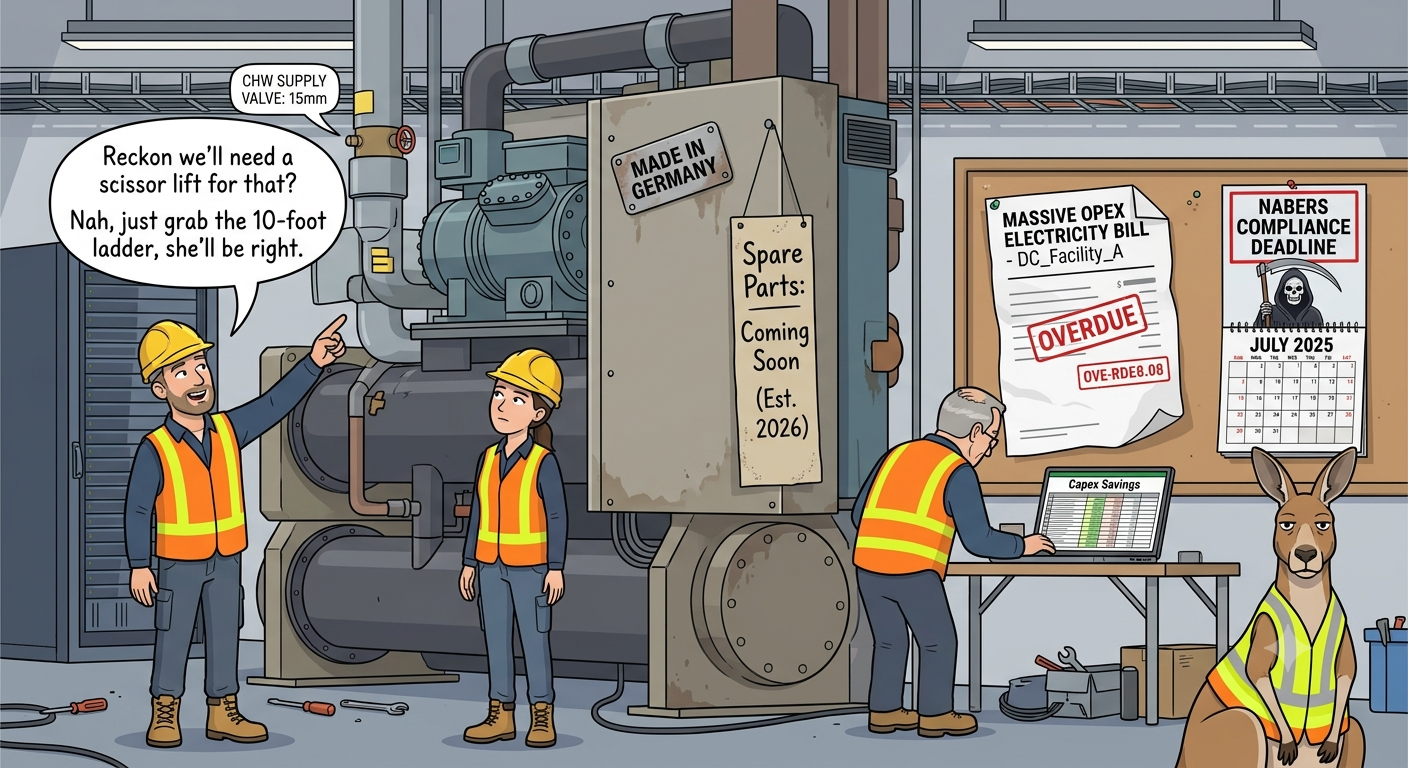
In Australia, we rely heavily on imported switchgear, UPS modules, and PLCs. Saving 15% on Capex by buying a European or Asian brand with a local agent sounds good—until that agent drops the line.
The MTTR Nightmare: Mean Time To Repair blows out from 4 hours to 4 days when you are waiting for an IGBT module to clear customs. In a Tier III site, that means running in a degraded, unsafe state for nearly a week.
Version Lock-In: Three years down the track, that imported controller is obsolete. The new version has a different firmware and won't talk to your existing BMS. You are forced to replace the entire control stack - not just the faulty part.
The Engineering Rule: Insist on open protocols (Modbus TCP/IP, BACnet) during procurement. And demand that critical spares (UPS IGBTs, PLC CPUs, drive boards) are physically stored on-site as part of the initial Capex. A 48-hour "vendor response" promise is not good enough when you are flying gear from Europe.
Continue to Part 2: The Blueprint vs The Machine - Physical Layout, Thermal Futures, and Lifecycle Obsolescence