
Why Operations Can’t Be an Afterthought: The 20-Year Lesson from 2014
In the fast-paced world of data centres, where technology evolves at breakneck speed, it’s easy to dismiss an article written over a decade ago as outdated. But sometimes, the most foundational truths are timeless.
A 2014 article on the Uptime Institute blog, “Best Practice is to Start with the End in Mind” by Lee Kirby, is one such piece. While the servers and cooling technologies have advanced since its publication, its central message has only grown more critical. The article makes a compelling case that Operations should not be the final phase of a data center project - it should be the starting point.
At a time when we’re obsessed with AI-optimized designs and rapid deployment, it’s worth revisiting this wisdom. Because despite all our advancements, the fundamental lifecycle of a data centre remains unchanged, and operations is still the most undervalued, yet most vital, part of the equation.
The 1% Problem: Why Design Gets All the Attention
Kirby’s core argument in 2014 was a simple matter of mathematics and perspective. A data center’s lifespan is measured in decades - often 20 years or more. The design and construction phase? That’s typically just 1 to 2 years.
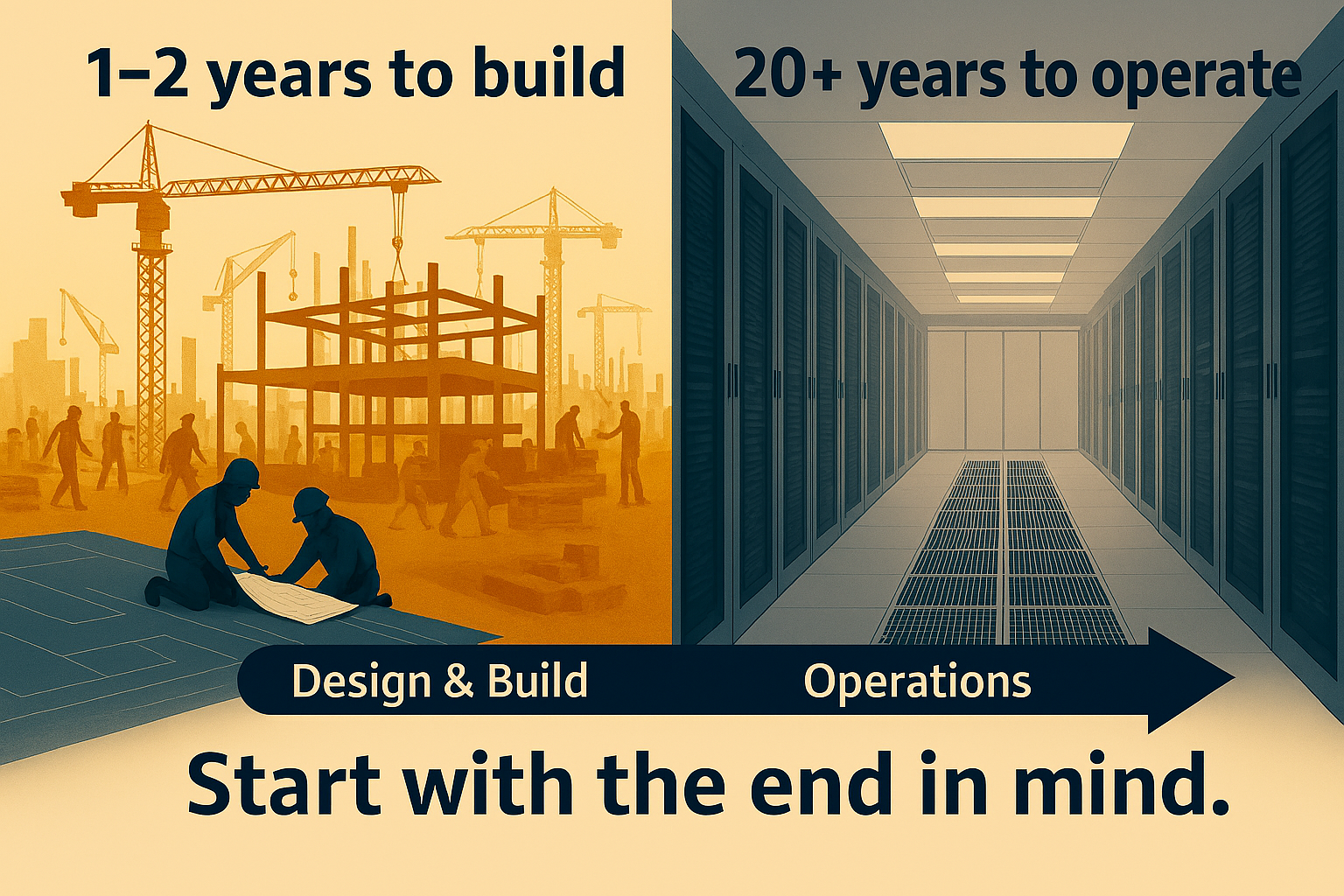
Yet, this short, capital-intensive period is where the vast majority of the focus, budget, and excitement is directed. We celebrate the ribbon-cutting, the Tier Certification, and the cutting-edge architecture. But as Kirby notes, “all design-build activity is really just a form of change management.” It’s a prelude.
The real performance - where value is either created or squandered—happens during those 18+ years of operations. The 2014 article argued that by treating operations as an afterthought, organizations were locking in inefficiencies, higher total cost of ownership (TCO), and unnecessary risks from day one.
Relevance in 2026: A Lesson Still Unlearned
If this was a “best practice” in 2014, why does it feel so relevant today? Because the industry is still grappling with the consequences of ignoring it.
The past decade has seen an explosion in data centre complexity. We now manage high-density AI racks, sophisticated liquid cooling, and increasingly complex hybrid IT environments. The margin for error in operations has shrunk, not expanded.
The challenges Kirby highlighted - the “enormous costs” of rework in the first year, the failure of Value Engineering (VE) processes that ignore long-term maintainability - are still the norm. We still see facilities where the design team forgot to account for how a 2MW generator would be replaced, or where maintenance access requires shutting down half the hall.
Kirby’s proposed solution - integrating operations from the pre-construction phase to define success metrics (SLAs, KPIs), develop maintenance concepts, and review designs for maintainability - remains the gold standard. It’s the difference between building a monument and building a machine that delivers value for two decades.
Extracting Value: The Unseen Engine
This brings us to a fundamental truth: Value is not extracted from a data centre by its architecture; it is extracted by its operations.
You can have the most beautifully designed, Tier IV-certified facility on paper. But if the operations team lacks the right procedures, training, staffing, or authority to manage it, that facility will underperform. It will suffer from preventable downtime, suffer from creeping inefficiencies, and ultimately fail to deliver the return on investment that justified its construction.
Operations is the engine that converts the capital investment (CAPEX) into a reliable, efficient, and long-term operational expenditure (OPEX) asset. Without a world-class operations team, the data center is just an expensive, inert building.
From Principle to Practice: The AOS Course
Understanding why operations must lead is the first step. The next is knowing how to build and lead an operational team that can deliver on the promise of the facility’s design.
This is precisely the focus of our upcoming Uptime Institute Accredited Operations Specialist (AOS) course, held in Perth from June 22-26, 2026.
This intensive 4.5-day masterclass is designed to bridge the gap between high-level principles and daily practice. It’s for the facility managers, operators, and IT professionals who are responsible for extracting that long-term value. The course, supplemented with exclusive insights from Vertiv, tackles the exact challenges Kirby identified over a decade ago, but through a modern, practical lens:
Moving from Theory to Execution: Learn how to translate a facility’s design into robust Policies and Procedures (SOPs, MOPs, EOPs).
Aligning Teams and Business Goals: Understand how to structure staffing and business operations to meet today’s demanding SLAs.
Proactive Risk Management: Develop strategies for maintenance and risk management that go beyond reactive fire-fighting.
Achieving Operational Sustainability: Apply the principles of the Tier Standard: Operational Sustainability - the very framework that would have guided the integrated approach Kirby advocated for in 2014.
Led by Ronnie Tsang, a Uptime Institute Technical Consultant with over 28 years of APAC-wide experience, this course isn’t just theory. It’s a practical toolkit for building an operations program that ensures your data centre delivers value for its entire 20-year lifespan.
Conclusion
The data centre industry loves innovation. We chase the next big thing in design, efficiency, and density. But the most successful organizations are those that balance this forward-looking innovation with a steadfast focus on the fundamentals of operations.
The 2014 article was a call to action that remains unanswered. It’s time to stop thinking of operations as the final step and start recognizing it as the central purpose. After all, the goal isn’t just to build a data center; it’s to run it, reliably and efficiently, for the next two decades.
To learn how to build and lead a world-class operations team, join us for the AOS Masterclass in Perth. Register today and ensure your data centre is ready to deliver value from day one.