
The gap between good intentions and real results is costing operators dearly - and Australia is feeling the heat.
Data centre energy consumption is soaring. Cloud computing is expanding. AI workloads are multiplying. And energy costs? They're climbing faster than most operators anticipated.
The warning signs are everywhere. Global average Power Usage Effectiveness (PUE) - the industry's primary efficiency metric - has barely budged in years. Despite widespread awareness and ambitious sustainability pledges, progress has stalled.
Nowhere is this tension more acute than in Australia and the broader Asia-Pacific region, where a data centre boom is colliding with surging energy demand, tightening regulations, and the relentless growth of AI infrastructure.
Further reading: Beyond PUE: Why Total Power Usage Effectiveness (TUE) Is the Metric Liquid Cooling Has Been Waiting For
The hard truth: we're not making progress
According to Uptime Institute's latest research, global average PUE improved from 2.50 in 2007 to approximately 1.54 today. But that progress has largely plateaued over the past several years.
The plateau isn't a technical ceiling. It's an operational failure.
Data from Uptime's Management & Operations assessment program reveals a persistent gap between intention and execution:
Peak energy management processes in computer rooms scored just 46% on proactive behaviours (the effectiveness threshold is 80%)
Electrical distribution peak energy efficiency management averaged only 51%
Emerging technologies evaluation scored a mere 40%
Facility improvement initiatives incorporating efficiency goals scored just 56%
These numbers paint a troubling picture: when capital budgets are available and improvement projects are underway, efficiency considerations are often an afterthought rather than an integrated approach.
The three forces making this urgent
1. The rising cost of energy
Forty-two per cent of enterprise and colocation data centre operators cited per-kWh energy cost as their greatest unit cost increase over the past 12 months. Meanwhile, 64% of colocation providers expect to raise power prices in the coming years, with most anticipating increases of 6–10%.
In Australia, the picture is particularly stark. As of Q4 2025, average industrial electricity prices range between USD 0.20 and 0.40 per kWh. The Australian Energy Market Operator (AEMO) estimates that data centres consumed approximately 3.9 TWh in fiscal 2025—equivalent to a continuous average demand of 0.45 GW. And this is just the beginning.
2. The regulatory wave
Regulations requiring efficiency improvements are no longer a distant concern. 25% of operators report sustainability regulations are already affecting their operations, and another 53% expect new requirements within the next five years.
Countries including China, France, Germany, the Netherlands, and Singapore have all implemented or proposed mandatory PUE limits. Germany requires new facilities to achieve PUE of 1.2, while existing facilities must reach 1.5 by July 2030. Singapore reduced its PUE limit from 1.3 to 1.25 in January 2026.
The EU's Energy Efficiency Directive now requires detailed public reporting on PUE, Water Usage Effectiveness, renewable energy fractions, and waste heat reuse readiness.
Australia is setting a new global benchmark. From 1 July 2025, all data centres hosting Australian federal workloads must meet a minimum 5‑star NABERS Energy rating—which typically translates to a PUE of 1.4 or better. This requirement, part of the Australian Government's Net Zero in Government Operations Strategy, cements energy efficiency as a non‑negotiable baseline not just for government data centres but increasingly as a benchmark across the entire sector.
But Australia isn't stopping there. In July 2026, Prime Minister Anthony Albanese announced that future large‑scale AI data centres will face mandatory obligations around electricity, water, and infrastructure. New facilities will be required to underwrite new electricity generation and pay the full cost of connecting to the grid—so households aren't left footing the bill. Data centre companies will have to contribute at least as much energy to the grid as they consume, including both renewables and firming power. They'll also be required to minimise water use and pay for any additional water infrastructure necessary. As Albanese put it: "Australia will be the first country in the world to bring these issues into a single, national framework."
Across the Asia-Pacific, the regulatory momentum is building:
Japan is expanding energy efficiency legislation to include minimum performance standards and information reporting requirements for data centres. The government has set a national average PUE limit of 1.4 by 2030 and a PUE of 1.3 for all new data centres built from 2029 onwards.
Singapore has introduced SS 715:2025, an industry standard requiring data centre IT equipment to meet international energy efficiency standards, aiming to save energy consumption by at least 30%. National targets include achieving a PUE of 1.3 or lower and a Water Usage Effectiveness of no more than 2.0 cubic metres per megawatt‑hour.
Malaysia has adopted the IFRS Sustainability Disclosure Standards and is progressing its National Energy Transition Roadmap toward net‑zero emissions by 2050.
India's draft National Data Centre Policy 2025 proposes 20‑year tax exemptions tied to performance benchmarks including PUE efficiency, with leading facilities already achieving PUE ratios as low as 1.3.
3. The AI tension
Here's the complication: AI infrastructure is hungry. AI training and inference workloads require dense compute configurations that consume far more power per rack than traditional IT equipment.
The data is striking: 31% of organisations with net‑zero emissions goals have modified or extended those goals due to AI expansion plans.
In Australia, the scale is staggering. Driven by AI, cloud computing and digital infrastructure demand, Australian data centres are expected to grow fourfold within a decade and could represent up to 11 per cent of the nation's total electricity consumption by 2035—up from about one per cent in 2025. Data centre capacity is projected to rise from 1.35 GW today to between 4.7 GW and 7.4 GW by 2035.
The Clean Energy Finance Corporation warns that if no additional offsetting renewable generation is built, data centres could significantly impact electricity markets. The solution? An additional 3.2 GW of renewable energy capacity and 1.9 GW of battery storage by 2035 would contain price rises and neutralise additional emissions.
Across APAC, the story is similar. Energy use in data centres throughout the region is rising to match skyrocketing demand. Gartner projects that electricity usage by AI‑optimised servers will rise almost fivefold, from 93 TWh in 2025 to 432 TWh by 2030.
Operators who can extract more compute work per watt will be better positioned to absorb AI‑driven load growth without proportional increases in energy consumption or carbon emissions.
The hidden barrier: organisational silos
Efficiency isn't just a technical challenge - it's an organisational one.
Effective sustainability strategy requires cross‑functional collaboration between facilities engineering, IT operations, procurement, finance, and executive leadership. Any meaningful change - raising temperature setpoints, optimising cooling, shifting to more efficient UPS operating modes - requires agreement from multiple teams whose priorities often diverge.
Operations teams are typically evaluated on reliability and uptime. Changes that could theoretically introduce risk appear as challenges rather than opportunities. Sustainability teams may have the mandate to drive improvements but often lack the authority or budget to override operational conservatism.
The result? Efficiency improvements can take months or years to fully implement.
The biggest opportunity you're probably missing
Let's talk about where the real savings are.
Most data centre operators focus their efficiency efforts on the facility side—cooling systems, airflow management, power distribution. It's understandable. That's where PUE lives. That's what regulators measure. That's what gets reported.
But here's the problem: the facility side is no longer where the biggest gains are.
As data centres become more efficient, IT equipment takes up an ever-larger slice of the energy pie. Look at the numbers:
| PUE | IT equipment's share of total energy |
|---|---|
| 2.0 | 50% |
| 1.5 | 67% |
| 1.3 | 77% |
| 1.1 | 91% |
In older facilities running at PUE 2.0, IT and infrastructure split the energy bill roughly 50-50. But in modern, well-tuned facilities—the kind with PUEs of 1.3 or better - IT equipment is responsible for 75% or more of all energy use.
Yet most sustainability programs still pour time and money into shaving a few points off PUE, while ignoring the 70-90% of energy that's actually doing the work.
And that's a missed opportunity.
Here's the maths:
Double your IT equipment utilisation, and you can cut total data centre energy consumption by roughly 45%
Improve PUE from 1.5 to 1.4, and you cut total energy by just 7%
The difference is stark. And IT efficiency doesn't stop at energy savings. When you run IT more efficiently, you also get:
Less heat produced → lower cooling load
Fewer physical servers → less floor space required
Lower cooling demand → reduced water use
PUE improvements alone don't deliver any of these extras. They just make the cooling system work a bit harder, a bit smarter—while the real energy hog (underutilised IT gear) keeps chugging along unchanged.
The bottom line: If you're serious about cutting costs and emissions, you can't afford to treat IT efficiency as someone else's problem. The biggest lever is already sitting in your racks. It's time to pull it.
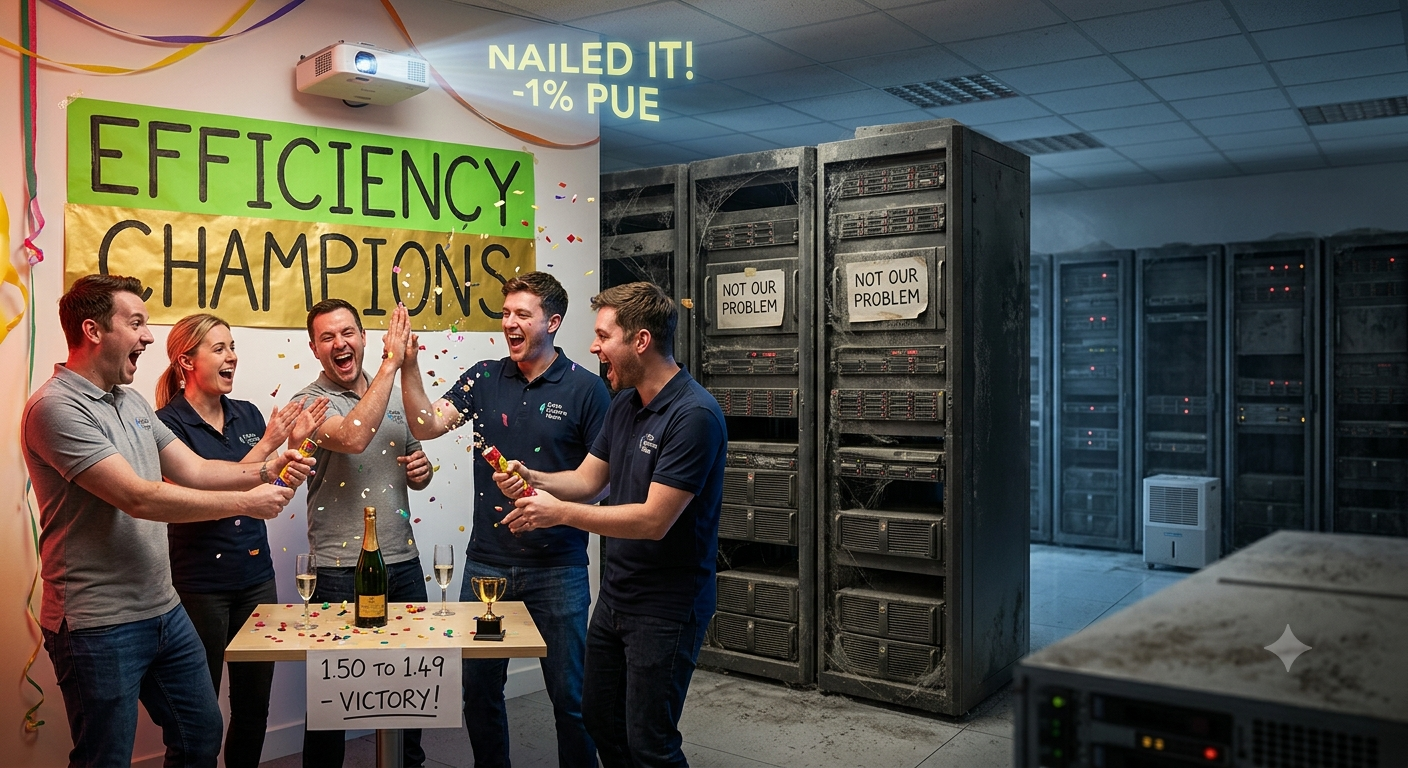
Missing the point: Celebrating PUE improvement.
In the APAC context, this opportunity is immense. Operators in China, Europe and North America report the lowest average PUEs, while the Asia‑Pacific region (excluding China) continues to face staffing challenges and region‑specific barriers to efficient cooling. PUEs of 1.4 - 1.6 remain typical in markets like Malaysia and China, with best‑in‑class facilities aiming below 1.3 through liquid cooling and airflow optimisation. The gap between best practice and average performance represents a massive efficiency opportunity waiting to be captured.
The six principles that actually work
Drawing on decades of global experience, Uptime Institute has identified six principles that distinguish organisations achieving sustained efficiency progress:
1. Operations matter as much as design
Good design establishes a theoretical efficiency ceiling. How you operate determines what you achieve in practice. Temperature setpoints drift. Cooling systems lose efficiency. Workloads shift. Without active, ongoing operational management, even a well‑designed facility will underperform.
2. Build cross‑functional alignment and dedicated governance
Organisations that make meaningful progress have dedicated sustainability staff, clear ownership of efficiency goals, and formal plans with milestones and accountability. Setting a target isn't the same as having a plan.
3. Embed efficiency into every improvement cycle
Treat energy performance as a standard component of every capital project and technology evaluation. Hardware refreshes, cooling system upgrades, capacity expansions—all should include explicit efficiency criteria. Retrofitting improvements after the fact is invariably more expensive and disruptive.
4. Elevate IT efficiency as a priority
IT procurement teams need to incorporate performance‑per‑watt benchmarks into hardware selection. Workload management teams need to understand energy implications of utilisation rates. Set IT equipment utilisation improvement goals and track them with the same rigour applied to performance metrics.
5. Pursue facility‑side efficiency with discipline and rigour
While IT offers the greatest leverage, facility improvements remain important. Focus on white‑space optimisation (containment, airflow management), cooling system performance, electrical distribution efficiency, and integrated capacity planning.
6. Recognise that sustainability and operations are complementary
The perception that sustainability and reliability are in conflict is simply wrong. Operators who excel at operational disciplines also tend to perform well on sustainability. Better airflow management reduces hot spots. Improved monitoring enables earlier detection of anomalies. Framing sustainability as complementary rather than competing is both rhetorically useful and analytically correct.
The bottom line
The data centre industry is at an inflection point—and nowhere is this more evident than in Australia and the Asia‑Pacific.
Energy costs are rising. Regulations are multiplying. AI is driving capacity growth. Scrutiny of carbon performance has never been more intense.
Australia's data centre capacity is set to more than double to 3,100 MW by 2030, with hyperscalers like Amazon, Microsoft, Google, Apple and Meta driving up to 40 - 50% of the entire market. The nation's position is unique: with liberal access to AI compute, geographic proximity to Asia, and deep renewable energy potential, Australia is poised to become a regional hub for sustainable digital infrastructure. But the window to lead is narrow.
The tools, methodologies, and best practices to improve efficiency exist and are proven. The challenge is execution.
Efficiency programs fail not because technical solutions are unavailable, but because organisational conditions—alignment, governance, prioritisation, sustained management attention—are not in place.
Closing this gap requires treating energy efficiency not as a project but as a discipline: embedded in operating procedures, integrated into every improvement cycle, supported by dedicated resources and governance, and pursued with the same rigour applied to reliability.
Operators who make this transition will be better positioned to manage rising energy costs, achieve compliance, satisfy customer expectations, and scale infrastructure efficiently as demand grows.
Those who don't risk falling behind—not just on sustainability metrics, but in the financial and competitive performance that efficiency drives.
As Prime Minister Albanese recently warned, Australia has a narrow window to set AI's "social licence" before major investments become entrenched. The same is true for the entire Asia‑Pacific region. The time to act is now.
This article draws on Uptime Institute's 2026 Sustainability and Climate Change Survey, Global Data Center Survey 2025, and extensive consulting experience with data centre operators worldwide.