
The Hidden Cost of Australia's AI Boom: Why Our Data Centres Are a Public Health Time Bomb
Australia is racing to position itself as a global AI powerhouse. From Melbourne's new AI supercomputer to Sydney's sprawling hyperscale data centres, the investment boom is being hailed as a vital downpayment on our economic future. But as the concrete is poured and the servers fire up, a silent crisis is unfolding in communities across the country - one that engineers, policymakers, and citizens can no longer afford to ignore.
The rapid growth of AI isn't just a power and water challenge. It's a public health crisis in the making.
The Digital Smog Settles Over Australia
According to a landmark analysis by researchers Shaolei Ren and Adam Wierman (“Mitigating the Public Health Impacts of AI Data Centers”, Havard Business Review), AI data centres in the United States are projected to impose an annual public health cost of up to US$20 billion by 2028, driven primarily by air pollution from both on-site backup generators and pollutant-intensive electricity sources. The released pollutants - PM2.5 fine particulate matter and nitrogen oxides (NOx) - are "silent killers" that can penetrate deep into the lungs, triggering asthma, lung cancer, heart attacks, and even premature deaths. Critically, these pollutants are considered "non-threshold": there is no safe level of exposure.
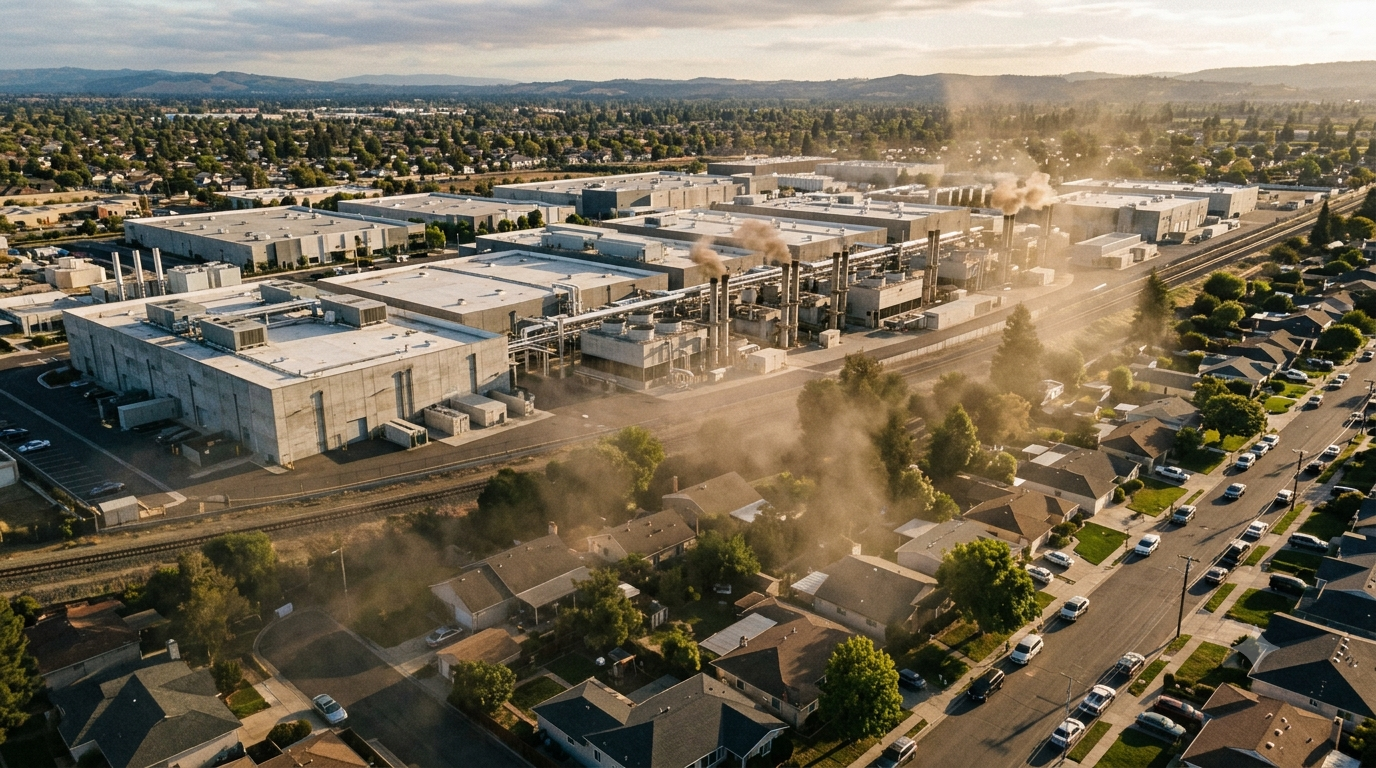
Aerial view of a sprawling data centre campus with rows of buildings, emitting a brownish-grey smog that drifts across a nearby suburban area.
Here in Australia, the picture is equally alarming - and in some ways, uniquely our own.
Australia is already one of the top five data centre hubs in the world, with more than 300 facilities across the country. By 2030, data centres could consume up to 15% of Australia's electricity - and since more than half of our power is still generated from coal, every query, every stream, and every AI model training run comes with a health cost.
The Australian Energy Market Operator (AEMO) estimates that data centres consumed around 4 terawatt hours in FY2025 - approximately 2.2% of total grid demand. By 2030, that share could jump to at least 8%, with some estimates as high as 15%. By 2050, demand could reach 37 TWh under a base scenario, or 54 TWh if Australia becomes a hub for APAC regional AI inference and training.
The Two-Headed Beast: Generators and Grid Power
Like their American counterparts, Australian data centres face two distinct but intertwined sources of public health burden.
On-site diesel generators remain the backbone of backup power for data centres across Australia. These generators typically adhere to US EPA Tier 1 to Tier 4 emissions standards or EU Stage I to Stage V standards. The problem? Even the newest facilities continue to rely on diesel generators, many of which are Tier 2 units with significantly higher emission rates than Tier 4 alternatives. A typical diesel generator can emit hundreds of times more NOx per unit of electricity than a well-controlled natural gas-fired power plant.
In Melbourne's West Footscray, the M3 hyperscale AI "factory" - less than 10km from the CBD - is reportedly expanding its diesel generator fleet from 40 to 100 units. Local residents have expressed deep concern about the cumulative environmental and health impacts of the facility, which operates in the shadow of a growing residential population.
The pollutant-intensive electricity sources present an even bigger challenge. Despite years of progress, Australia's coal-heavy grid means that every megawatt consumed by a data centre carries a health penalty. A 2024 study by the European Environment Agency estimated the public health cost of air pollution from power plants at roughly 1% of GDP. For Australia, with its ageing coal fleet and growing data centre load, the proportional burden could be substantial.
Uneven Burdens: Who Pays the Price?
The health impacts of AI are not evenly distributed - and Australia's most disadvantaged communities are bearing the brunt.
In Western Sydney, one of the state's fastest-growing and most economically challenged regions, a cluster of large data centres is emerging. The proposed Marsden Park project - a $3.1 billion development by Australian-owned CDC - will be the largest data centre in the southern hemisphere. Yet the region is already up to 10°C hotter than the rest of Sydney during extreme heat events. Studies have found that AI hyperscale sites increase land surface temperature by an average of 2°C after operations begin, inducing local microclimate zones that can affect populations up to 10 kilometres away.
In the NSW Southern Highlands, residents of Moss Vale have expressed devastation over a proposal to build three gas-fired power stations with a combined capacity of more than 700 MW to run local data centres. More than 200 locals recently protested the plan, citing concerns about particulate pollution and its health effects on the community.
In Victoria's Broadmeadows, local representatives have raised alarm about a hyperscale data centre proposal at the former Ford factory site, warning of increased air pollution, poorer health outcomes like asthma, and the consumption of land that could address the housing crisis.
Why Carbon Metrics Aren't Enough
Here's where the engineering gets critical - and where many sustainability strategies fall short.
Carbon emissions and public health risks share common sources, but they are fundamentally different problems. Carbon emissions produce similar long-term climate effects regardless of where they're released. But PM2.5-type air pollutants have immediate health consequences that are far greater when emitted in densely populated areas than in sparsely populated ones.
This means that a carbon-centric sustainability strategy - relying on carbon offsets and renewable energy certificates - can actually miss the local health impacts entirely. A data centre powered by grid electricity in a coal-heavy region may have the same carbon footprint as one in a cleaner region after offsets, but the health burden on nearby communities is vastly different.
The engineering implication is clear: location matters as much as consumption.
Australia's National AI Framework: A Critical Juncture
Australia is at a crossroads - and the government is taking notice. In December 2025, the Commonwealth Government released its National AI Plan, a key pillar of the Future Made in Australia agenda. The Plan is anchored in three goals: Capturing the Opportunity, Spreading the Benefits, and Keeping Australia Safe. It sets out a clear pathway for Australia to be a developer and adopter of trusted, world-class AI solutions, creating the right environment for investment, innovation and adoption to flourish.
As part of the Plan, the government released Expectations of data centres and AI infrastructure developers - five national expectations covering national interest, energy transition, water sustainability, skills and jobs, and local innovation. These Expectations make clear that data centre developments must put the needs of the Australian people first, ensuring communities benefit directly through jobs and investment while supporting the clean energy transition and safeguarding water security. The government expects data centres to underwrite new renewable power supply, pay their full share of new grid connectivity so costs are not passed to consumers, and support the energy transition through demand flexibility mechanisms.
Going further, in July 2026, Prime Minister Anthony Albanese announced a world-leading AI framework that will introduce a set of Australian Standards for AI, building on the Data Centre Expectations. These standards will set out clear rules for large data centres - including a legal obligation to underwrite their own new power supply, pay full connection costs, reduce power when needed to strengthen the grid, and be as water efficient as possible. The Federal Government will also work with States and Territories to ensure large data centres are built in the most appropriate locations, with input from local communities.
Effective from July 2026, the Office of AI has been established within the Department of Prime Minister and Cabinet to accelerate implementation of the Australian Standards on a national level. The standards are expected to be legislated in early 2027. The Assistant Minister for Science, Technology and the Digital Economy, Andrew Charlton, has emphasised that Australia has an opportunity to ensure new technology delivers inclusive, safe and sustainable growth, with shared benefits for workers and the community.
However, significant gaps remain. The National AI Plan confirms a 'light touch' approach to regulating AI, relying on existing laws rather than introducing mandatory guardrails. While this reduces the compliance burden, it raises questions about whether existing environmental and health protections are sufficient to address the unique challenges posed by AI data centres. Critics argue this doesn't go far enough, with Greenpeace Australia Pacific calling for an urgent moratorium on data centre approvals until binding regulations are in place.
The NSW parliamentary inquiry into data centres - with 67 submissions, including from the Centre for Safe Air - is examining the environmental and social impacts of the sector's rapid expansion. The Centre for Safe Air has highlighted the ongoing reliance on backup diesel generators as a largely unregulated source of harmful air pollution.
Health-Informed Engineering: Four Levers for Change
The researchers behind the US analysis advocate for "health-informed AI"—an approach that places public health at the centre of decision-making, from AI model deployment to data centre siting. For Australian engineers, project managers, and sustainability practitioners, four critical practices emerge:
1. Standardised Reporting
Criteria air pollutants have been overlooked in AI model cards and sustainability reports. Australian companies should work with standards organisations to extend the Greenhouse Gas (GHG) Protocol to include criteria air pollutants and their associated public health impacts. This isn't just about transparency—it's about giving engineers the data they need to make informed design decisions.
2. Spatially-Aware AI Deployment
AI workloads offer significant operational flexibility. Training can be distributed across multiple data centres and shifted across locations and time zones. Technology companies have already leveraged load-shifting to reduce carbon emissions. Extending these systems to incorporate public health metrics requires only minor algorithmic adjustments—but the benefits are substantial.
Analysis from the US study shows that health-informed load shifting could cut overall health impacts by 26%, lower electricity costs by 3%, and reduce carbon emissions by more than 1%. For Australia, where the grid mix varies significantly by region and time of day, the potential is even greater.
3. Strategic Data Centre Siting
The siting of AI data centres can directly worsen local air quality and health. Some state agencies, like the Washington Department of Ecology, have begun conducting health impact assessments for data centres. Australian planners should follow suit. The Federal Government has already signalled its intention to work with States and Territories to ensure large data centres are built in appropriate locations with community input.
In Western Sydney, the clustering of data centres in heat-vulnerable communities is a planning failure that compounds existing environmental injustices. Engineers and planners must use comprehensive, science-based health impact analyses to guide siting decisions - and avoid placing facilities near schools, hospitals, and residential areas.
4. Clean Electricity Sourcing with a Health Lens
While the grid transition to clean energy faces multifaceted challenges, the scale of AI data centres can influence fuel choices. Company executives should prioritise pollutant-free energy sources in the supply mix. Critically, when investing in grid-scale clean energy, priority should be given to regions with poor air quality and high population density, where emission reductions deliver the greatest public health benefits.
The government's Expectations already require data centres to underwrite new renewable power supply. But in the NSW Southern Highlands, the proposal to power data centres with on-site gas plants represents a step in the opposite direction, drawing criticism from the local council for being "at odds" with climate action plans and net-zero targets.
What Engineers Can Do Right Now
For engineers working in or with the data centre industry, the path forward is clear:
Demand better data: Push for health impact assessments to be as routine as environmental impact statements.
Design for flexibility: Build load-shifting capabilities into AI training pipelines and data centre operations.
Advocate for cleaner backup: Explore alternatives to diesel, including battery storage, hydrogen fuel cells, and selective catalytic reduction systems that can lower NOx emissions.
Engage with communities: The days of "decide, announce, defend" are over. Communities want—and deserve—a seat at the table.
The Bottom Line
AI's rapid growth brings not only opportunities but also public health risks that are increasingly borne by individual communities, especially those with disadvantaged populations. From the siting of data centres to the sourcing of electricity and the scheduling of AI workloads, the design choices made today will determine whether AI exacerbates or alleviates health burdens.
The Australian government has taken important first steps—the National AI Plan, the Data Centre Expectations, and the emerging Australian Standards for AI signal a growing recognition that this infrastructure must serve the national interest, not undermine it. But the proof will be in the implementation. Without explicit attention to public health metrics—air quality, particulate matter, NOx emissions, and their localised impacts—Australia risks repeating the mistakes of the United States, where AI data centres have been allowed to impose a staggering public health burden on vulnerable communities.
We remain optimistic that technology companies, engineers, citizens, and policymakers can work together to slow—or even flatten—the growth of AI's public health burden. Just as carbon-aware practices have reshaped the climate conversation, health-informed AI can guide the responsible advancement of AI—promoting cleaner air and healthier communities.
The question is not whether Australia will build data centres. The question is whether we will build them wisely.