
Data centre investment boom: record cheques, but can we build – and run – them?
If global data centre construction were an arms race, Australia has just thrown every cheque book on the table.
In the past 18 months alone, the scale of commitments has gone from impressive to staggering. Amazon (June 2025) pledged AUD 20 billion between 2025 and 2029. Microsoft (April 2026) one‑upped that with AUD 25 billion by the end of 2029, expanding its Azure compute infrastructure by more than 140%. IREN (June 2026) announced an 800‑megawatt campus in Bundey, South Australia – one of the largest data centre developments in the Asia‑Pacific to date. And Anthropic, the AI giant behind Claude, signed a Memorandum of Understanding with the federal government in March 2026, with ambitions for up to five gigawatts of new capacity in Australia by 2030 – and a long‑term target of 20 gigawatts, which would increase our annual electricity generation by roughly 60 per cent on today's figures.
This is a supercycle by any measure. But as the old saying goes: be careful what you wish for. Because the hardest part isn't signing the cheques – it's connecting to the grid, securing the water, and then finding someone qualified to keep the lights on for the next two decades.
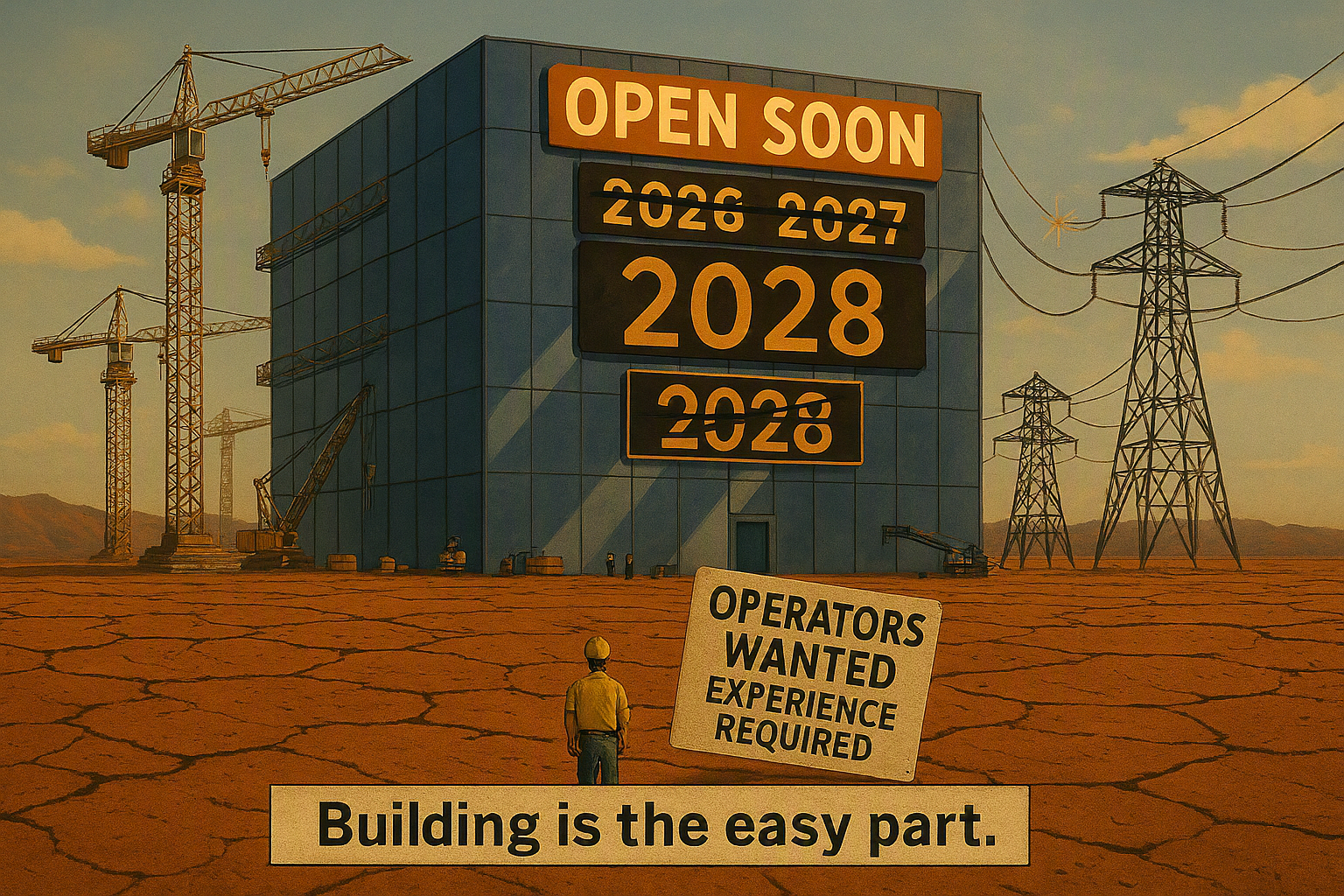
Massive data centre being constructed with operators wanted signage.
The twin engines: cloud and AI - now with hyperscale firepower
Global trends remain the bedrock. According to DCD Intelligence's Financing the Data Center Buildout, the world needs to double capacity by 2030, requiring at least USD 3 trillion in investment. In 2025, data centres accounted for 31% of global investment – about US$17.9 billion – well above the five‑year average of 15%.
Australia is soaking up a disproportionate share of that global flow. Deloitte's Investment Monitor shows local investment has topped AUD 37 billion, growing 60% in just 12 months. With over 250 facilities, we are already the fifth‑largest market globally, projected to reach $9.02 billion by 2031.
Microsoft CEO Satya Nadella made the trip to Sydney in April 2026 to announce his company's AUD 25 billion bet, alongside a pledge to train three million Australians on AI by 2028. That's a huge commitment to digital skills – but as we'll see, it doesn't quite solve the physical skills problem.
Amazon isn't just spending on buildings; it's also building three new solar farms in Victoria and Queensland totalling more than 170 megawatts – a clear nod to the power problem. Meanwhile, IREN's co‑CEO put it succinctly: "South Australia offers what AI infrastructure at scale requires: abundant clean energy, the connectivity to serve the APAC region, and a State Government that understands the opportunity."
But even with that optimism, the physics of the grid – and the reality of the water cycle – are unforgiving.
The grid bottleneck: 60% more generation? Not so fast
Here's the wake‑up call. Anthropic's long‑term target of 20 gigawatts would increase Australia's annual electricity generation by about 60 per cent. That is not an upgrade; that is a complete rebuild of the national electricity market.
The Australian Energy Market Operator (AEMO) now forecasts data centre electricity consumption to grow from 4 TWh (2% of grid demand) in 2025 to 12 TWh (6%) by 2030 and 34 TWh (12%) by 2050 – a 25% year‑on‑year growth rate unlike any other industrial load in the country's history.
But the headline numbers hide the real problem: location. Approximately 80% of data centre deployments are concentrated in Sydney and Melbourne. This geographic clustering, combined with Australia's radial transmission topology, creates acute supply vulnerabilities. Hyperscale data centres require sustained baseload at 80‑100% utilisation, rapid ramp rates of 10‑50% per minute due to GPU bursts, and power quality within milliseconds of acceptable outage. The result is a widening gap between announced projects and capacity likely to be delivered by 2030.
Victoria is the canary in the coalmine. AEMO has flagged over 18 GW of industrial load inquiries (mostly data centres) in Melbourne's north and west. If all proceeded, peak demand would more than double – which AEMO has flatly called "impossible" to support. AusNet, Victoria's grid operator, is assessing more than 10 GW of connection requests.
Energy expert Professor Bruce Mountain warns this has "gold‑rush" hallmarks – developers inflating power needs just to secure a place in the queue, hoping to flip the rights later. "If policy‑makers and network companies can't fairly allocate upgrade costs to data centre firms, we'll repeat the mistake of wasted over‑investment," he says.
IREN's approach in South Australia offers a smarter template. They've secured a transmission connection agreement with four 330kV feeder exits, with energisation expected from 2028. That's not a vague promise; that's a fixed, credible grid pathway. In today's market, that kind of certainty is worth its weight in gold – and it's exactly what risk‑aware investors are demanding.
The hidden constraint: water
Amid all the focus on megawatts, a quieter but equally critical constraint is emerging: water.
Many large data centres in warm climates rely on evaporative cooling, consuming upwards of 25.5 million litres of water annually per megawatt of IT load. A single large facility can use more water than a small town. In Australia, where drought cycles are part of the natural rhythm, water availability is becoming a binding constraint on data centre approvals. The federal government has formally included water security among its expectations for AI infrastructure developers. One water utilities report projects cooling will surge from 1% to 25% of total potable water demand by 2035.
This isn't just an Australian story. In Singapore, regulators have enacted a 200MW tranche for new data centres with strict green power and water efficiency rules, forcing operators to consider secondary hubs in Malaysia and Indonesia – which come with their own infrastructure and water challenges. As the Harvard Business Review article “Your Company Needs an Energy Strategy for AI’s Next Phase” notes, the issue is not only aggregate demand; it is location. AI‑focused data centres are geographically concentrated, and the grids serving them face local constraints in transmission, interconnection, cooling, and permitting.
The post‑build trap: who actually runs these mega‑facilities?
Even if you nail the grid connection and secure the water rights, there's a second, equally daunting challenge: skilled operators.
Modern data centres are no longer just racks and cooling towers. They are complex infrastructure assets that blend high‑voltage electrical systems, industrial‑scale mechanical cooling, fibre optics, and real‑time digital orchestration. As DCD's report puts it: "Data centres are an infrastructure asset, a big departure from traditional real estate."
Microsoft's pledge to train 3 million Australians in AI is commendable – but AI literacy is software and data science. It does not produce the high‑voltage electricians, industrial HVAC technicians, commissioning engineers, or facility managers who actually keep a live data centre running. That is a completely different skills pipeline – and it is severely broken.
According to an industry recruiter, shortages are already being felt across construction, operations, and engineering. With AI‑driven capacity growth only just beginning to accelerate, there is little prospect of the global workforce catching up to meet the scale of demand now being projected.
In Victoria alone, data centre capacity is set to grow dramatically over the next decade. Depending on the facility type, up to 30% of the workforce is in operational roles – electricians, cooling specialists, and cross‑trained engineers. But these roles require years of trade experience, plus specific data‑centre certifications. TAFE and university pathways are not keeping pace.
Without a co‑ordinated national workforce plan – one that targets physical trades, not just digital ones – existing staff will face burnout, safety risks will climb, and operational reliability will suffer. That directly hits investor returns, because downtime in a hyperscale facility costs millions per minute.
This is where the principle of starting with the end in mind becomes critical. A data centre's lifespan is measured in decades – often 20 years or more. The design and construction phase? That's typically just 1 to 2 years. Yet this short, capital‑intensive period is where the vast majority of the focus, budget, and excitement is directed.
"Value is not extracted from a data centre by its architecture; it is extracted by its operations." You can have the most beautifully designed, Tier IV‑certified facility on paper. But if the operations team lacks the right procedures, training, staffing, or authority to manage it, that facility will underperform. It will suffer from preventable downtime, creeping inefficiencies, and ultimately fail to deliver the return on investment that justified its construction.
"Operations is the engine that converts the capital investment (CAPEX) into a reliable, efficient, and long‑term operational expenditure (OPEX) asset," as Ecanet's analysis puts it. "Without a world‑class operations team, the data centre is just an expensive, inert building."
The solution - integrating operations from the pre‑construction phase to define success metrics (SLAs, KPIs), develop maintenance concepts, and review designs for maintainability – remains the gold standard. It's the difference between building a monument and building a machine that delivers value for two decades.
Outsourcing: a pragmatic response to the talent crunch
Faced with the talent shortage, a growing number of Australian operators are turning to data centre outsourcing.
Outsourcing allows organisations to tap into specialist providers who already have the trained technicians, 24/7 monitoring centres, and proven maintenance protocols. Models range from fully managed (the provider handles everything end‑to‑end) to co‑managed (the provider covers incident response and preventative maintenance, while in‑house teams retain control over change windows and critical workloads).
For project owners, this is a critical strategic decision:
Build in‑house – you gain direct control, but you face a brutal recruitment war, escalating labour costs, and the risk that your new facility sits idle for months waiting for a qualified facility manager.
Outsource – you get speed and reliability, but you must carefully vet vendors, negotiate tight service‑level agreements, and ensure they hold the right security clearances and technical certifications.
Either way, operational capability cannot be an afterthought. It must be modelled into the business case from Day 1 – including contingency budgets for talent retention, training, or third‑party service fees. The goal isn't just to build a data centre; it's to run it, reliably and efficiently, for the next two decades.
Overbuild risks and the ghost‑demand trap
The sheer scale of the new announcements - Amazon's $20 billion, Microsoft's $25 billion, IREN's 800 MW, Anthropic's 5–20 GW ambitions – raises an inevitable question: are we overbuilding?
Globally, DCD Intelligence warns of a mismatch between announced hyperscaler demand and contracted demand. A significant portion of the supply pipeline is built on indicative, not binding, commitments. In Europe, take‑up in 2025 fell short of supply for the third consecutive quarter – a warning flag.
Australia is not immune. Of the 8,181 MW of committed and early‑stage pipeline nationally, only about 25% is currently considered truly deliverable, given grid and land constraints. Oxford Economics' analysis suggests the vast majority of connection inquiries are speculative.
Anthropic's 20 GW long‑term target is a case in point. That would represent a seismic shift in Australia's energy landscape – but is it a genuine forecast, or a negotiating chip to secure government support? Until those MWs are backed by firm transmission agreements, water approvals, and binding offtake contracts, wise observers will treat them with healthy scepticism.
The bottom line
The digitisation of the global economy is irreversible. Australia – with its renewable energy potential, available land, stable rule of law, and growing digital economy – is uniquely positioned to become a Pacific‑powerhouse data centre hub.
But the recent announcements from Amazon, Microsoft, IREN, and Anthropic have raised the stakes dramatically. The grid is straining, the water table is under pressure, the skilled workforce is nowhere near sufficient, and the gap between announced and deliverable capacity is wide.
Your AI strategy just became your energy and water strategy – and, we would add, your operations strategy.
Those who secure the right sites with credible power and water, who lock in operational talent (or reliable outsourcing partners), who start with the end in mind, and who maintain disciplined scrutiny of ghost demand will be the ones best placed to deliver sustained, reliable performance.
Building is the easy part. Running it - reliably, safely, and efficiently, for the next 20 years - is where the real challenge begins.
Further reading:
Start with the End in Mind – why operations drive long‑term data centre value, and how to design for it from day one
AI Strategy Is Grid and Water – Australia's energy and water constraints, with practical data and response frameworks
This analysis draws on the DCD Intelligence report "Financing the Data Center Buildout", alongside Australian‑specific data from AEMO, Deloitte, and the latest market announcements from Amazon, Microsoft, IREN, and Anthropic. Additional insights are drawn from Ecanet Engineers' blogs.