Data Centre Trends in 2026: Key Takeaways from the Uptime Institute Global Survey
The digital infrastructure landscape is shifting faster than ever. The 16th annual Uptime Institute Global Data Center Survey 2026delivers a clear message: the industry is expanding and investing heavily, but it’s doing so under intensifying constraints, growing complexity, and a level of scrutiny we haven’t seen before.
Back in our review of the 2025 survey, we noted the perfect storm of rising densities, staffing crunches, and efficiency pressures. Twelve months on, those trends haven’t just continued—they’ve accelerated. And here in Australia, the local context makes these global trends feel particularly urgent. Our data centre capacity is projected to double to 4.1 gigawatts by 2030, placing immense strain on energy grids, water supplies, and a workforce that’s already stretched thin.
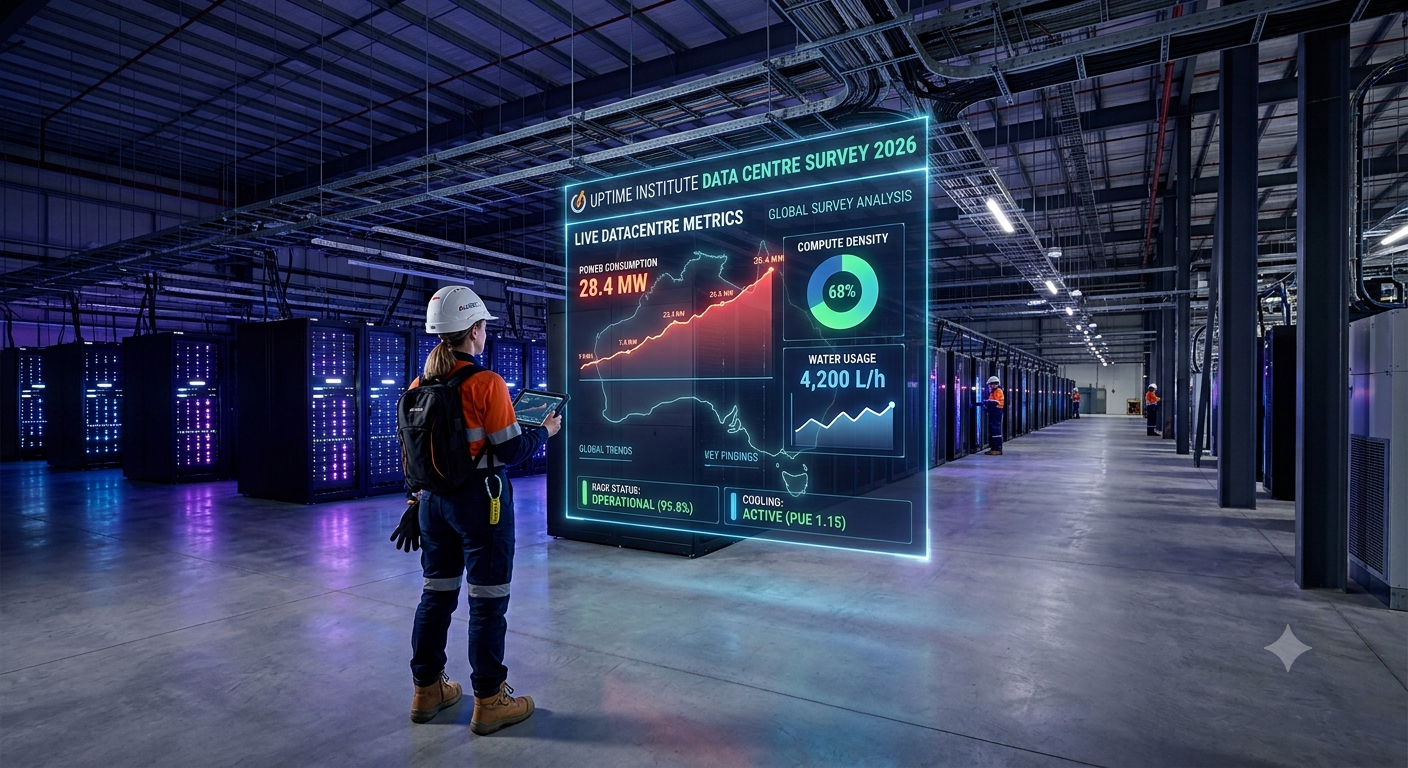
Let’s break down the key findings from the 2026 report and what they mean for Australian operators.
1. The Density Dilemma Is Hitting Hard
For the first time, the average modal rack density surpassed 11 kW in 2026, up significantly from 9 kW the previous year. Even when you strip out the new super-dense facilities with racks above 30 kW, the average still sits at 7.8 kW - a noticeable climb from 7.5 kW in 2025. A growing number of operators are now reporting peak densities of 30 kW or higher.
What this means locally: Traditional cooling architectures and power distribution systems simply aren't cut out for this. As AI and high-performance computing workloads drive these density increases, operators here will need to seriously evaluate whether their existing facilities can handle next-generation hardware. Retrofitting older sites - or designing new builds with scalability baked in from day one - is no longer a nice-to-have; it's a strategic necessity.
2. Costs Are Still Top of Mind - But Power Availability Is Closing Fast
High costs remain the greatest concern for management teams in 2026, with 79% of respondents saying leadership is at least somewhat worried. However, the survey also reveals rapidly growing anxiety around capacity forecasting, power availability, and ongoing supply chain disruptions.
What this means locally: Power is the elephant in the room. Industry forecasts predict that data centre electricity consumption in Australia will jump by 37.7% in 2026 alone, reaching 6.2 terawatt-hours (TWh). Securing firm grid connections, managing energy price volatility, and meeting decarbonisation targets are becoming major strategic headaches. It’s not just about managing costs anymore - it’s about securing the physical capacity to grow at all.
3. AI Expectations Are Cooling - But Practical Use Cases Are Emerging
Despite the relentless hype around generative AI, operators' expectations of its benefits in data centre operations actually declined slightly in 2026. Trust remains highest for lower-risk applications like sensor data analytics and predictive maintenance, rather than fully autonomous control.
What this means locally: We’re moving past the hype and into a phase of practical, measured experimentation. The first wave of AI tools - driven largely by niche players and startups - is now being joined by major DCIM developers and cooling suppliers adding LLM-based functionality to their platforms. For Australian operators, the smart move is to identify specific, low-risk use cases where AI can deliver clear value, rather than betting the farm on sweeping automation.
4. Fewer Outages, But the Stakes Are Getting Higher
For the sixth year running, the survey shows improvement in reported outage frequency. The share of respondents who experienced an outage in the past three years fell by three percentage points. However, one in ten outages is still classified as serious or severe, and the financial and operational costs of these failures continue to rise.
What this means locally: The long-term trend is positive, but we can't afford to be complacent. The recent Telstra national network outage is a prime example. It disrupted rail networks and triple-zero emergency calls, all triggered by a software defect in servers used for time synchronisation at data centres in Sydney and Melbourne. It was a stark reminder that even relatively minor technical issues can cascade into major, nationally significant incidents. As our reliance on digital infrastructure deepens, the margin for error is shrinking fast.
Side Note: IT Efficiency - The Hidden Opportunity
While much of the industry's focus is on physical infrastructure like power and cooling, the survey highlights a crucial, often overlooked area for efficiency gains: the IT equipment itself. Two key metrics - server utilization and server refresh cycles - show that significant opportunities for optimization exist within the racks.
Server utilization is a prime example. Underutilized servers waste energy while idling, whereas fully utilized servers perform more work per kilowatt-hour. Yet, excluding colocation operators who don't have access to this data, only around 42% of operators collect it. Server utilization is reported to third parties even less often (21%) than it is recorded.
Server refresh cycles are also shifting. Between 2015 and 2023, operators reported increasing server life cycles from around 36 to 44 months. Since 2023, this trend has reversed - operators are retiring servers sooner, with the average lifetime now around 41 months. This is driven by rapid innovation, rising densities, and the pressure to maximize facility power capacity.
The takeaway? Optimizing IT efficiency isn't just an environmental goal - it's a business imperative. By focusing on server utilization and strategically managing refresh cycles, operators can reduce costs, improve sustainability, and build more resilient, future-ready data centres.
Further reading: Why data centre energy efficiency is stuck - and how to fix it
5. The Staffing Shortage Is Getting Worse
More than half of all respondents (53%) now report difficulty finding qualified candidates for open roles - a significant jump from 46% in 2025. Staff turnover remains a persistent headache, with skilled staff frequently poached by competitors.
What this means locally: The talent drought is intensifying. Large, specialist AI facilities are compounding the problem because they require new skill sets to handle higher thermal densities and complex cooling systems. We're also seeing a flow-on effect into the broader construction sector, with traditional trades like electricians being lured away by high-paying data centre projects. The industry’s pipeline of new talent simply isn't keeping up with demand.
This is where Ecanet Engineers can make a tangible difference. Our education programs, delivered in partnership with Uptime Institute, are specifically designed to address this widening skills gap. Our Accredited Operations Specialist (AOS) Masterclass goes beyond theory to focus on the practical realities of managing mission-critical operations - covering operational sustainability, risk management, maintenance best practices, and proven strategies to reduce human error. It's about giving your team the real-world knowledge they need right now.
6. Sustainability Metrics Are Back on the Rise
The share of operators actively collecting sustainability metrics returned to an upward trend in 2026. More than half now track water usage—a significant increase driven by growing public pressure and new legislation. Energy consumption (87%) and PUE (79%) remain the most tracked metrics, often mandated by regulators or customers.
What this means locally: Sustainability has gone from a "nice-to-have" to a commercial imperative. And in Australia, the numbers are eye-opening. Sydney Water estimates that data centres could account for 15 to 20% of Sydney's total water supply by 2035. Industry analysis suggests that Australian data centres are already using around 5.5 billion litres of water annually for cooling. The Federal Government has put sustainable water use at the centre of its data centre investment framework. If you're not tracking your water footprint and carbon emissions, you're going to find yourself on the back foot with regulators, investors, and customers.
7. A Historic Shift in Workload Placement
For the first time in Uptime's survey history, third-party data centre facilities and services now account for a larger share of IT workloads (46%) than enterprise-owned corporate data centres (44%).
What this means locally: The hybrid IT strategy is now the dominant model across the board. While corporate data centres remain central to many organisations, the balance has officially tipped. This underscores the importance of having a clear, flexible workload placement strategy - and ensuring you have the infrastructure and skilled staff to support it, regardless of whether workloads are running on-premises or in colocation and cloud environments.
Looking Ahead
The 2026 survey reveals an industry at a crossroads. Demand is surging, driven by AI and high-density workloads, but operators are grappling with limited power availability, falling grid reliability, soaring costs, supply chain constraints, and critical staffing shortages. Maintaining resilience while modernising infrastructure will be the defining challenge of the next decade.
At Ecanet Engineers, we specialise in bridging the gap between complex engineering challenges and the skilled workforce needed to solve them. Whether you're retrofitting for higher densities, upskilling your team, or navigating the intricacies of modern data centre operations, we're here to help.
Get in touch with us today to discuss how we can support your data centre strategy - or to secure a spot in our upcoming masterclass.
This article is based on the Uptime Institute Global Data Center Survey 2026 executive summary. For the full report, visit Uptime Institute.