
Your AI Strategy Is Now a Grid Strategy (And a Water Strategy)
In business, there's a reliable pattern: follow the bottleneck. The tech world has lived through this cycle before. Value pooled in the "pipes" (connectivity), then in "attention" (discovery), then in "intelligence" (compute). Now, as a June 2026 Harvard Business Review article “Your Company Needs an Energy Strategy for AI’s Next Phase” makes clear, the Great Value Loop is moving again. The next constraint is no longer a smarter model or a faster chip. It's the raw physical infrastructure of energy and water.
Welcome to the fourth era of AI: Energy & Physics.
Global data-centre electricity use is projected to roughly double from 485 TWh to 950 TWh by 2030. AI-focused facilities will triple their consumption. But for leaders in Australia and the broader Asia-Pacific region, this is not an abstract forecast. It is already showing up in grid connection queues, state planning documents, and the nation's most ambitious infrastructure announcements.
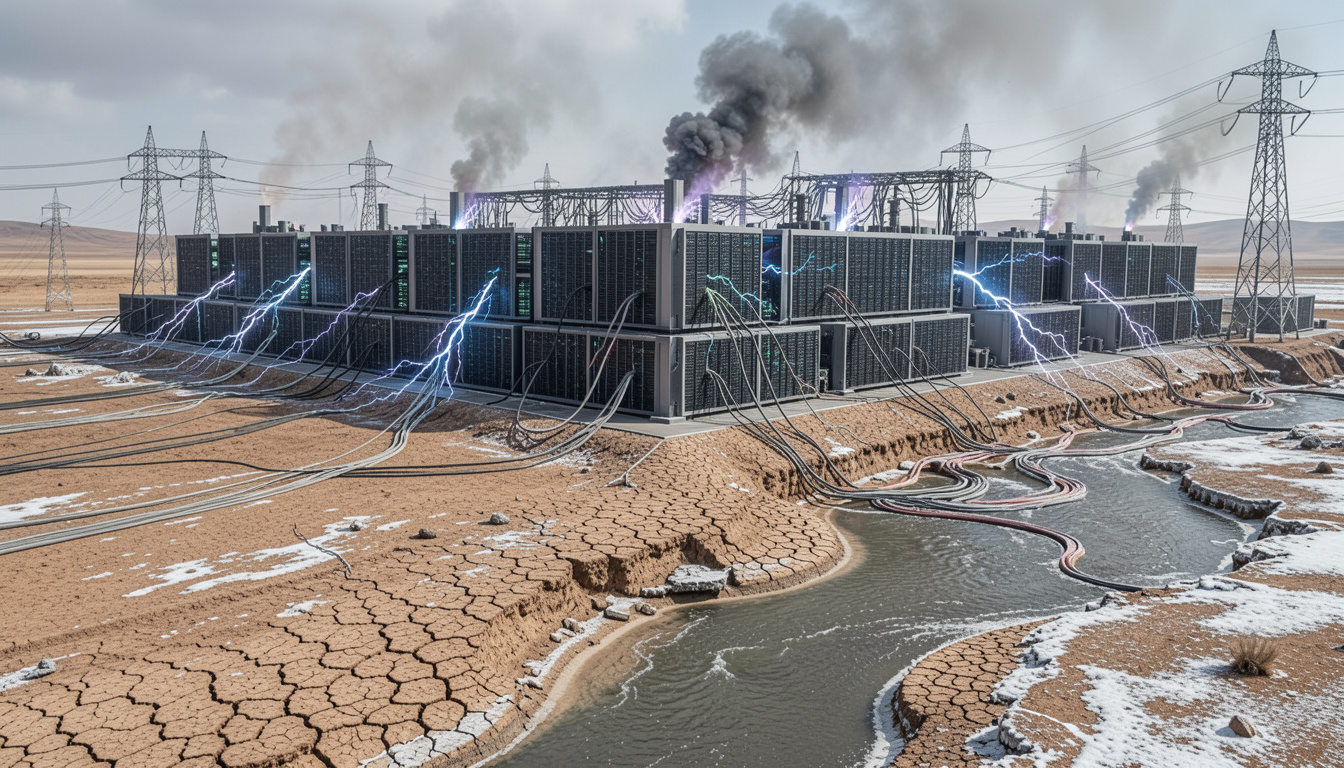
Massive AI data centre drawing huge power from an overloaded grid, parched riverbed, salt-crusted barren plains
Australia's Data Center Boom: The Numbers Are Staggering
Australia has rapidly become one of the world's most attractive hyperscale data center markets, ranking in the global top five to ten by capacity. The reasons are clear: abundant land in Renewable Energy Zones, renewable penetration exceeding 40% in the National Electricity Market, political stability, Five Eyes trust status, and proximity to Asian demand centers.
The scale of announced investment is breathtaking.
Amazon (June 2025): AUD 20 billion (USD 13 billion) between 2025 and 2029, plus three new solar farms in Victoria and Queensland totaling more than 170 megawatts.
Microsoft (April 2026): AUD 25 billion (USD 18 billion) by end of 2029, expanding Azure compute infrastructure by more than 140%. CEO Satya Nadella announced it in Sydney, alongside a pledge to train three million Australians on AI by 2028.
IREN (June 2026): An 800‑megawatt data center campus in Bundey, South Australia — one of the largest data center developments announced in the Asia‑Pacific region to date. The transmission connection agreement secures four 330kV feeder exits, with energization expected from 2028. As IREN's co‑CEO put it: "South Australia offers what AI infrastructure at scale requires: abundant clean energy, the connectivity to serve the APAC region, and a State Government that understands the opportunity."
Anthropic (March 2026): The AI giant behind Claude signed a Memorandum of Understanding with the Australian government, committing to explore data center infrastructure and energy investments throughout the country. Anthropic CEO Dario Amodei met with Prime Minister Anthony Albanese in Canberra to formalize the agreement. The company has disclosed ambitions to build data centres consuming up to five gigawatts of new capacity in Australia by 2030, with a long-term target of 20 gigawatts - which would increase Australia's annual electricity generation by approximately 60 per cent on today's figures.
Yet even as these headlines roll in, a quieter truth is emerging. Data from DC Byte shows 252 tracked projects across Australia. The Clean Energy Finance Corporation projects data center capacity rising from about 1.35GW today to between 4.7GW and 7.4GW by 2035 - a more than 5x expansion in less than a decade.
The Energy Reality Check
This explosion of announced capacity is colliding head‑on with Australia's grid realities. The Australian Energy Market Operator (AEMO) now forecasts data centre electricity consumption to grow from 4 TWh (2% of grid demand) in 2025 to 12 TWh (6%) by 2030 and 34 TWh (12%) by 2050 - a 25% year‑on‑year growth rate unlike any other industrial load in the country's history.
But the headline numbers hide the real problem: location. Approximately 80% of data centre deployments are concentrated in Sydney and Melbourne. This geographic clustering, combined with Australia's radial transmission topology, creates acute supply vulnerabilities. Hyperscale data centres require sustained baseload at 80‑100% utilisation, rapid ramp rates of 10‑50% per minute due to GPU bursts, and power quality within milliseconds of acceptable outage.
The result is a widening gap between announced projects and capacity likely to be delivered by 2030. Many proposals remain early stage, duplicated across connection queues, or dependent on power and water approvals that are anything but certain.
The Hidden Constraint: Water
Amid all the focus on megawatts, a quieter but equally critical constraint is emerging: water. Many large data centers in warm climates rely on evaporative cooling, consuming upwards of 25.5 million litres of water annually per megawatt of IT load. A single large facility can use more water than a small town.
In Australia, where drought cycles are part of the natural rhythm, water availability is becoming a binding constraint on data centre approvals. The federal government has formally included water security among its expectations for AI infrastructure developers. One water utilities report projects cooling will surge from 1% to 25% of total potable water demand by 2035.
The APAC‑Wide Picture
The trends in Australia echo across the region, but with local variations. In Singapore, regulators have enacted a 200MW tranche for new data centers with strict green power and water efficiency rules, forcing operators to consider secondary hubs in Malaysia and Indonesia - which come with their own infrastructure and water challenges. South Korea and Japan face limited land for renewables and significant water stress in industrialised regions. As the HBR article notes, the issue is not only aggregate demand; it is location. AI‑focused data centers are geographically concentrated, and the grids serving them face local constraints in transmission, interconnection, cooling, and permitting.
A Simplified Playbook for Any Company
You don't need to become a utility. But you do need a strategy. The HBR authors offer five straightforward disciplines:
Make energy and water intensity visible - Track energy cost per workflow, tokens per kWh, and water usage assumptions.
Reduce demand before buying supply - Use smaller models, cache responses, batch non‑urgent workloads.
Contract for optionality - Sign virtual power purchase agreements, colocation reservations, and engage with water authorities early.
Redesign where compute runs - Shift flexible workloads to energy‑rich, cool‑climate, or water‑secure regions.
Make someone accountable - Create a council with veto power over major AI deployments.
The Bottom Line
Every major technology transition eventually hits a physical wall. The internet hit the last mile. Mobile hit spectrum. AI is now hitting the grid and the water table. The 800MW IREN announcement in South Australia is a sign of ambition — but also a warning. Without reliable, affordable, permitted power and sustainable water, those megawatts will remain on paper, not online.
So here is the reality for every Australian and APAC business leader, whether you run a multinational or a small shop: the models will keep getting smarter, but the electrons and the litres will become the binding constraint. And once you understand that, one thing becomes unavoidable.
Your AI strategy just became your energy and water strategy.