
Higher Density Isn't Always Better!
While the world chases ever‑higher rack densities, Uptime Institute Research Director Daniel Bizo argues that an exclusive focus on densification risks becoming tunnel vision that ignores costs and alternative choices. For Australian data centre owners, a wave of new regulations makes the stakes even higher.
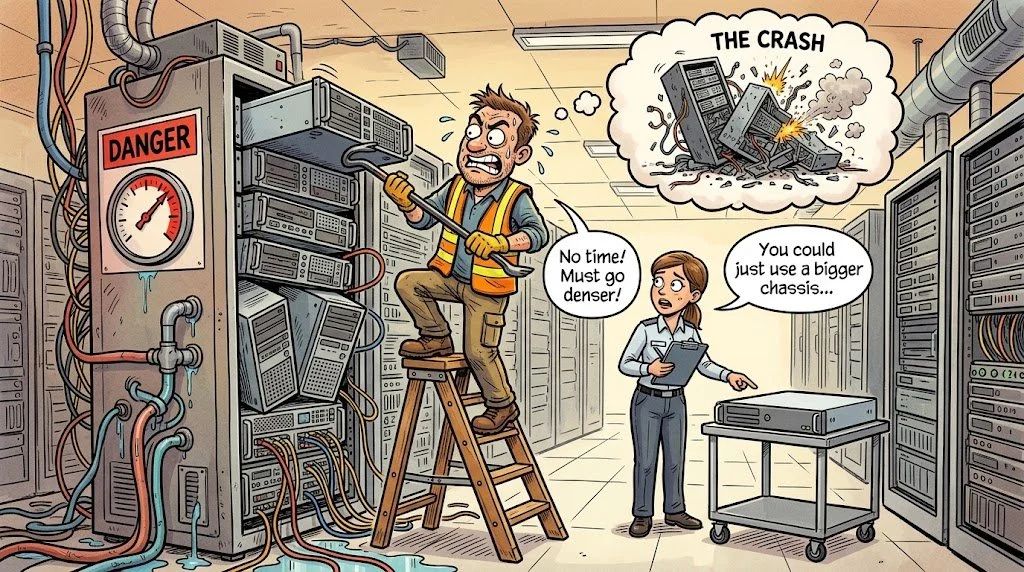
A satirical cartoon of an engineer trying to cram one more server into an already overflowing rack.
For years, the data centre industry has been fixated on one metric: rack density. Pack more compute into every cabinet, adopt liquid cooling, and push efficiency to the limit. It seemed like the only path forward, especially with the AI boom.
But as Daniel Bizo, Research Director at Uptime Institute Intelligence, points out in the Uptime Institute Journal, there are several critical factors to consider when planning a technical roadmap for IT thermal management. The 2026 Global Data Center Survey tells a more nuanced story - one that challenges the "density at all costs" mantra. And for Australian operators, local regulatory pressure is turning this global question into a local imperative.
The Australian Landscape: Boom Times, Tighter Rules
Let’s start with what’s happening on home soil.
Australia is already one of the largest data centre markets in the Asia‑Pacific region, with around 1.8 GW of installed capacity in 2025 – one of the highest per‑capita rates in the world. And that number is growing fast: by 2030, national capacity is expected to more than double, reaching 4.1 GW.
Investment figures are just as striking. In the first quarter of 2026, data centre investment drove a 6.5 % rise in private new capital expenditure, with data centre construction spending rising for the seventh consecutive quarter – up 12.6 %. Companies spent roughly $8.7 billion on data centre builds. AI is the primary driver – Australian data centre electricity consumption is forecast to grow by 37.7 % in 2026, reaching 6.2 terawatt‑hours.
But growth brings scrutiny.
In March 2026, the Federal Government released its Data Centres and AI Infrastructure Developer Expectations document, setting national resource‑consumption caps for the industry for the first time. Key requirements include:
New facilities must achieve a PUE of 1.3 by 2027 – among the toughest standards globally.
Existing facilities must retrofit to PUE 1.5 by 2030, or face significant penalties.
A national water‑use efficiency (WUE) cap of 0.4 L/kWh now applies to all facilities over 5 MW.
From July 2026, mandatory real‑time resource data reporting to the Clean Energy Regulator comes into effect.
New South Wales has launched a parliamentary inquiry into data centres, and Victoria has rolled out a Sustainable Data Centres Action Plan. The Federal Government also mandates that any facility hosting government workloads must achieve a NABERS Energy rating of 5 stars, which typically translates to a PUE below 1.4.
Perhaps most significantly, the Government is pushing new data centres to build their own renewable energy generation rather than drawing from the grid. Energy Minister Chris Bowen has made it clear that facilities relying solely on gas will not meet national standards and will not be registered.
Against this backdrop, every decision about density, cooling, and efficiency carries more weight than ever.
The 2026 Density Numbers – and What They Really Mean
Now, let’s turn to the Uptime Institute survey.
The 2026 data shows that the average modal rack density has crossed 11 kW for the first time, up from 9 kW the previous year. Even when you exclude the ultra‑dense outliers above 30 kW, the average still sits at 7.8 kW – a noticeable climb from 7.5 kW in 2025. A growing minority of operators now report peak densities of 30 kW or higher.
But here is the critical insight from Uptime's analysis: densification delivers the greatest economic benefit when starting with low single‑digit rack power levels - most of the capital cost gains come from requiring smaller data halls, fewer racks, shorter conductor runs and fewer power distribution components. However, from around 20‑25 kW per rack, overall capital cost gains start to thin out as savings from IT space compression become marginal, and power distribution and thermal management equipment for high‑density use cases carry a cost premium
The Efficiency Plateau: We’re Not Getting Better Fast Enough
While density climbs, energy efficiency has stalled. Global average PUE improved from 2.50 in 2007 to roughly 1.54 today – but that progress has largely flatlined over the past several years.
This is not a technical ceiling; it is an operational failure. Uptime’s Management & Operations assessment data shows a persistent gap between intention and execution:
Proactive energy management in computer rooms scored just 46 % (the effectiveness threshold is 80 %).
Electrical distribution efficiency management averaged only 51 %.
Evaluation of emerging technologies scored a mere 40 %.
Facility improvement initiatives that integrated efficiency goals scored just 56 %.
When capital budgets are available, efficiency is too often an afterthought.
And costs are rising. 42% of enterprise and colocation operators cited per‑kWh energy cost as their greatest unit‑cost increase over the past year. Meanwhile, 64 % of colocation providers expect to raise power prices in the coming years, with most anticipating hikes of 6-10 %.
For Australian operators, this convergence of rising energy costs and tightening PUE caps means that squeezing every kilowatt‑hour out of your infrastructure is no longer just good practice - it is a compliance necessity.
The DLC Premium: What the Uptime Institute Journal Reveals
This brings us to one of the most misunderstood aspects of the liquid‑cooling transition. As Bizo notes, while DLC promises to reduce infrastructure capital costs in the future when IT hardware standardises on liquid cooling, for now, the support for DLC comes at a premium - even in new builds - due to the need for additional equipment such as coolant‑distribution units (CDUs), pipes and manifolds.
Uptime Institute's cost estimates reveal that, on balance, this premium can amount to roughly 5‑10% in capital expenditure for new builds (including full commissioning), depending on requirements and assumptions. For existing data centres, the cost of adding support for DLC will be higher still.
Importantly, most facilities are expected to oversize total air plus liquid cooling capacities to manage the shift from air loads to liquid loads. Even with Direct Liquid Cooling in place, you still need 20–30% air‑cooling capacity – because not every component can be liquid‑cooled. DLC typically handles 70-80% of the heat from high‑TDP components like GPUs and CPUs. But the remaining 20-30% - from networking cards, storage drives, memory modules, power supplies, and auxiliary processors – still relies on conventional air cooling. A 130 kW rack, for example, might require over 100 kW of liquid capacity and roughly 30 kW of air cooling alongside it.
You aren't eliminating your air‑cooling infrastructure – you are adding liquid cooling on top of it. That means dual systems, dual maintenance, dual points of failure, and higher capital outlay.
For Australian operators, this is especially relevant. Under the new WUE cap of 0.4 L/kWh, evaporative cooling – which consumes significant water – is under intense pressure. But liquid cooling is not a silver bullet either; it still depends on that 20–30% air‑cooling backup, and the overall facility PUE must still meet the 1.3 target.
The Overlooked Risk: Resilience Takes a Hit
Beyond cost, high density narrows your fault‑tolerance window. As Bizo explains, in traditional low‑density facilities (under 10 kW per rack), loss of cooling gave operators several, sometimes tens of, minutes before inlet temperatures exceeded IT equipment tolerances – a comfortable cushion that left sufficient time for engine generators to take the load and for cooling systems to restart.
At high densities, this will not be the case: IT systems using cold plates typically cannot tolerate loss of circulation for more than a few seconds (immersion tanks ride through several minutes). This adds the need for thermal storage and/or to put mechanical loads on UPS (such as facility water pumps and CDUs), which add substantial costs
A Pragmatic Path Forward
If extreme density isn’t always the answer, what is?
Uptime Institute offers a concrete, often‑overlooked recommendation: standardise on 2U chassis instead of 1U for your server fleet.
The logic is simple. A taller chassis accommodates larger fans and heatsinks, enabling better airflow and less pre‑heating of downstream components. Larger fans spin more slowly and consume far less power than their tiny, high‑speed counterparts.
The numbers are telling. Uptime cites SPEC Power benchmark data showing that, with identical CPU, memory, disk, and software, a 1U system consumes 30-60 W more than a 2U system. At idle, the gap widens to roughly 70 W.
Why? Fan power scales with the cube of rotational speed. In a cramped 1U enclosure, fans must scream to move enough air – and the power penalty is exponential. A 2U chassis lets you use slower, quieter, and dramatically more efficient fans.
For Australian operators facing a PUE target of 1.3, those 30-60 W savings per server - multiplied across hundreds or thousands of units – can make the difference between compliance and penalties.
Practical Steps for Australian IT Infrastructure Owners
Based on the Uptime Institute’s 2026 findings and Australia’s regulatory environment, here are actionable steps you can take right now:
1. Challenge the “Density First” Assumption
Before you spec your next hall or purchase, ask: do I really need >20–25 kW per rack? If not, staying at moderate density with larger form factors is often the smarter financial move. Industry consensus is that liquid cooling only becomes economically justifiable in the 20–30 kW range – and most Australian facilities are still well below that.
2. Make 2U Your Default Server Specification
Unless you have a severe space constraint, prioritise 2U chassis for new acquisitions. The immediate payoff is lower fan power, and the long‑term benefit is extended runway for your existing air‑cooled infrastructure - especially as CPU TDPs approach 600 W and memory power exceeds 200 W. More internal volume gives you breathing room and directly helps your PUE.
3. Run a Realistic ROI on Liquid Cooling – and Don’t Forget the 20-30 %
Before committing to DLC, do a total‑cost‑of‑ownership analysis that includes not just the IT hardware but also CDUs, piping, facility modifications, and the cost of adding resilience (thermal storage, UPS‑backed pumps). Crucially, factor in that you still need 20–30 % air‑cooling capacity – you are not eliminating your air system, you are adding to it. If your density is far below 20–30 kW, the incremental efficiency gains may never pay back the premium.
4. Put Water Efficiency (WUE) on the Same Footing as PUE
For Australian operators, WUE is no longer optional. The 0.4 L/kWh national cap means any facility relying heavily on evaporative cooling faces a serious challenge. Evaluate cooling solutions with both PUE and WUE in mind – they are now equally regulated.
5. Start Compliance Reporting Now – Don’t Wait
The new Data Centre Sustainability Framework (DCSF) requires mandatory real‑time resource data reporting from July 2026. You need to have metering, data collection, and reporting systems in place well before that deadline. Build the capability now – staff training and system integration take time.
6. Design for Resilience, Not Just Density
If you do deploy high‑density zones, assess the cooling‑interruption risk and allocate appropriate thermal storage or UPS capacity for mechanical loads. Build in buffer time for failover; don’t assume you can always react in seconds.
Final Thought
Amid the AI‑fuelled rush for “higher, faster, denser,” it is easy to forget that technology choices are never one‑size‑fits‑all. Uptime Institute’s research reminds us that the best path often lies in careful trade‑offs, not blind pursuit of a single number.
For Australian operators, those trade‑offs are now shaped by some of the toughest PUE and WUE regulations anywhere in the world. But that same pressure creates an opportunity: to build more efficient, more resilient, and ultimately more cost‑effective facilities – not by chasing the highest density, but by choosing the right density for your specific workload and regulatory context.
Sometimes, slowing down the density race lets you win the marathon – and in Australia’s fast‑evolving market, that might just be the smartest move of all.
Read the full Uptime Institute Journal article: Lower density brings server efficiency and cooling gains