
Powering the Cloud: Can NSW's 40% Wind Mandate for Data Centres Actually Work?
Last Monday, the New South Wales government unveiled a nation-leading Data Centre Policy Framework that has sent ripples through both the tech and energy sectors. The headline? New data centres built in the state must source at least 40% of their energy from wind power - and commit to 100% renewable energy within four years - to qualify for a fast-tracked 75-day approval pathway.
It's a bold move. But it raises a critical question: is wind energy actually practical for powering data centres, which demand 24/7 reliability? And what about the transmission costs of getting that wind power from regional farms to Sydney's data centre hub? Let's dig in - this time with the full context of NSW's newly released guidelines.
The Policy in a Nutshell
The framework, released on 17 August 2026, consists of three pillars: the Data Centre Guidelines themselves, regulatory reform to address cost recovery in the energy sector, and an IPART review into water pricing for data centres. Together, they set clear expectations for data centre development across the state.
Under the guidelines, developers who meet six key principles can have their proposals assessed within 75 days in government hands. Eligible proposals must source 100% of their energy within four years from new renewable energy agreements, including 40% from wind power. Projects that don't comply? As NSW Treasurer Daniel Mookhey put it, they can still "chance their arm" - but they'll find themselves "almost alone". Planning Minister Paul Scully confirmed there is no "automatic knockback" for non-compliant proposals, but they won't enjoy the streamlined pathway.
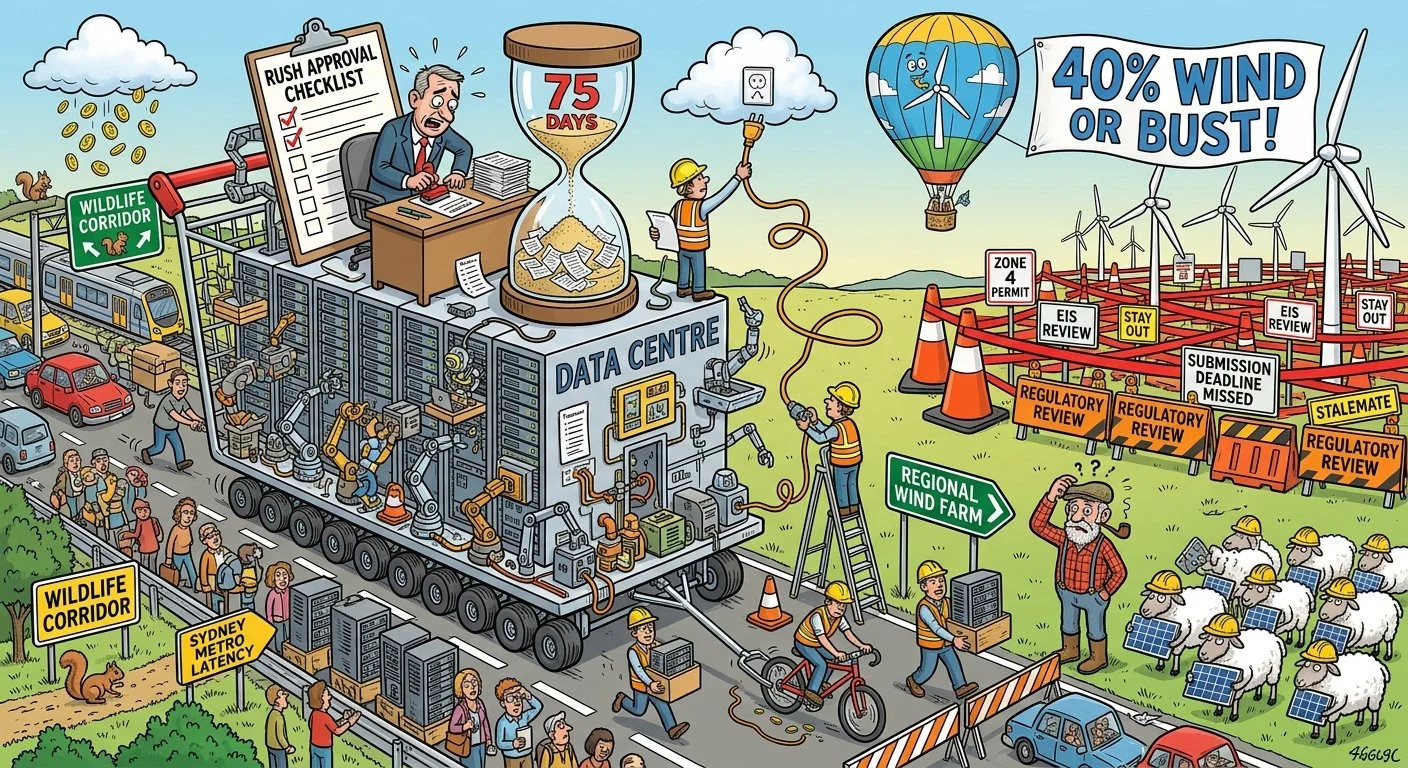
The rationale is clear: data centres are set to consume up to 11% of NSW's grid-supplied energy by 2030. That's a massive new load. The government wants to ensure this demand drives - rather than undermines - the state's renewable energy transition, particularly by creating long-term demand for struggling wind projects.
The Six Principles: What Developers Must Deliver
The guidelines establish six core principles that eligible projects must meet:
Principle 1 – Apply world-class environmental and efficiency standards – This is where the wind mandate lives. Projects must design for a Power Usage Effectiveness (dPUE) ≤ 1.25 and Water Usage Effectiveness (dWUE) ≤ 1.0 (potable water) or ≤ 1.6 (non-potable), with an alternative pathway of dPUE ≤ 1.3 and dWUE ≤ 0.44. Water-intensive cooling systems must use 100% recycled water or have clear agreements for transition to rainfall-independent supply. Diesel generators must meet strict NSW Clean Air Regulation Group 6 limits regardless of operating hours.
Principle 2 – Impose no net cost to consumers and communities – Data centres must demonstrate ability to reduce grid-supplied electricity demand by 25% of forecast average load for up to two hours via load shifting or on-site storage—not using diesel generators. They must enter commercial arrangements with energy utilities to protect consumers from stranded asset costs.
Principle 3 – Fund additional supply of water and energy – This is the engine room. Projects must enter PPAs and firming agreements with a minimum 40% wind generation component, storage capacity of at least 25% of generation capacity for four hours duration, and contracted energy supply equal to annual average demand from year four of operation. Agreements must be for new assets that haven't reached Final Investment Decision, with a minimum ten-year term.
Principle 4 – Enhance local community infrastructure and amenity – Proponents are encouraged to engage in benefit-sharing with host communities, following principles adapted from the renewable energy sector: collaborative, transparent, community-focused, proportionate, and lasting.
Principle 5 – Invest in future industries across the supply chain – Data centres are encouraged to prioritise local content where possible, supporting NSW's 340,000-strong tech workforce and growing digital industries.
Principle 6 – Demonstrate a commitment to training and skills – Developers must demonstrate support for training workers involved in construction and operation, including apprenticeships and partnerships with recognised training providers like TAFE NSW.
Is Wind Practical for Data Centres?
This is the million-dollar question. Data centres are notorious for demanding five-nines (99.999%) reliability. Wind, by contrast, is intermittent - it blows when it blows, and it doesn't when it doesn't.
The short answer: yes, it's feasible, but not without significant engineering and financial investment.
The guidelines recognise this challenge. That's why Principle 3 requires not just wind PPAs, but storage capacity of at least 25% of generation capacity for four hours duration. Battery storage is explicitly called out as critical, and the state expects data centre proponents to include this in their applications. Pumped hydro is also noted as playing a critical role in providing longer-duration firming.
Another challenge: "annual renewable claims cannot guarantee hour-by-hour deliverable clean power" under grid congestion. In other words, a PPA that says "we bought 40% wind energy over the year" doesn't mean the data centre is actually running on wind power at 2 AM on a still night.
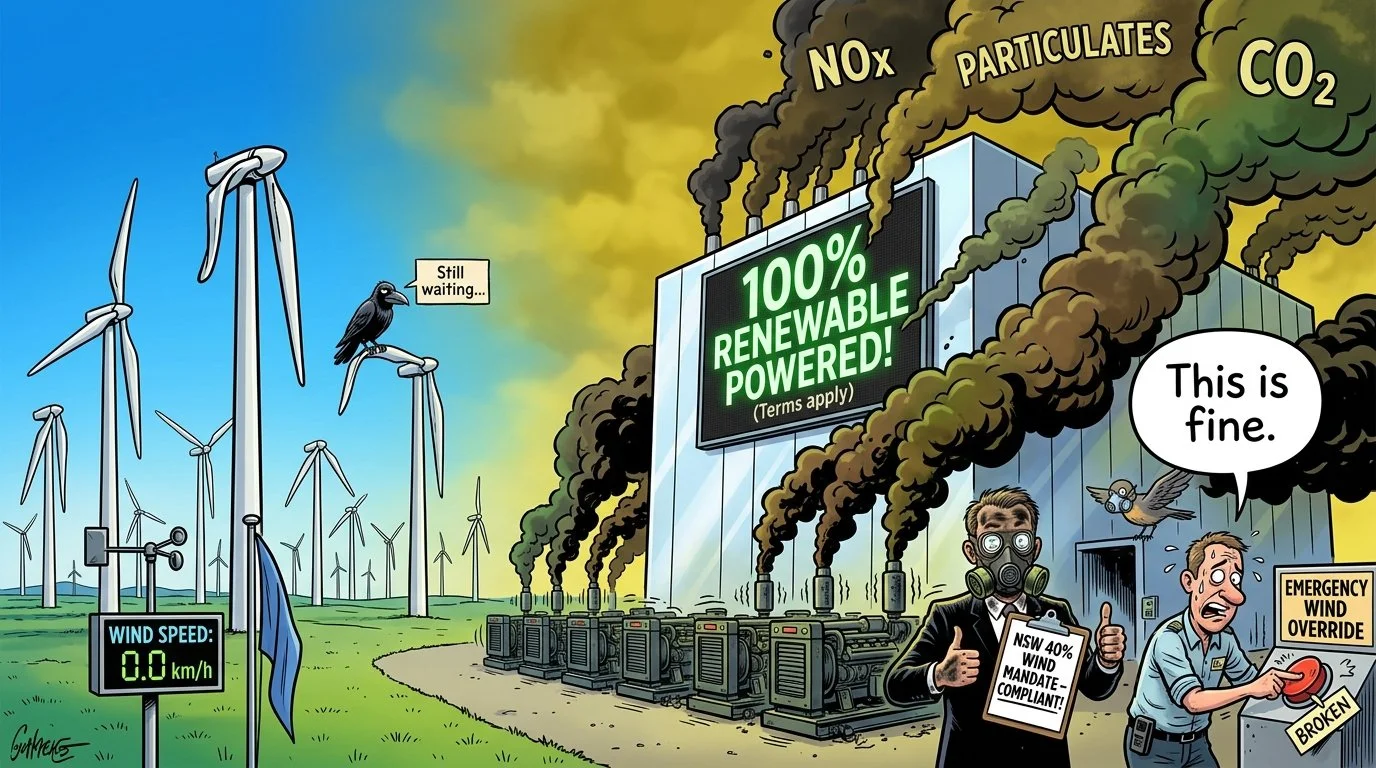
On a windless day….
The Technology Topology Required
To turn intermittent wind into reliable data centre power, you need a hybrid microgrid architecture. Here's what the guidelines effectively mandate:
1. Wind + Storage ("Hybrid Renewables")
Wind alone is too variable. The guidelines require storage capacity of at least 25% of generation capacity for four hours duration. Battery storage is critical and can be part of hybrid assets or separate from generation.
2. Demand Flexibility
Principle 2 requires data centres to demonstrate ability to reduce grid-supplied electricity demand by 25% of forecast average load for up to two hours. This can be achieved through load shifting—curtailing ancillary loads, using thermal storage for air conditioning, or scheduling programmable compute tasks outside peak periods. On-site or proximate renewable generation and storage can also contribute.
3. The Missing Piece: Backup
Even with storage, wind alone cannot guarantee 24/7 uninterruptible power. The guidelines address this through stringent diesel generator standards - but they explicitly do not allow diesel generators to count towards demand reduction measures. Generators must meet strict air pollutant limits (nitrogen oxides 450 mg/m³, solid particles 50 mg/m³, volatile organic compounds 1,140 mg/m³, carbon monoxide 5,880 mg/m³) regardless of operating hours.
Further reading: The Hidden Cost of Australia's AI Boom: Why Our Data Centres Are a Public Health Time Bomb
The Elephant in the Room: Transmission Costs
Here's where things get really interesting and challenging.
NSW's best wind resources are in regional areas: the Central West, the South West Renewable Energy Zone, and the Hunter region. But 90 per cent of NSW's existing data centre facilities are clustered around the Sydney metropolitan area.
The guidelines explicitly acknowledge this tension. Principle 2 notes that data centres located "outside the Sydney Ring" are expected to have smaller contribution obligations due to greater grid capacity in many locations, reducing the need for upstream infrastructure upgrades. In contrast, additional demand in highly congested parts of the network is likely to require significant infrastructure upgrades, adding to costs.
The transmission cost challenge is real:
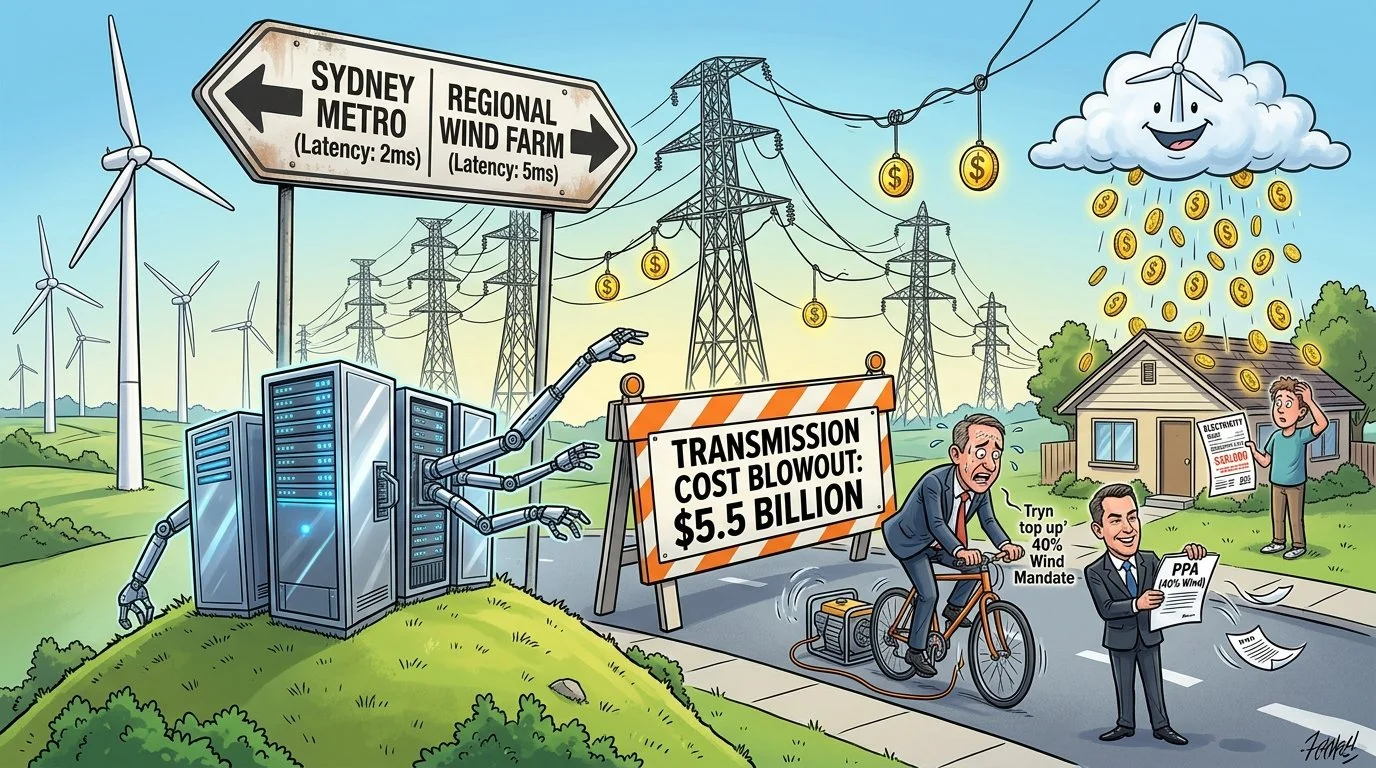
The Central West Orana Renewable Energy Zone was originally estimated at $650 million. It's now $5.5 billion.
HumeLink has blown out from ~$1 billion to $4.8 billion.
EnergyConnect now carries a $4.1 billion price tag.
Transmission charges already account for about 40% of a typical power bill. Adding more lines - and making data centre operators foot the bill for grid upgrades as the framework requires - will only push costs higher.
The guidelines attempt to address this through Principle 2's requirement that data centres "enter commercial arrangements with energy utilities that protect the wider customer base from the possibility of assets built for data centres becoming stranded". This can include prepayments, take-or-pay arrangements, upfront capital contributions, or financial guarantees.
A Smarter Alternative: Bring the Data to the Power
Here's the twist. A recent Site It Right report by the Carbon Zero Initiative argues there's a more cost-effective solution: build the data centres near the wind farms, not the other way around.
The guidelines implicitly support this approach. Principle 2 explicitly notes that data centres located "outside the Sydney Ring" are expected to have smaller contribution obligations due to greater grid capacity. The guidelines also encourage brownfield sites with existing energy and water infrastructure capacity, away from sensitive areas like homes and schools. Former coal-fired power station sites are specifically mentioned as attractive locations.
Sending data from regional centres to Sydney and back takes between 3.4 and 6.8 milliseconds - well within standards for generative AI, cloud services, and business software. And building internet connections to regional sites is cheaper than constructing new energy transmission lines.
The Bottom Line
NSW's 40% wind mandate is ambitious, and it's clearly designed to kickstart struggling renewable projects and align data centre growth with the state's energy transition. The guidelines represent the first detailed translation of Australia's national data centre policy direction into operating rules.
Yes, wind can power data centres - but only with:
Significant overbuild of renewable capacity
Large-scale battery storage (at least 25% of generation capacity for four hours)
Hybrid wind-storage configurations
Demand flexibility (25% load reduction capability)
Stringent diesel generator emissions controls
Commercial arrangements protecting consumers from stranded assets
The transmission cost challenge is real. Building new lines from regional wind farms to Sydney is eye-wateringly expensive. But the guidelines offer a pathway: locate outside the Sydney Ring, where grid capacity is greater and contribution obligations are smaller.
As one data centre operator put it: "Data centres are too often talked about as a problem for the grid. The real question is where they are built and how they operate."
The NSW government has set the bar. Now it's up to developers to figure out the most practical, cost-effective way to clear it.
Side Note: What's Happening in the Rest of Australia?
NSW isn't acting in isolation. A patchwork of federal and state initiatives is rapidly taking shape.
The Federal Government has announced plans for Australia to become the first country in the world to bring data centre location, energy, and water obligations under a single national framework. The headline proposal? New large-scale data centres would carry a legal obligation to put at least as much energy into the grid as they take out—becoming "net-generators, not net-users". Federal Energy Minister Chris Bowen has vowed to override state governments that oppose the national rules.
Victoria is aggressively courting data centre investment, but energy planners are rewriting forecasts amid concerns about grid capacity. AEMO has warned that Victoria and NSW will need an extra four gigawatts of gas-fired generation capacity over coming decades to manage data centre demand.
Queensland and the Northern Territory have delivered a blanket "no" to the federal proposal, arguing that mandating 100% renewables "precludes more commercial outcome possibilities" - and that gas should remain on the table.
South Australia, already at 75 per cent wind and solar, is positioning itself as the natural home for data centres, with a $32.5 billion renewable energy pipeline and plans to require data centres to "bring their own renewable energy".
The Australian Capital Territory, while 100% renewable, has made it clear that new data centres will have to provide their own renewable energy sources - there's no free ride on the ACT's existing green credentials.
Western Australia has substantial wind and solar opportunities as well as abundant natural gas, with a notable project - Project Meridien in the Kimberley - planning to run on a mix of wind, solar, and natural gas.
What emerges is a nation in the middle of a high-stakes policy experiment. Most states are aligning with the federal push for renewables-backed data centres. Queensland and the NT are the conspicuous outliers. The Business Council of Australia is warning that renewable-only mandates risk higher costs. And data centre operators - who have already committed to net zero by 2030 targets - are watching closely.
One thing is certain: the data centre boom is forcing Australia to have a conversation it can no longer avoid. As one industry leader put it: "The success of one increasingly depends on the success of the other" - the digital and energy transitions are now inextricably linked.