
The Wind Farm "Drought": The Elephant in the Room for NSW's 40% Mandate
[A follow-up to our previous blog: "Powering the Cloud: Can NSW's 40% Wind Mandate for Data Centres Actually Work?"]
Back in August, we explored NSW's ambitious Data Centre Guidelines - a framework requiring new data centres to source 40% of their energy from wind and hit 100% renewables within four years to qualify for a fast-tracked 75-day approval pathway. We questioned whether wind was practical for 24/7 data centre operations, and highlighted the eye-watering transmission costs of getting wind from regional REZs to Sydney.
But there's a more fundamental problem we didn't fully explore. One that threatens to derail the entire policy before it even gets going.
Australia is in the grip of a wind farm "drought."
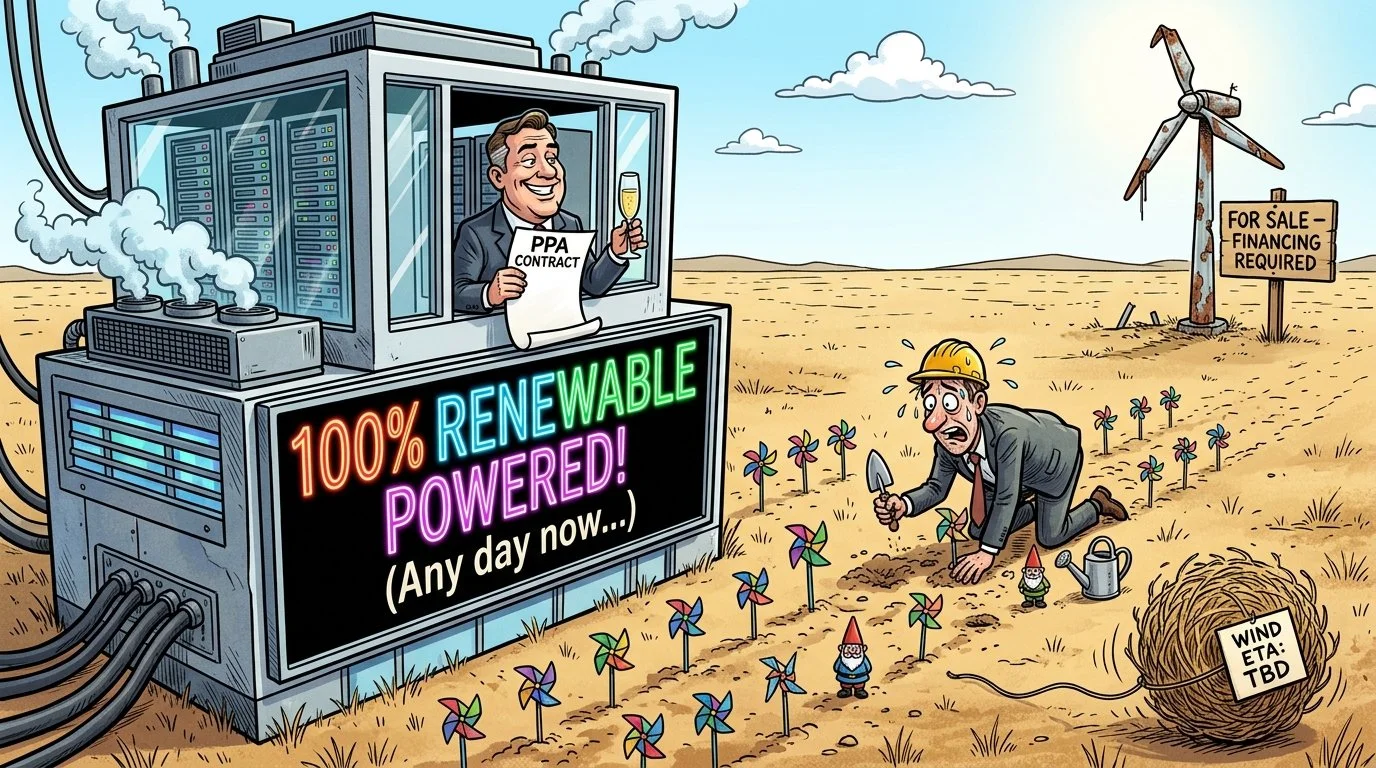
What Is the Wind Farm "Drought"?
Back in mid-2023, Climate Change and Energy Minister Chris Bowen declared Australia would need to build "around 40 wind turbines a month" to meet the 82% renewable target by 2030. More than three years on, the country is falling "short on one particular count." Australia is enduring "something of a new wind farm drought" - and it's threatening to undermine the government's renewable energy ambitions.
The problem, according to David Dixon, an analyst at global energy consultancy Rystad, is economic. Wind turbines simply cost too much to build, at least while wholesale electricity prices remain fairly subdued. "You're basically out of the money," Dixon says.
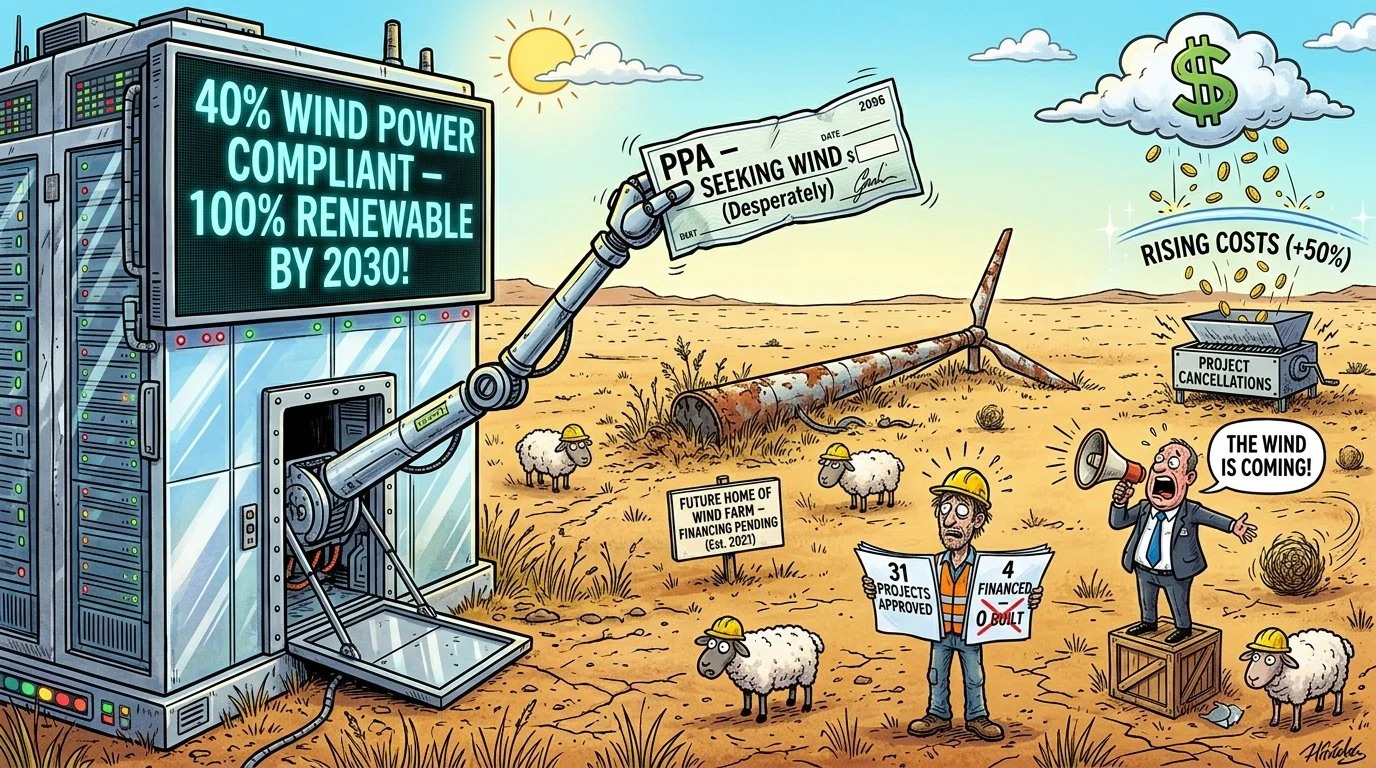
Of the 31 wind projects that have won support through the federal government's Capacity Investment Scheme (CIS)—the flagship program designed to underwrite renewable revenues - just four have reached "financial close." In other words, only four have convinced lenders to actually hand over money to build the turbines.
Why? Because construction costs for wind farms have skyrocketed 30% to 50% since projects bid for government contracts. As Dixon bluntly puts it: "No-one is going to lend money to your project."
The Economics Are "Getting Worse, Not Better"
Origin Energy CEO Frank Calabria paints an even grimmer picture: "The cost of developing a wind farm today is roughly 50% higher than it was in 2020." "Wind projects that were bankable a few years ago, are now finding it very hard to clear the hurdle. That is a problem, because wind is essential to the system we're building."
Origin's own 1.45 GW Yanco Delta Wind Farm - approved for construction in south-west NSW - won CIS support but still hasn't reached a final investment decision. Even with the scheme, Calabria says "the economics of wind remain challenging." "Our problem is not ambition; we want to build this infrastructure. The projects exist. The intent is there. The problem is economics - and it is getting worse, not better. "
NSW: One Wind Farm, Zero Momentum
The scale of the problem is starkest in NSW. Despite being home to Australia's biggest fleet of coal-fired power plants—all due to retire over the coming decade - NSW has just one wind farm currently under construction: Squadron Energy's 414 MW Uungula project.
One wind farm. In the entire state.
That's it.
The NSW government is "scrambling to secure enough new renewable energy capacity to fill the looming shortfall" - but the pipeline of wind projects simply isn't converting from approval to construction.
What This Means for NSW's Data Centre Mandate
The NSW guidelines require data centres to source 40% of their energy from new wind assets that haven't reached Final Investment Decision at the time of contracting. But if wind projects can't get financed in the first place, where will that wind power come from?
The policy is built on an assumption: that new wind projects will be built to supply data centre demand. But the wind farm "drought" shows that assumption is cracking.
If wind projects can't get financed, data centres can't sign PPAs for new wind. If data centres can't sign PPAs, they can't get fast-tracked approval.
It's a vicious cycle - and the industry is already responding. ASL, the company managing key tenders, has quietly changed the rules in NSW, moving away from "lowest price" bids to "best value" to ensure projects can actually secure finance and get built. As ASL CEO Nevenka Codeville put it: "We cannot wait until coal retires for price signals to stimulate investment. We need the investment to happen now. "
The Irony
NSW is mandating data centres to create demand for wind power at the exact moment the wind industry is struggling to get projects financed. The policy designed to rescue struggling wind projects is dependent on a supply pipeline that's drying up.
Meanwhile, Singapore - a densely packed city-state with virtually no domestic renewables - is taking a technology-neutral approach to its 50% green energy requirement, allowing biomethane, hydrogen, and ammonia alongside renewables. It's building a 700MW low-carbon data centre park on Jurong Island, colocating demand with new energy infrastructure.
NSW, by contrast, has bet heavily on a single technology - wind - at a moment when that technology is facing its most severe economic headwinds in years.
The Bottom Line
NSW's 40% wind mandate is bold. But it's built on a foundation that's currently cracking. The wind farm "drought" isn't a temporary blip - it's a structural problem driven by economics, rising costs, and a financing system that can't keep up.
The question isn't just whether data centres can run on wind. It's whether the wind will actually get built in the first place.
And right now, the answer is looking increasingly uncertain.
This follow-up article draws on reporting by Daniel Mercer and Tim Leslie at ABC News: "Wind project 'drought' puts in doubt Australia's green energy targets" (24 August 2026).
For the full article: www.abc.net.au/news/2026-08-25/wind-farm-drought-threatens-australias-renewable-energy-target/107070744
For the official NSW Data Centre Guidelines: www.infrastructure.nsw.gov.au/expert-advice/data-centres/