
Engineers Are Headless No More: How Data, Knowledge, and AI Empower Teams to Lead
Engineers have a thankless superpower: they see the future. They spot structural weaknesses, looming failures, and better ways forward. But too often, that foresight is wasted. Management hears “cheaper is better” while engineers speak the language of physics and resilience. The result? Brilliant proposals get a polite but firm “No, thank you.”
This gap isn’t just frustrating. It’s a liability. In 2026, the cost of ignoring engineering judgment has exploded - from surging data centre energy costs to brittle supply chains. The solution isn’t for one side to “win.” It’s for engineers to stop feeling headless and start leading with their expertise fully weaponised.
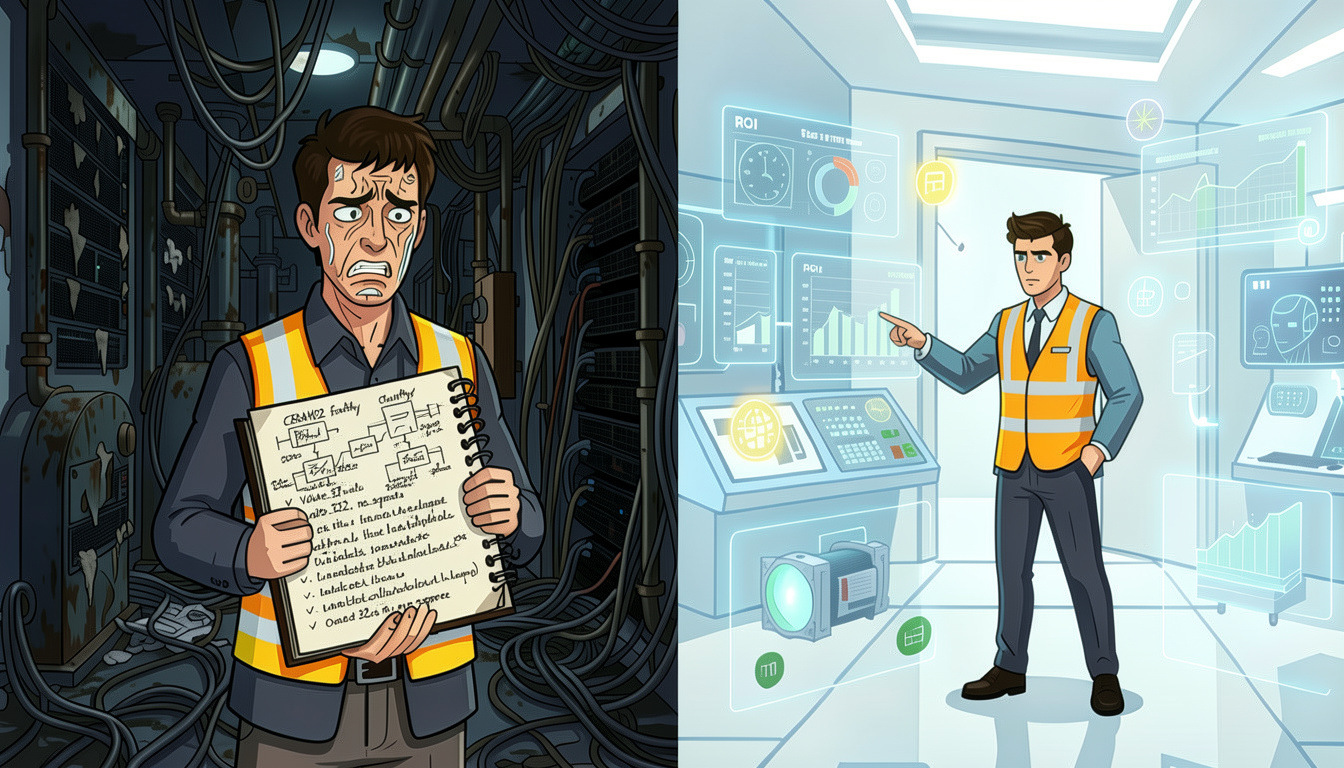
An AI generated image (spot the error!) comparing a stress out engineer with a data-empowered engineer.
Related reading:
Start with the end in mind – why operations, not just design, drive long-term value.
Operational sustainability - separating durable engineering principles from short-term hype.
Here are three practical shifts that make that possible.
1. Justify Actions with Hard Data, Not Hunches
The single biggest reason engineering proposals get rejected? They sound like activity instead of outcome. “We should refactor the cooling system” sounds like a cost. “We can cut energy waste by 22% and prevent three outages a year” sounds like a saving.
Actionable practices:
Start with the business outcome, not the technical solution. Map your initiative to one of four value drivers: grow revenue, protect revenue, reduce cost, or reduce risk.
Model ROI using numbers the business already trusts. For protecting revenue: probability of incident × impact per incident × number of high-value events. Historical downtime figures and conversion losses during outages are language the CFO understands.
Use operational telemetry as your evidence. Pull data from existing control systems or monitoring logs. Identify hidden inefficiencies - like failing to enable free cooling on a chiller when outdoor air is cooler than indoor return air and humidity is below 50%, or worse, enabling it during high heat or humidity and forcing mechanical AC units to work harder. Properly managed free cooling prevents costly humidity spikes and compressor burnout. Quantify the energy waste and equipment risk – then present the fix as a clear saving.
Build a before/after baseline. Measure current performance, model the improvement, and track actual results. This turns “trust me” into “here’s the data.”
Engineers armed with this kind of model aren’t asking for permission. They’re demonstrating inevitability.
2. Turn Knowledge into a Strategic Asset, Not a Walking Risk
When an engineer retires or moves on, their expertise often walks out the door. This isn’t inefficient. It’s a business risk. Yet most organisations still rely on undocumented know-how and fragmented wikis.
Actionable practices:
Automate knowledge capture from daily work. Instead of relying on manual documentation, capture insights from team chat, ticket systems, and meeting notes. The goal: a living memory where a solved bug or a design trade-off is automatically retained and searchable.
Preserve decision context, not just outputs. Record why engineering choices were made, what alternatives were considered, and who owns each decision. This turns tribal knowledge into an auditable asset.
Replace knowledge loss, not people. The aim isn’t automation. It’s ensuring that hard‑won expertise doesn’t disappear when someone moves on. A single source of truth across conversations and documentation cuts time wasted on status updates and knowledge transfer.
Turn learning into applied practice. Passive training (slides, audio) yields less than 10% retention. Applied practice with feedback yields over 70%. Build role‑relevant work simulations - system design walkthroughs, troubleshooting scenarios, or root‑cause analysis drills - and make them part of team upskilling.
The most expensive engineering failure isn’t a blown transformer. It’s the accumulated expertise that walks out the door. Build systems that retain it.
3. Put AI to Work with Clear, Repeatable Actions
AI isn’t just something engineers need to justify. It’s a practical tool you can use today to work smarter, faster, and with harder evidence.
Actionable practices:
Set up predictive alerts using your existing sensor data. Start with one critical asset. Collect three months of operational readings (temperature, vibration, pressure). Use a simple anomaly detection model to learn “normal.” Then configure it to flag deviations before failure occurs. You’ll move from “I think this might fail” to “this component has a 78% probability of failure in the next 10 days.”
Create a digital twin for your most failure-prone system. Even a lightweight model - combining physics equations with real‑time sensor data - can simulate what‑if scenarios. Use it to answer: “What happens if we run this chiller 10% harder? What if we delay fixing the faulty CRAH for two weeks?” Run those scenarios before anyone authorises a change.
Let AI triage your alerts before you see them. Review the last 100 incidents. Which patterns repeat? Train a simple classifier to recognise those patterns. Then set a rule: only escalate alerts that the model can’t explain. You’ll cut noise by 50-80% and spend your time on genuinely new problems.
Embed AI guidance into daily frontline work. For common repair or diagnostic tasks, build a step‑by‑step checklist powered by past solutions. When a technician types a symptom, the system suggests the most likely fix based on similar past cases. This slashes mean time to repair and ensures consistent outcomes even when your most experienced person is on leave.
Run a weekly “AI audit” of your own work. At the end of each week, ask: What decisions did I make that an AI could have made faster? What data did I wish I had? Then build or request one small automation to fill that gap next week.
AI isn’t coming for your job. It’s coming for the tedious parts of your job. Use it to focus on what actually matters.
4. Get the Skills and Support You Need
Knowing what to do is one thing. Having the training and the right partner to execute it is another.
Get hands‑on training: Our AOS Course teaches engineers and leaders how to apply these exact practices—data‑driven justification, knowledge retention, and AI‑augmented operations—in your real environment.
Explore our services: From operational assessments to full implementation, see how we help teams move from “headless” to heads‑up at What We Do.
From Headless to Heads‑Up
None of this means the core problem has disappeared. Management will still be tempted by cheap shortcuts. The engineer will still sometimes be greeted with a blank stare.
But the balance of power has shifted.
Today’s engineer walks into that meeting with data, not hunches. With ROI models built from operational telemetry. With predictive systems that forecast failure before it happens. With knowledge platforms that capture expertise and share it across the team - turning individual brilliance into institutional strength.
The 20‑year lesson remains true: the real value of any system is extracted not by its design but by the quality of its ongoing operation. As volatility makes every watt and every minute count, that lesson has never been more urgent.
Engineers are headless no more. They have the practices, the data, and the AI partners to make their case - and to build systems that actually work.
The only question left: are management teams ready to listen?