
An Australian Perspective
Part 2: Enabling Technologies and Equipment Ecosystem
The Sidecar: A Pragmatic Path
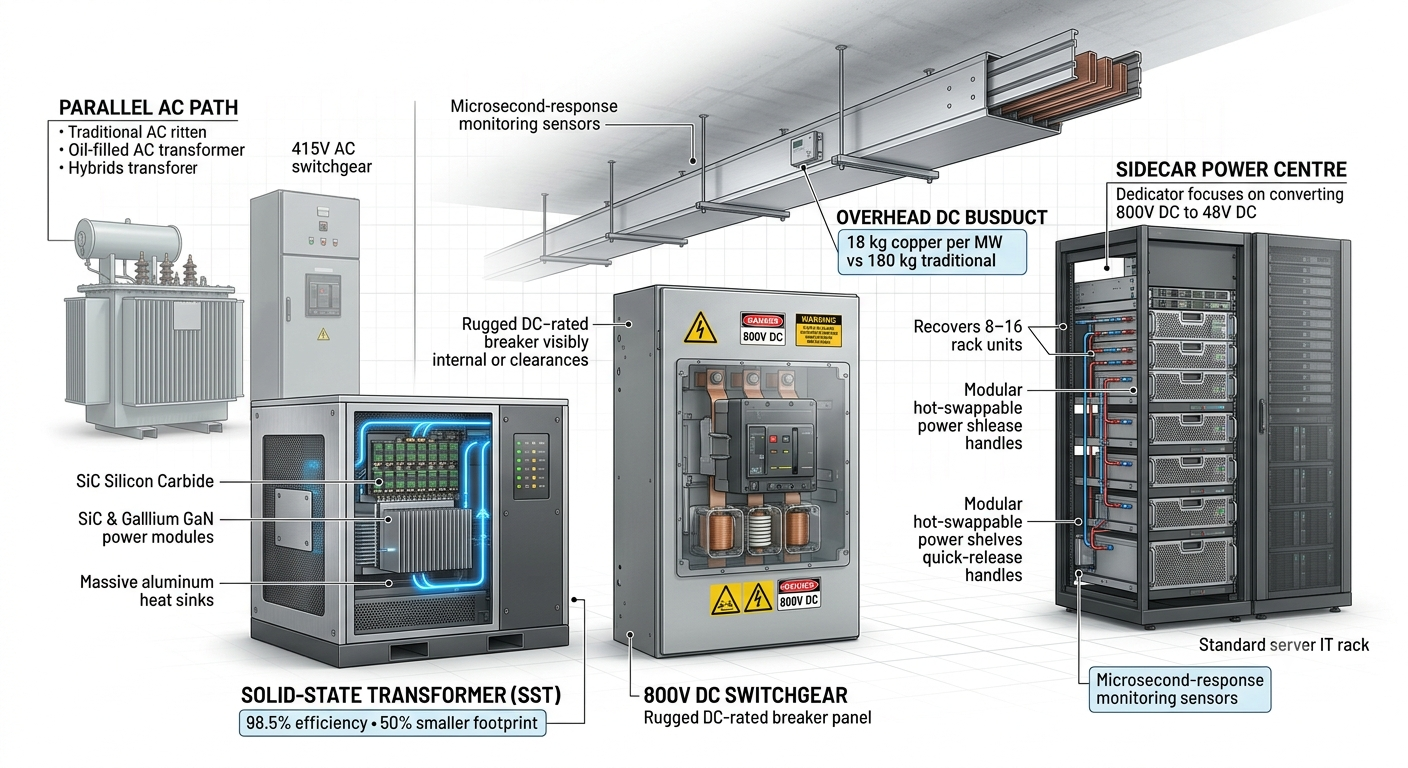
A critical near‑term enabler is the sidecar architecture - a dedicated 800V DC power centre positioned alongside the IT rack rather than integrated within it. This offers several engineering advantages:
Recovers 8-16 rack units previously consumed by power conversion, returning that space to compute
Preserves upstream AC infrastructure, containing the 800V DC transition close to the compute rather than requiring immediate facility‑wide redesign
Enables staged deployment, with 800V DC moving from rack to pod to data hall as standards and customer requirements mature
Schneider Electric's sidecar implementation, developed with NVIDIA, relocates power conversion equipment outside the compute rack, reducing congestion within IT infrastructure while improving energy efficiency. Vertiv's PowerDirect 5000 delivers 400-900 kW directly into the compute over a busbar - and is already being evaluated by Australian colocation providers.
Solid‑State Transformers: The Enabling Technology
The linchpin of the 800 VDC architecture is the solid‑state transformer (SST) . Unlike traditional line‑frequency transformers—which use iron cores, copper windings, and oil cooling - SSTs employ high‑frequency switching with silicon‑carbide (SiC) and gallium‑nitride (GaN) semiconductors to achieve a step‑change in performance.
Key advantages at a glance:
Efficiency: 98.5% vs. ~96–97% for traditional units – that 1.5% difference at megawatt scale translates to tens of kilowatts of saved heat.
Volume & footprint: More than 50% smaller than an equivalent iron‑core transformer – a critical saving in land‑constrained Australian sites.
Single‑stage conversion: Directly converts 11 kV or 22 kV AC to 800 VDC in one step, eliminating the need for separate rectifiers and bulky step‑down transformers.
Availability: Targeting 99.999% (five‑nines) reliability, compared to ~99.99% for traditional units.
Power density: Achieving up to 312 kW/m² – crucial for cramming GW‑scale AI factories into inner‑city brownfield sites.
Vendor offerings (active in the market):
Delta Electronics: Complete SST ecosystem converting medium‑voltage AC directly to an 800V DC bus at 98.5% efficiency. Integrated with their sidecar power shelves and liquid‑cooling CDUs. Already demonstrating 1.1 MW+ rack support.
Sungrow Power (EnerNeo): Supports 10 kV to 13.8 kV AC input, delivering 800V DC output across 1.5–4.5 MW power blocks. Signed framework agreements totalling over 130 MW – including deployments in APAC.
Hitachi Energy: Partnered directly with NVIDIA to develop a "grid‑to‑rack" 800V DC SST architecture specifically supporting the Kyber rack design (576 GPUs, 2027).
ABB: Collaborating with NVIDIA on SST solutions for 1 MW‑class racks, with a focus on grid‑forming capabilities to satisfy AEMO's new interconnection rules.
SolarEdge (in partnership with Infineon): Joint development targeting 13.8–34.5 kV AC to 800–1500V DC conversion, leveraging Infineon's CoolSiC MOSFETs for high‑efficiency switching.
Enphase Energy (IQ SST): A distributed approach using 342 small GaN‑based power modules per 1.25 MW rack – offering granular redundancy (N+1 at module level) which appeals to Australian colocation providers seeking resilience without over‑provisioning whole transformers.
DG Matrix: Interport multi‑port SST platform, already commercially available, supporting 12–34.5 kV AC direct to high‑voltage DC with multiple output ports for both IT and auxiliary loads.
For Australian operators, the takeaway is that SSTs are no longer lab prototypes - they are commercially shippable products with signed offtake agreements. The challenge now is not availability, but local certification: SSTs must comply with AS/NZS 60076 (for transformers) and AS/NZS 3000 (for electrical installations), and the certifying bodies are still developing specific testing regimes for high‑frequency SiC‑based units.
Vendor Landscape: Power and Distribution Equipment
Beyond SSTs, the broader equipment ecosystem is rapidly maturing:
Vertiv: 800V DC platform expected in the second half of 2026, aligned with NVIDIA's 2027 deployment plans. Includes centralised rectifiers, high‑efficiency DC busducts, and rack‑level DC‑DC converters.
Eaton: Launched 800V power architectures for NVIDIA AI factories, integrating supercapacitors and high‑efficiency busbar distribution technology compliant with ORV3 standards.
Siemens: Already presented a complete 800V HVDC architecture through Data Centre Solution 5.0, supplemented by DC protection and switchgear product lines (3WD series, rated for 2,000 A and breaking capacities up to 65 kA).
Schneider Electric: Sidecar implementation developed with NVIDIA, relocating power conversion outside the compute rack.
Australian Context: Market and Regulatory Realities
Australia's data centre market is in a rapid growth phase, with deployable capacity forecast to nearly double from roughly 1,350 MW to over 3,100 MW by 2030, driven largely by AI-focused builds. The pragmatic reality, however, is that grid interconnection - not hardware availability - is emerging as the single largest project risk for new facilities.
On the regulatory front, the Australian Energy Market Commission (AEMC) has released draft rule changes specifically targeting inverter‑based loads like large data centres. The proposed framework requires large facilities to self‑insure new electricity supply and bear the full cost of grid connection, preventing pressure from being passed onto household and business electricity bills. Meanwhile, the Australian Energy Market Operator's (AEMO) "Package 2" rule change is directly driven by the projected growth of gigawatt‑scale campuses, enforcing stringent requirements for fault ride‑through, reactive power support, and fast‑frequency response.
What does this mean for 800 VDC? It turns a regulatory burden into a genuine engineering advantage. The 800 VDC architecture - with its parallel BESS and supercapacitors - inherently provides fast‑ramp capabilities and grid‑forming characteristics. A well‑designed 800V DC facility is substantially easier to connect under the new AEMO regime compared to a traditional transformer‑and‑UPS AC plant, which requires bulky additional harmonic filters and reactive compensation to achieve similar grid compliance.
From a density perspective, Australian operators across Sydney's industrial zones and Melbourne's emerging tech corridors are already designing for rack loads north of 100 kW. The practical ceiling for 48V distribution sits around 60-80 kW before copper losses and cable bulk become unmanageable. This means any new AI‑capable facility commissioned from 2027 onwards must adopt 800V DC distribution for the IT pod, or risk being stranded capacity unable to host Blackwell Ultra, Rubin, and subsequent GPU generations. The density threshold is not a future hypothetical - it is already being factored into tender documents for new builds in New South Wales and Victoria.
Land constraints compound the issue. Established data centre corridors in Sydney's western suburbs and Melbourne's outer fringe are tightly held, with land values escalating. The >50% footprint reduction offered by solid‑state transformers compared to traditional iron‑core units makes the 800 VDC transition highly attractive for brownfield redevelopment.
Critically, the grid connection timeline is now often the critical path for project delivery. AEMO's strict new modelling requirements for large loads mean that connection agreements are taking 12-18 months to secure - longer than the lead time for SST procurement. Operators who engage early with their local network service provider (e.g., Ausgrid, Endeavour Energy, CitiPower, or Powercor) and present a clear 800 VDC architecture with inherent grid‑support features are finding the approval pathway smoother than those pushing traditional 415 VAC plant.
In short, the Australian market is not adopting 800 VDC out of enthusiasm for new technology. It is adopting it because the physics of AI density, the tightening of AEMO's connection rules, and the brutal economics of land and copper are forcing the transition.
[End of Part 2]
Continue to Part 3 for the deep technical dive: DC fault protection, Tier III/IV reliability challenges, and on‑site generator integration.