
Powering the Future: Practical Steps for Data Centre Energy and Sustainability in Australia and APAC
Australia and APAC are on the cusp of an infrastructure revolution - and the professionals who understand the energy story behind it will be the ones who shape its future.
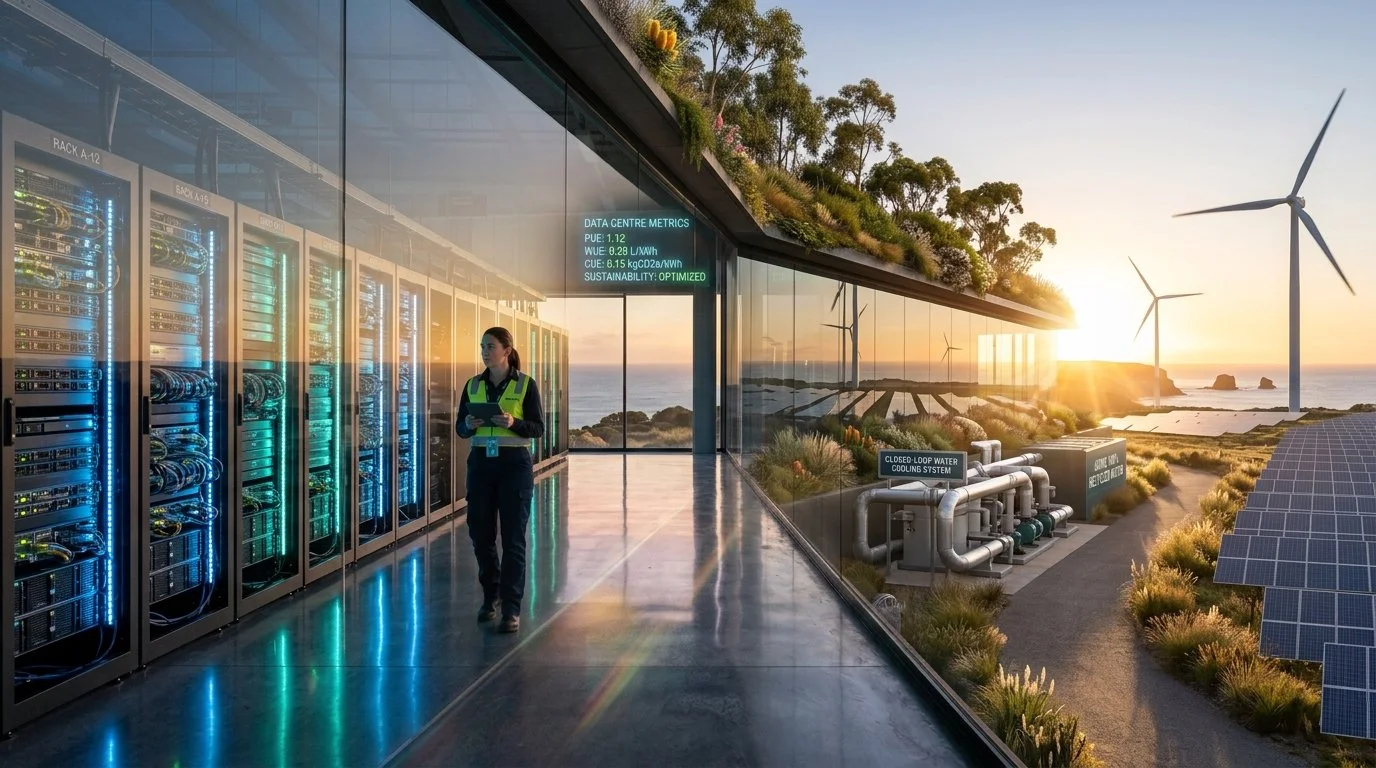
The Boom Is Real. The Pressure Is Even More Real.
Data centres have quietly become the backbone of modern life. From streaming and cloud storage to the AI systems that are rapidly transforming every industry, the demand for digital services continues to accelerate. In Australia alone, data centres consumed approximately 4 TWh of electricity in 2024–25, accounting for around 2% of total grid-supplied electricity - a figure expected to grow to up to 6% by 2030. The Australian Energy Market Operator (AEMO) forecasts consumption could reach 12 TWh by 2029–30, equivalent to 6% of the National Electricity Market's grid-supplied electricity.
Across the Asia-Pacific, the picture is even more dramatic. APAC data centre power capacity is projected to grow from 16 GW in 2025 to 70 GW in 2030 - a 4.4-fold increase - with Australia among the five fastest-growing markets in the region. Data centre electricity consumption in Asia Pacific could grow from under 200 TWh in 2025 to more than 1,000 TWh by the mid-2030s.
This growth is not just a technical challenge. It is a business, regulatory, and reputational challenge. As energy demands and sustainability expectations evolve, organisations need professionals who understand both the technical and business implications of energy and environmental performance.
The Metrics That Matter: Beyond PUE
For years, the data centre industry has fixated on a single metric: Power Usage Effectiveness (PUE). But PUE alone fails to capture the full environmental impact of a facility. A more holistic view combines three key metrics:
| Metric | What It Measures | Why It Matters |
|---|---|---|
| PUE (Power Usage Effectiveness) |
Ratio of total facility power to IT equipment power. Ideal is 1.0. | Measures energy efficiency of infrastructure. |
| WUE (Water Usage Effectiveness) |
Litres of water consumed per kWh of IT load. | Critical in water-stressed regions like Australia. |
| CUE (Carbon Usage Effectiveness) |
Total carbon emissions relative to IT energy consumption. | Tracks progress towards net-zero goals. |
Leading operators in Australia are already achieving impressive figures. AWS's Sydney region achieved an average PUE of 1.1 and WUE of 0.10 L/kWh in 2025. OVHcloud's Sydney facility boasts a PUE of 1.29, WUE of 0.30 L/kWh, and CUE of 0.18. AirTrunk's A$4.6 billion sustainability-linked loan was the first to utilise CUE as a key performance indicator.
The Australian Regulatory Landscape Is Shifting Fast
The pressure to get this right is intensifying. In March 2026, the Federal Government released its Data Centres and AI Infrastructure Developer Expectations document, setting national resource-consumption caps for the first time.
Key requirements include:
New facilities must achieve a PUE of 1.3 by 2027 — among the toughest standards globally.
Existing facilities must retrofit to PUE 1.5 by 2030, or face significant penalties.
A national water-use efficiency (WUE) cap of 0.4 L/kWh applies to all facilities over 5 MW.
From July 2026, mandatory real-time resource data reporting to the Clean Energy Regulator comes into effect.
Any facility hosting government workloads must achieve a NABERS Energy rating of 5 stars, typically translating to a PUE below 1.4.
The Government is pushing new data centres to build their own renewable energy generation rather than drawing from the grid.
New South Wales has introduced world-leading guidelines with Design PUE ≤1.25 and tight Water Usage Effectiveness targets, measured to ISO standard at 100% IT load. Design WUE targets are set at ≤1.0 for potable water or ≤1.6 for non-potable water, with mandatory drought resilience and recycled water measures.
The Clean Energy Council has proposed a Flexible Contracting Framework requiring data centre operators to match their grid electricity consumption with Additional Firmed Renewables (AFRs), supported by certificates. The Renewable Energy Guarantee of Origin (REGO) scheme commenced on 3 November 2025, issuing digital certificates for each megawatt-hour of renewable electricity generated.
APAC Regulatory Snapshot
The regulatory environment across APAC is tightening in different ways across key markets:
Singapore - New facilities must achieve PUE ≤1.25 at 100% IT load. The Green Mark certification requires PUE at 25% IT load of 1.39 or better. At least 50% of power must come from eligible green energy pathways
Japan - Operators must achieve an average PUE ≤1.4 by 2030. New facilities from 2029 onwards must achieve PUE ≤1.3 within two years of operation
Malaysia, South Korea - Regulators are moving towards frameworks tied to energy efficiency, renewable energy procurement, and grid impact assessments to raise barriers to market entry
India - Governments are directing data centre development to regions with stronger grid availability and lower-carbon power supplies
Across the region, regulators are increasingly requiring data centres to share responsibility for grid reliability, flexibility, and decarbonization - moving away from traditional utility agreements
Practical Steps You Can Take Today
Before you even think about formal training, there are practical actions you can take right now. The industry's fixation on rack density at all costs is a trap — Uptime Institute's 2026 Global Data Center Survey reveals that pushing beyond 20–25 kW per rack delivers diminishing capital cost savings, as the specialised power and cooling gear required at extreme densities actually commands a cost premium.
Here are three less obvious steps that challenge conventional thinking:
1. Standardise on 2U Chassis Instead of 1U for Your Server Fleet
This is one of the most overlooked recommendations in the industry. While the instinct is to pack more compute into every cabinet, the 2026 survey data suggests a different approach. A 2U chassis can accommodate higher-performing CPUs and GPUs with better airflow and thermal headroom, often reducing the need for aggressive cooling and allowing you to operate at a more efficient point on the density curve. The "density at all costs" mantra ignores the real trade-offs in capital cost, operational complexity, and cooling efficiency.
2. Treat Grid Support as a Commercial Opportunity, Not Just a Compliance Cost
Regulators across APAC are increasingly requiring data centres to provide grid support services in exchange for power access. In Australia, rules have been proposed requiring facilities over 30 MW to remain connected during voltage and frequency disturbances and recover demand in a controlled manner following grid events. Rather than viewing this as a burden, operators can turn demand flexibility into a commercial advantage by identifying flexible loads, batteries, and thermal storage that can be monetised or used to reduce network and energy costs. In Japan, regulators are considering frameworks that allow facilities to connect before grid reinforcements are completed, provided operators install load-shedding capabilities or battery storage.
3. Plan for the 10-Year Obsolescence Cliff
The eCANET Engineers blog highlights a critical but often overlooked issue: the 10-year obsolescence cliff in data centre infrastructure. Cooling systems, power distribution units, and even building management systems have finite lifespans. Planning for phased replacement and choosing modular, upgradeable components can prevent stranded assets and ensure your facility remains compliant with tightening PUE and WUE requirements. This forward-looking approach is far more cost-effective than reactive retrofits when regulations change.
Additional practical actions:
Prioritise recycled water and non-potable sources for cooling systems, engaging early with water utilities on infrastructure and transparent reporting.
Map your Scope 1, 2, and 3 emissions — from backup diesel generators (Scope 1), purchased electricity (Scope 2), and third-party services (Scope 3).
Consider accredited GreenPower and develop a renewable energy procurement roadmap that includes PPAs and firmed renewable solutions.
Move early on grid connections — get connection feasibility and network capacity advice before committing to expansion.
Introducing: Energy and Sustainability Fundamentals
Uptime Institute’s Energy and Sustainability Fundamentals (ESF) course is a practical, self-paced introduction to the energy and sustainability issues shaping modern data centres. Delivered online through Uptime Education, it takes around 6-8 hours to complete.
The course explains how energy enters, moves through and leaves a data centre — and how sustainability decisions affect performance, risk, compliance and long-term business success. Topics include data centre fundamentals, energy use, PUE/WUE/CUE and other metrics, IT equipment, power, cooling, water, carbon accounting, reporting and regulation, energy procurement, financial fundamentals, business strategy and energy reuse.
It is designed for professionals who are new to data centre energy or sustainability, or who support operations, facilities, engineering, procurement, finance or business strategy. It is also a strong foundation for anyone preparing for advanced Uptime Institute credentials such as CDCAP®, CDCEP®, CDCSP® or the Accredited Sustainability Advisor (ASA) program.
Download the full course brochure here.
Ready to Enrol?
With Australian and APAC regulations tightening around PUE, WUE, carbon reporting and renewable procurement, energy and sustainability literacy is becoming a core professional skill — not a niche specialisation. The ESF course gives you the foundational knowledge to engage confidently in those conversations and decisions.
👉 Enrol in Energy and Sustainability Fundamentals today and position yourself at the forefront of sustainable digital infrastructure. For enrolment details, contact us.