
The Great Data Centre Decarbonisation Circus: A Semi-Serious Field Guide for APAC and Australia
Warning: This article contains sarcasm, carbon, and at least one joke about regulators. Reader discretion is advised. The technical bits are real. The tone is not.
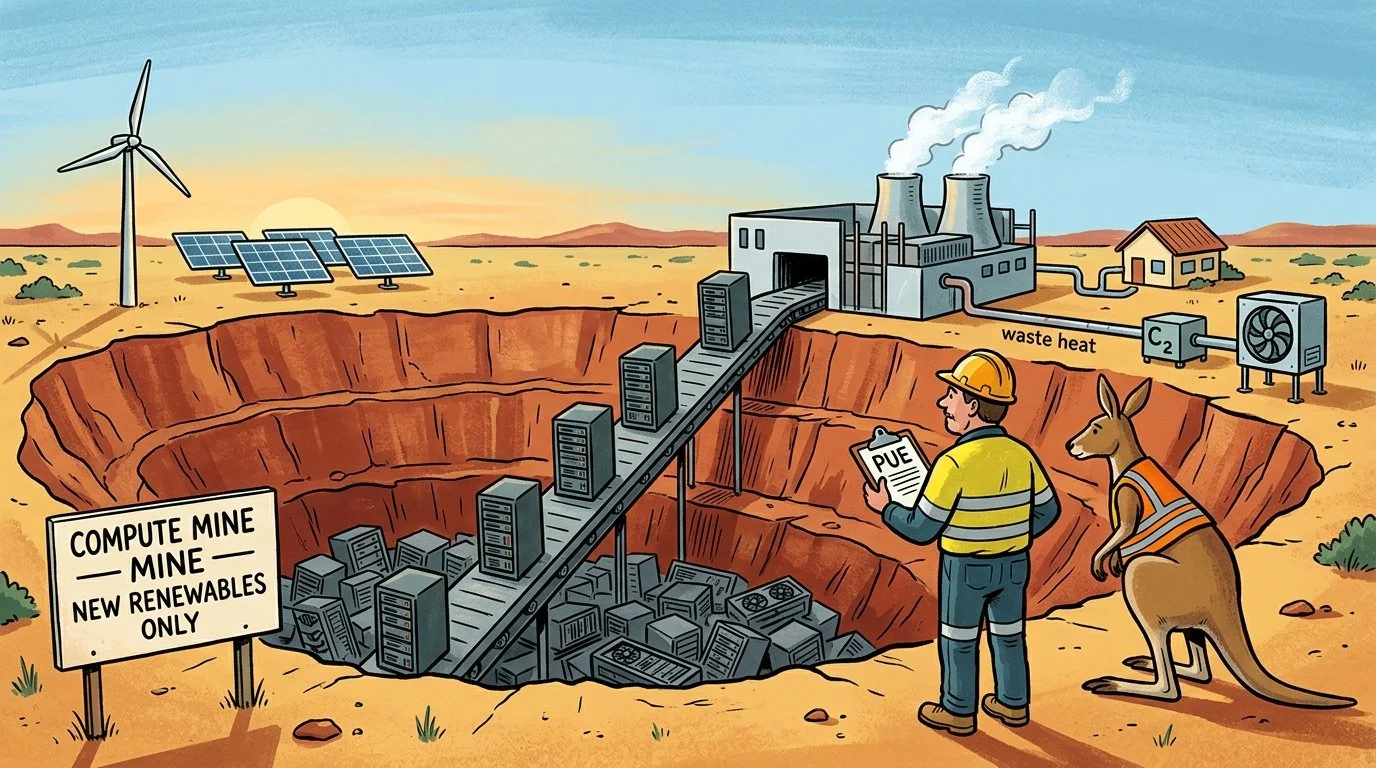
Act I: The Context - AI’s Infinite Appetite Meets Physics
Data centres are the new cathedrals of the digital age. Except instead of worshippers, they have GPUs. Instead of incense, they have hot air. And instead of collection plates, they have power purchase agreements.
The problem is simple: AI is hungry. In 2024, data centres consumed roughly 1.5% of global electricity. By 2030, that figure is projected to double. In the EU alone, capacity is expected to exceed 28 GW by 2030, pushing electricity consumption beyond the current 2.5% share. By 2025, the sector was responsible for over 0.5% of global CO₂ emissions. Without intervention, that footprint could double or quadruple.
The cloud, it turns out, is not weightless. It is just someone else’s smokestack.
The Serious Bit: The sector’s absolute emissions are rising even as efficiency improves. Policy is shifting from voluntary guidelines to mandatory requirements. The era of “we’ll report it next year” is ending.
Act II: The Rules - A Choose-Your-Own-Adventure Regulatory Novel
If you enjoy reading legal documents written by committees who have never met a semicolon they didn’t like, you are in luck. Data centre decarbonisation regulation is a patchwork quilt stitched together by people with very different ideas about what “urgent” means.
European Union: The Overachiever
The EU is the teacher’s pet of data centre regulation. Under the Energy Efficiency Directive (EED), data centres with installed IT power of 500 kW or more must report KPIs on energy and water consumption, cooling efficiency, and waste heat use to a European database. Facilities over 1 MW must reuse waste heat unless they can prove it is technically or economically infeasible. France goes further, requiring operators to reuse at least 20% of excess heat.
The EU is also developing minimum energy-efficiency standards and a sustainability label covering water use and clean energy supply. The “needs assessment” is due by 2027, which in regulatory time is basically tomorrow.
United Kingdom: The Quiet Achiever
The UK relies on Streamlined Energy and Carbon Reporting (SECR). Large companies must report energy use, greenhouse gas emissions, and energy efficiency actions. Scope 3 emissions reporting is voluntary but strongly encouraged—like flossing, but with more paperwork.
United States: The Fragmented Republic
The US approach is a mix of federal ambition and state-level chaos. Bills like the Data Center Water and Energy Transparency Act of 2026 and the Data Infrastructure Energy Measurement and Standards Act aim to mandate reporting and direct NIST and the DOE to develop best practices. California, as ever, is ahead: AB 1577 mandates monthly reporting of water and energy metrics, while SB 886 creates a dedicated tariff requiring data centres to bear full grid interconnection and clean energy costs.
APAC and Australia: The Wild Frontier
APAC is not a single market. It is a collection of national experiments in energy policy, water scarcity, and AI-driven growth.
Australia is legislating binding national standards. New data centres must fully offset electricity demand with new renewable generation and demonstrate firmed capacity - batteries, gas, or something that keeps the lights on when the sun goes down. They must register with AEMO, and facilities over 30 MW must actively support grid stability. Energy Minister Chris Bowen has insisted there will be “no exceptions and no carve-outs.”
In New South Wales, the Southern Hemisphere’s largest data centre is targeting a market-leading WUE of 0.01 through air-based cooling with reused chilled water. NABERS provides a 1-to-6 star rating, and some government procurement now requires 5 stars or PUE ≤ 1.4. The NGER Act requires large operators to report energy and emissions.
Singapore has the Green Data Centre Roadmap, aiming to add at least 300 MW while improving efficiency. SS 715:2025 targets IT equipment efficiency, and the Tropical DC Standard allows higher operating temperatures, cutting cooling energy by 2–5%. Because in Singapore, air conditioning is not a personality trait—it is a regulatory variable.
Malaysia has mandatory Data Centre Sustainability Guidelines, requiring disclosure of PUE, CUE, and WUE, with a plan to tighten the WUE cap from 2.2 to 2.0 m³/MWh over ten years.
Japan is promoting “Watt-Bit Collaboration”—coordinated power and communications infrastructure. It sounds like a buddy cop movie, but it is actually a grid strategy.
South Korea introduced K-RE100, allowing renewable procurement through bilateral PPAs. India lets some states treat data centre developers as distribution licensees, enabling direct power procurement.
The Serious Bit: International standards like ISO/IEC 30134 define KPIs including PUE, REF, and ERF. The Greening AI Data Centres Coalition and OCP/iMasons are working on aligned environmental and social performance standards.
Act III: Practical Measures - The Industry’s Greatest Hits
Operators are deploying a familiar playlist of decarbonisation strategies. Some are genuinely impressive. Some are carbon accounting with extra steps.
Energy Efficiency and Cooling
PUE is the golf score of data centres: lower is better, and everyone claims they are better than they are. Google reported a trailing-twelve-month PUE of 1.09 across its global fleet. Liquid cooling—direct-to-chip and immersion—can cut cooling energy by roughly 30%. AI is also being used to optimise cooling in real time, which is either elegant or terrifying, depending on your view of machines optimising machines.
Keppel and Shell launched a pilot in Singapore using Gas-to-Liquids (GTL) immersion cooling fluid, expected to improve energy efficiency by up to 48% compared to air cooling.
Renewable Energy and Carbon-Aware Operations
PPAs are carbon indulgences with better lawyers. Amazon signed nine new PPAs in Australia totalling 430 MW, lifting its Australian renewable portfolio to 990 MW across 20 projects, supporting its AU$20 billion data centre expansion. Google is nearing completion of the Mulwala solar farm in NSW.
Carbon-aware scheduling shifts delay-tolerant workloads away from high-carbon periods, achieving up to 7% carbon reduction. It is like doing laundry at 2 a.m., but for billion-dollar GPUs.
24/7 Carbon-Free Energy moves beyond annual matching to hourly matching—because hourly matching is the new gluten-free.
Waste Heat Recovery
Your GPU’s fever dream can heat Finnish homes. A Microsoft cluster in Finland is expected to provide roughly 40% of Espoo’s district heating. The EU-funded MODERATOR project uses phase-change materials for low-temperature heat recovery. In Australia, waste heat could supply district heating or nearby industrial users, particularly in cooler climates like Melbourne.
Water Stewardship
Data centres are discovering that water is not just for cooling and crying over PUE. Water-neutral strategies include avoiding water-based cooling, maximising cycles of concentration, and rainwater harvesting. Some regions, like Kansas, are proposing legislation to require closed-loop cooling. The NSW facility targeting WUE 0.01 shows what is possible when air-based cooling and reused chilled water are designed in from the start.
Embodied Carbon and Circularity
Embodied carbon is the carbon you emit before you even switch on—like a debutante ball for concrete. Reducing it means using low-carbon steel and concrete, sourcing locally, and reusing materials from decommissioned buildings. The goal is 100% reuse, reusability, or recyclability, with no output to landfill or incineration.
Backup Power
Bridge Data Centres in Singapore piloted Hydrotreated Vegetable Oil (HVO) for backup generators, reducing lifecycle GHG emissions by up to 94.4% versus fossil diesel. It is like converting your emergency generator to a vegetarian.
Act IV: Cross-Industry Strategies - Heavy Industry Lends Its Toys
Heavy industry has been decarbonising for longer than data centres have existed. Some of its tools are now being adapted.
Carbon Capture, Utilisation, and Storage (CCUS)
CCUS is the industry’s favourite “get out of jail free” card. The jail is the atmosphere. The card costs billions and may not work at scale. But it is being taken seriously.
The primary application is powering data centres with natural gas combined cycle (NGCC) plants equipped with CCS. A Rice University study estimates that with CCS and underground saline aquifers, more than 90% of data centre-related CO₂ emissions could be mitigated. A planned hyperscale campus in Utah aims to capture CO₂ and convert it into low-carbon fuels.
In Australia, Pilot Energy partnered with Kala Data to launch modular data centres at its Arrowsmith facility in Western Australia. The deal generates early cash flow to help fund Pilot’s Cliff Head carbon storage project, Australia’s first offshore CO₂ storage initiative. It is a symbiotic relationship: the data centre helps finance the carbon capture, and the carbon capture helps justify the data centre.
Direct Air Capture (DAC) Powered by Waste Heat
Finally, a use for hot air from servers and earnings calls. DAC requires heat to release captured CO₂ from filters. Data centres produce low-grade waste heat. NEG8 Carbon notes that using data centre waste heat can reduce a DAC unit’s energy consumption by 71%.
Microsoft’s “DACinDC” pilot integrates DAC directly into data centre infrastructure, using waste heat from computing workloads. The company reports it has shown promise in offsetting the carbon footprint of AI workloads. A similar project in Massachusetts is exploring pairing data centres with DAC facilities.
On-Site, Low-Carbon Power Generation
When the grid is slow, build your own. Solid oxide fuel cells (SOFCs) can run on natural gas today and transition to hydrogen or biogas, and are inherently suited to carbon capture. Hydrogen fuel cells are being explored for base load power, with gas engines for load-following.
Fortescue is investing nearly AU$1 billion in an off-grid renewable energy system in the Pilbara. Initially for iron ore mines, the “green grid” is being opened to data centre developers seeking rapid, 100% renewable power. What could go wrong? Don’t answer, Western Australia.
Act V: Challenges and Opportunities - The Hangover
Challenges:
The speed of AI infrastructure development is outstripping supporting infrastructure, such as recycled water pipelines.
Regulatory fragmentation across APAC creates compliance complexity.
Water scarcity in Australia and parts of APAC demands closed-loop and air-based cooling.
CCUS and DAC remain costly and energy-intensive, though waste-heat integration improves viability.
Opportunities:
Data centres can become active participants in energy and resource ecosystems—providing grid stability, district heating, and carbon removal.
Australia’s national framework and Singapore’s tropical standards are becoming testbeds for innovation.
Symbiotic models—such as data centres financing carbon storage or sharing waste heat with DAC—create new revenue and sustainability pathways.
The sector is moving from passive electricity consumer to active contributor. Also known as “from problem to solution, if the PowerPoint holds.”
Conclusion: The Physics Doesn’t Care About Your PR
Decarbonising data centres is not a vibe. It is a spreadsheet, a PPA, a liquid cooling loop, and a regulator with teeth. The good news: the tools exist. The bad news: so does the next AI model.
From EU reporting mandates to Australia’s binding renewable offsetting rules, from liquid cooling and waste-heat district heating to CCUS and waste-heat-powered DAC, the industry is being dragged—sometimes willingly, sometimes by the ear—into the energy transition.
The next decade will determine whether data centres can scale with AI while aligning with national decarbonisation goals. The physics does not care about your marketing. But it does respond to engineering, policy, and money. Fortunately, the industry has plenty of the latter. The question is whether it has enough of the first two.
This article is satire-adjacent. Verify regulations before making investment decisions, or better yet, ask a lawyer with a sense of humour.