
The New Rules of Generator Reliability
Part 2: The Economics of Smarter Testing - Global Fuel Costs, HVO, and the 60-Second Solution
How operators are saving millions by cutting test hours without compromising uptime
In Part 1, we examined how the AI revolution has turned diesel generators into a sprawling, parallel fossil fleet – and how traditional short-run testing regimes are actually compromising reliability by clogging DPFs and failing to activate SCR systems.
But the economic case for overhauling generator testing is just as compelling. With diesel prices climbing worldwide and supply chains under extreme pressure, every unnecessary minute of run time costs real money.
The Australian Fuel Price Reality: A Litre-by-Litre Breakdown
Diesel prices in Australia have been on a rollercoaster ride, driven by geopolitical tensions and global supply disruptions. For data centre operators, this volatility translates directly to operational costs.
Australian Diesel Prices (May 2026)
As of late May 2026, the average diesel price in Australia sits at AUD 2.21 per litre. But this average masks significant volatility:
In mid-April 2026, prices peaked at AUD 2.76 per litre (approx USD 1.97/L)
Regional and remote areas have been hit even harder, with some locations exceeding AUD 3.39 per litre
In New South Wales, diesel spiked to 285.8 cents a litre before falling to 208.3 cents after the federal government's fuel excise cut
What's Driving the Spike?
The primary catalyst is ongoing conflict in the Middle East, which has disrupted global fuel supplies through the Strait of Hormuz - a critical chokepoint for crude oil shipments. Singapore Gasoil 10ppm sulphur – the international benchmark that drives Australian diesel prices – is now tracking at significant premiums.
The Australian government responded with a 50% reduction in the fuel excise (equivalent to 26.3 cents per litre) beginning 1 April 2026. While this provided some relief, prices remain substantially elevated compared to historical averages. Diesel is still 20 cents per litre higher than the monthly average before the US-Iran conflict.
The Global Context
Australia is not alone in facing high diesel prices. The global average diesel price stands at approximately USD 1.54 per litre – a 5.81% increase over the previous quarter and an 8.50% increase year-over-year.
For Australian data centre operators, these numbers are particularly concerning given the country's reliance on imported fuel and the limited domestic refining capacity.
The Operational Impact: What It Costs to Run a Generator
For a large-scale data centre, the numbers are sobering:
For every GW of data centre capacity, roughly $2.5 billion is spent on diesel gensets
Annual operating expenses (mostly testing) amount to $75 million
Around 40 million litres of diesel must be stored on-site for a large facility
With diesel at AUD 2.21 per litre, that 40 million litres represents $88.4 million in stored fuel alone. Every unnecessary test run adds to that cost.
Consider a 500 MW AI campus with typical testing regimes:
Monthly 15-minute tests across all generators: approximately 1,560 hours of run time per year across the fleet
Fuel consumption at low load: roughly 300 litres per hour per MW (estimated)
Annual fuel cost for testing: $2.3 million at current Australian diesel prices
Annual CO₂ emissions from testing: approximately 5,600 tonnes
Reduce those monthly tests to 60 seconds, and you've cut 92% of the testing fuel burn - saving over $2.1 million annually and reducing emissions by more than 5,100 tonnes of CO₂.
The Supply Chain Squeeze
The fuel price crisis is compounded by supply chain constraints. The global diesel generator market is projected to reach $22.6 billion in 2026, with demand for 42,000 units. Manufacturers simply cannot keep pace.
For operators already struggling to secure generators, the last thing they need is to burn expensive fuel on unnecessary test runs. As one analyst noted, "the diesel constraint is the binding factor for data centre TCO through at least Q3 2026."
The 60-Second Solution
Given these economic realities, the Cummins white paper makes a striking, data-driven recommendation: for low-load test protocols, optimise the procedure by reducing runtime to just 60 seconds.
Why? Because frequent generator tests conducted under minimal load for 10–15 minutes offer no reliability advantage over equivalent tests limited to 60 seconds. If you are going to do a no-load test, a minute is enough to confirm the engine starts, reaches rated speed, and the basic systems are functioning. Running it for 15 minutes doesn't add reliability value – it just burns expensive fuel, generates emissions, and accelerates DPF clogging.
The Trade-Off Matrix
The Cummins white paper provides a detailed table showing the relative impact of different test durations:
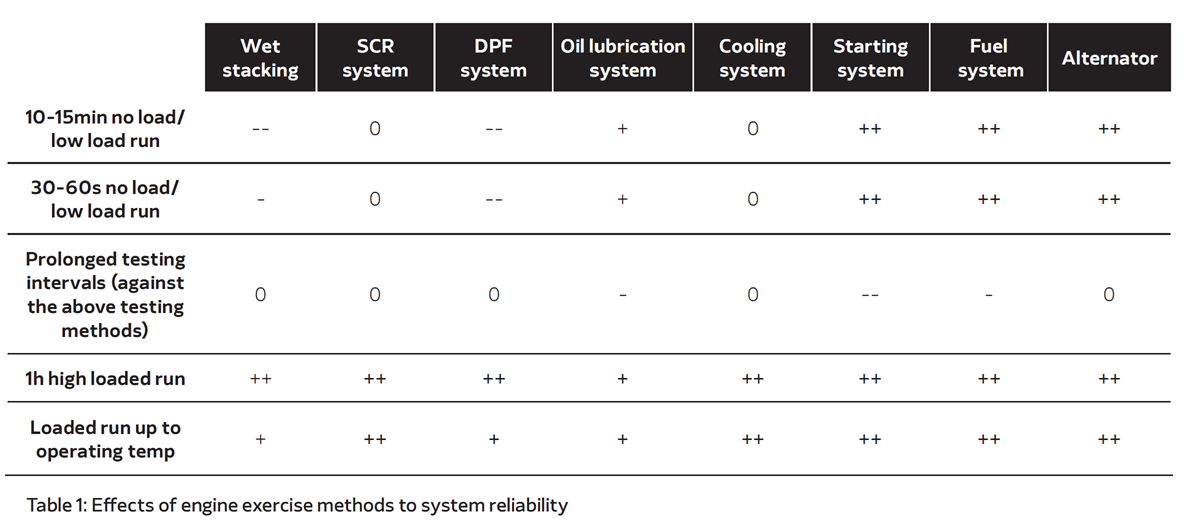
Source: Cummins white paper
The data is clear: the 10-15 minute no-load run is the worst of both worlds – it consumes fuel and creates emissions without materially improving reliability.
Beyond Fossil Diesel: The Rise of Renewable Alternatives
As fuel prices climb and sustainability pressures mount, the data centre industry is increasingly looking beyond conventional diesel. Hydrotreated Vegetable Oil (HVO) – also known as renewable diesel – has emerged as the leading alternative.
What is HVO?
HVO is a next-generation renewable fuel derived from 100% waste-based feedstock – including used cooking oils, animal fats, and other residual materials. It serves as a high-quality "drop-in" substitute for conventional fossil diesel, meaning it requires no modifications to existing backup generators.
Environmental Benefits
The emissions reductions are substantial. HVO can reduce lifecycle greenhouse gas emissions by up to 90% compared to fossil diesel. It also burns more cleanly, cutting particulate emissions by more than 40% and nitrogen oxide emissions by up to 8%.
Perhaps most importantly for standby applications, HVO offers superior storage stability – it can be stored for up to 10 years without degradation. This makes it ideal for generators that may sit idle for months at a time, addressing one of the key concerns with traditional biodiesel (FAME), which can degrade and cause filter plugging.
Industry Adoption
The data centre industry is already moving. Bridge Data Centres recently completed the inaugural HVO-powered backup fuel pilot in Asia Pacific, covering the full range of emergency backup power scenarios including generator startup, load transfer, and sustained operations under data centre conditions - with all performance and emissions targets met. The company intends to further deploy HVO-powered solutions across its data centre campus in Asia Pacific and beyond.
Rolls-Royce Power Systems has published a position paper with Microsoft highlighting HVO's potential as a sustainable transitional fuel for backup power in data centres. HVO has already been used by data centres in Europe for over a decade and is approved for use in Caterpillar, Kohler, and Cummins generators.
The Australian HVO Challenge
In Australia, HVO adoption faces a significant hurdle: there is currently no domestic production. Renewable diesel must be imported, making it expensive and logistically challenging.
In Australia, HVO can cost almost $5 per litre compared to fossil diesel at just under $2 per litre
The lack of local production means supply is limited and subject to global competition
However, as global demand increases and production capacity expands, prices are expected to decrease
Is HVO Worth the Premium?
Despite the current cost premium, HVO offers strategic value beyond emissions reduction:
Permitting relief: In regions with strict air quality requirements, HVO's cleaner combustion can help operators secure permits that might otherwise be denied
Fuel stability: The 10-year shelf life eliminates concerns about fuel degradation during extended idle periods
Sustainability leadership: For operators with aggressive net-zero commitments, HVO provides an immediately deployable solution that works with existing infrastructure
Price hedging: While HVO is currently more expensive, the gap narrows when fossil diesel prices spike – as we are seeing in 2026
What Actually Matters: The Three Critical Subsystems
To safely extend testing intervals to 6-12 months, operators must focus on three key areas:
1. Lubrication System
Engine oil film degrades over time. The most robust solution is a pre-lube pump that pressurises the oil multiple times a day, ensuring optimal conditions for starting with minimal wear. Without a pre-lube system, monthly runs help re-establish the film – but prolonged running beyond 60 seconds provides no added value. Operators should engage with engine manufacturers to evaluate the trade-off between oil film degradation and bearing wear.
2. Fuel System
Fuel stability becomes critical with extended idle periods. This is where HVO shines – its superior stability and shelf life make it ideal for standby applications. For operators sticking with conventional diesel, regular fuel sampling and testing are essential, particularly given Australia's fuel quality standards and the presence of biological content in some blends.
3. Starting System
With prolonged intervals, battery integrity becomes increasingly critical. Redundant batteries and starters in N+1 or N+N configurations are standard, but the most common failure point remains weak or faulty batteries. Implementing battery health monitoring with visual inspections, fluid checks, and open-circuit voltage measurements can catch issues before they become failures. Australian conditions – including extreme heat in some regions – can accelerate battery degradation, making monitoring even more important.
The Path Forward: From Monthly Ritual to Annual Strategy
The Cummins white paper advocates a smarter, risk-based approach for Australian operators:
Replace monthly 10–15 minute runs with 60-second start tests. The reliability benefit is identical; the fuel and emissions savings are substantial – potentially over $2 million per year for a large campus.
Install pre-lube systems to maintain oil film without running the engine.
Consider switching to HVO for superior stability during extended idle periods and significant emissions reductions – particularly in regions with strict air permitting requirements or where sustainability targets are aggressive.
Implement battery health monitoring with climate-appropriate temperature compensation.
Optimise annual full-load runs. There is no need to run at 70–100% for 1–2 hours. The essential requirement is running the engine at a load that raises the exhaust stack temperature to the manufacturer's recommended level for 30 minutes. This can be achieved faster at a higher load point, saving time and fuel.
The Yearly Run: Strategic, Not Prolonged
When SCR systems are installed, annual emissions testing for authorities is best paired with the yearly exercise run. This may extend the duration beyond 1 hour, but it consolidates testing into a single, strategic event rather than multiple wasteful short runs.
Conclusion: Smarter Testing for a Smarter Industry
The AI revolution has made diesel generators more critical than ever – and more expensive to operate. With Australian diesel prices averaging AUD 2.21 per litre (and spiking much higher during periods of geopolitical tension), the cost of unnecessary testing has never been more apparent.
But the solution isn't to test less; it's to test smarter. With modern engine controls, proper maintenance, and optimised procedures, standby generators can perform their critical function with only an annual exercise run – dramatically reducing fuel consumption, emissions, and operating costs.
For operators willing to take the next step, HVO offers a path to near-zero carbon backup power – compatible with existing infrastructure and capable of reducing lifecycle emissions by up to 90%. While the cost premium remains a barrier in the Australian market, the strategic benefits – including fuel stability, permitting relief, and sustainability leadership – make it an increasingly compelling option as global production expands and prices decline.
In an era of volatile fuel prices and $40 billion generator markets, this isn't just good engineering – it's essential business strategy.
The age of the monthly test ritual is over. The age of intelligent, optimised, and sustainable reliability has begun. Australian data centre operators who embrace this shift will not only reduce costs and emissions – they will build more resilient infrastructure for the AI-driven future.