
Australia’s data centre debate has found its flashpoint. The dispute over NextDC’s M3 facility in West Footscray - where residents blockaded the installation of high-voltage power poles along residential streets - briefly wiped billions from the operator’s market value and turned a zoning dispute into a national conversation about AI infrastructure. The episode matters, but not for the reasons the headlines suggest. What residents were blocking was the electricity connection, not the computation. And the computation - the data centre itself - remains the most resource-efficient, highest-value industrial activity in the Australian economy per unit of energy and water consumed. That engineering reality is the story the backlash keeps missing.
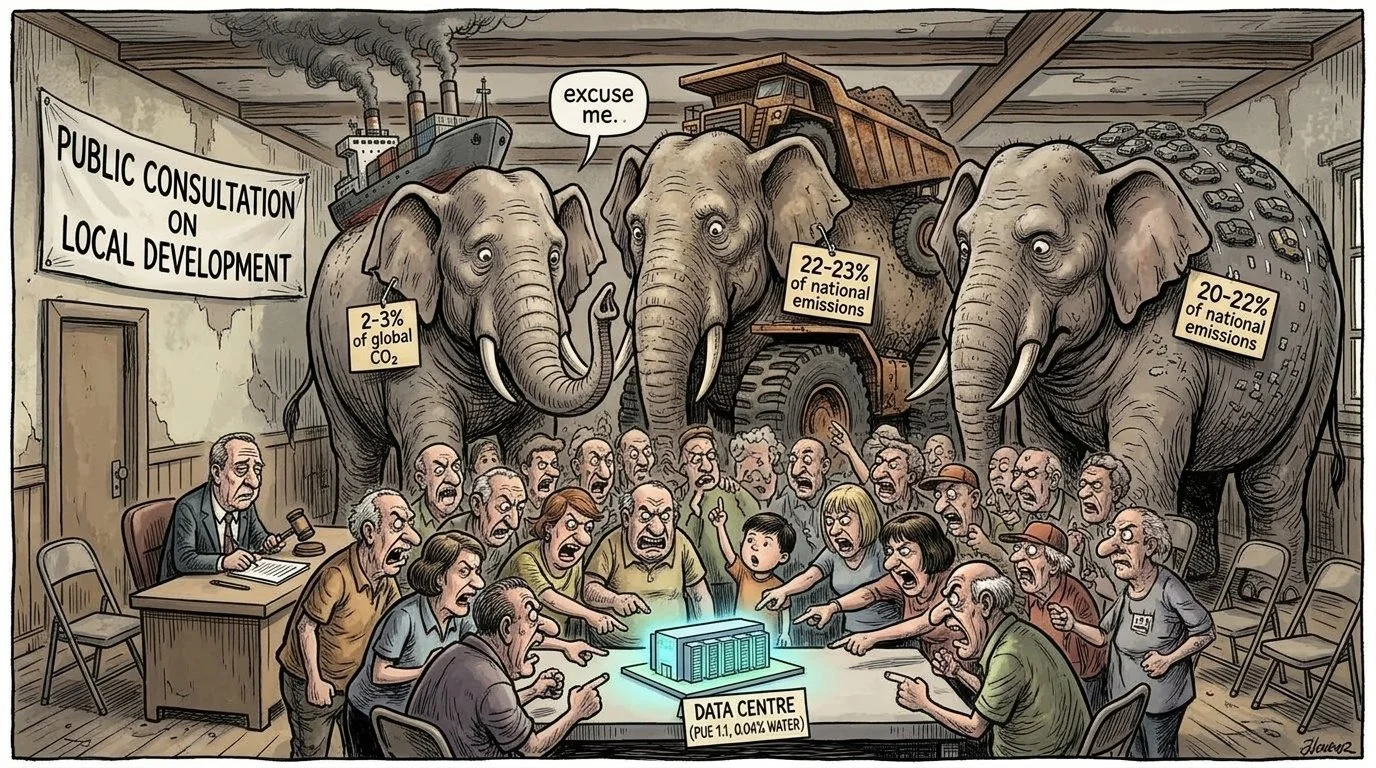
The Polluters We Do Not Picket
International shipping carries roughly 90 per cent of global trade and emits 2–3% of global CO₂ (~1 billion tonnes annually), burned as heavy fuel oil in international waters beyond any single nation’s climate regulation. Australia’s resources sector accounts for 22–23% of national emissions, and transport accounts for around 20–22%, with road vehicles responsible for the vast majority of domestic transport emissions. Mining alone consumes 16% of Australia’s electricity; manufacturing consumes 13%.
Data centres, by contrast, consume around 2% of national electricity - a figure projected to rise to 6% by 2030 and 9-10% by 2035. That growth is real and must be engineered for. But the implicit claim driving the backlash - that data centres are a primary environmental threat - is not supported by the emissions data. The heavy emitters are diffuse, entrenched, and physically woven into the economy. They are not asked for social licence in the same way because they have never had to be.
The Productivity Argument
The more important argument is economic value per unit of resource. Research commissioned by Data Centres Australia finds that the technology sector, including data centres, generates A$12.6 billion in gross value added per TWh of energy consumed. Mining generates A$9.1 billion per TWh. Manufacturing generates A$8.8 billion per TWh.
Every unit of energy delivered to a data centre produces roughly 1.4 times the economic value of the same unit delivered to mining, and 1.43 times the value of manufacturing. The data centre is not a passive drain on the grid. It is the highest-value industrial user of energy in Australia - and its output scales with intelligence and connectivity, not with tonnage extracted or kilometres hauled.
The investment stakes are equally disproportionate. Australia’s data centre pipeline is estimated at over A$155 billion, with a net GDP boost of around A$75 billion and support for approximately 400,000 jobs during rollout. The Reserve Bank of Australia notes that data centre investment has grown tenfold over three years and directly contributed up to 0.2 percentage points of annual GDP growth after accounting for imports. This is an infrastructure build comparable in scale to the mining investment boom - but with a fraction of the environmental footprint per dollar of output.
The Backlash Is Already Writing the Rules
The M3 dispute is not an isolated incident. It is the visible tip of a rapidly widening pattern of project withdrawals and pauses across the country, each driven by community opposition that conflates legitimate planning grievances with a false environmental premise.
Hazelmere, Perth (May 2026): GreenSquareDC formally withdrew its application for a A$1.1 billion, 120MW data centre in Perth’s eastern suburbs after receiving 1,890 public submissions, 1,829 of them opposing the project. The facility would have sat approximately 40 metres from the Helena River channel, adjacent to a primary school and on two Aboriginal heritage sites. The City of Swan council recommended rejection over noise from 88 diesel backup generators, and voted 11–2 to send a deputation against the proposal. GreenSquare’s CEO said the decision was “not made lightly” and maintained the site was appropriate for industrial use.
Lane Cove, Sydney (2026): Goodman Group withdrew its application for a 90MW data centre after months of resident opposition over electricity and water supplies, noise, and proximity to homes - just 20 metres from the nearest house.
Katoomba, Blue Mountains (June 2026): A smaller proposed data centre was withdrawn by MAK Urban Group amid community objections.
Cooks River, Sydney: A data centre component of a major logistics precinct was scrapped after community mobilisation over river ecology and resource use.
Tungkillo, Adelaide Hills: A 1,200MW hyperscale project was paused after the developer admitted it had “misread the strength of feeling” in the community.
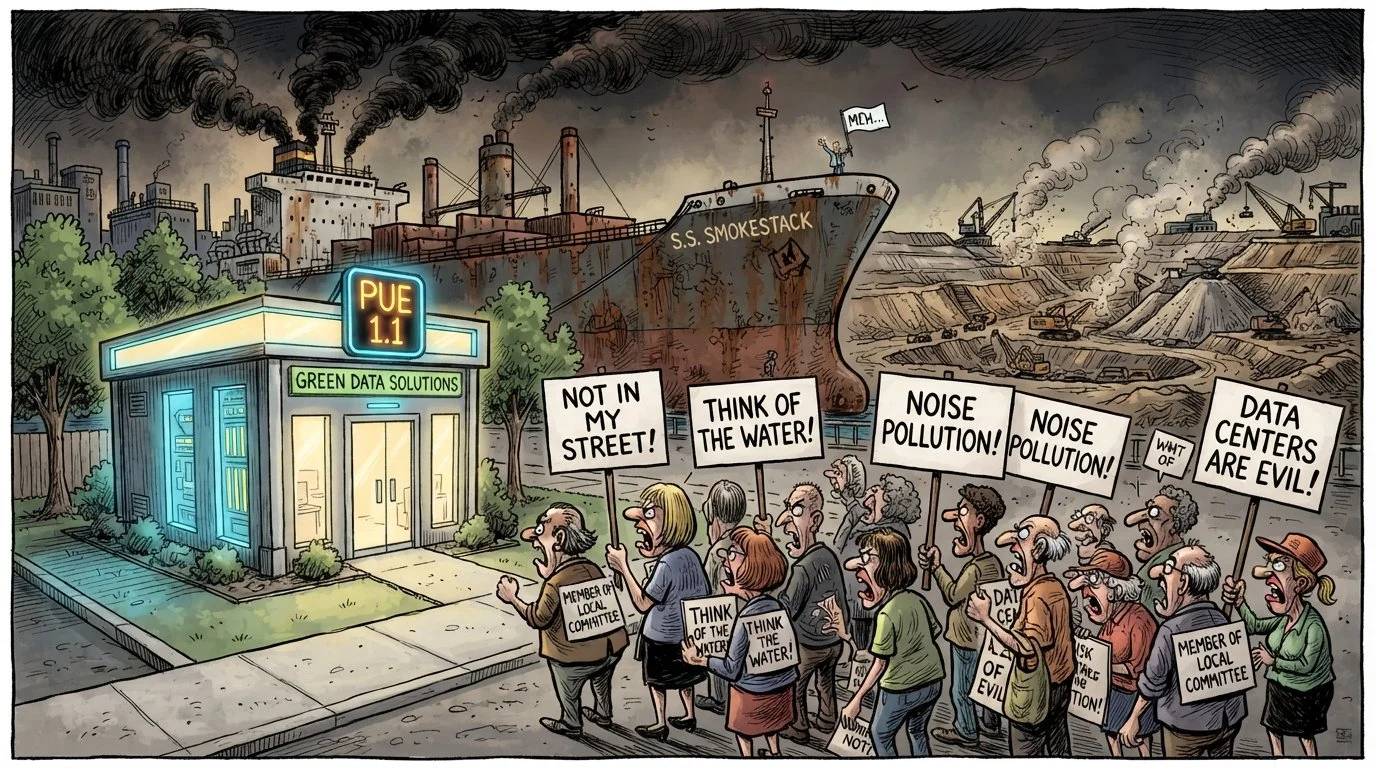
The cumulative signal is unmistakable: Australian digital infrastructure can now be delayed or derailed by neighbourhood opposition. And those rules are not calibrated to emissions, productivity, or per-compute efficiency. They are calibrated to visibility and proximity.
The Engineering Story the Backlash Ignores
What the protest narrative consistently misses is the pace of engineering innovation inside the facility itself. The modern AI data centre is not a warehouse full of inefficient servers. It is a thermal and electrical engineering system optimised to an extraordinary degree - and that engineering is the strongest answer to the backlash.
Power Usage Effectiveness (PUE) - the ratio of total facility energy to IT energy - has fallen dramatically. Legacy air-cooled facilities sat at PUEs of 1.8 to 2.5, meaning nearly half the energy was wasted on cooling and overhead. Direct-to-chip liquid cooling designs now achieve PUEs < 1.2, and Australia’s newest AI-focused facilities are being engineered to that standard. A PUE of 1.18 versus 1.55 means a 100 MW grid connection yields 84.7 MW of usable compute instead of 64.5 MW - a 31% increase in productive capacity from the same infrastructure. That is not incremental. It is the difference between meeting AI demand and falling structurally short.
Water efficiency follows the same trajectory. Data centres currently consume 0.04% of Australia’s potable water - seven times less than the nation’s public swimming pools. Closed-loop cooling and rainwater harvesting designs are pushing toward zero utility water for cooling. The Moss Vale facility in the Southern Highlands harvests roof rainwater and is designed to operate without town water supplies, with storage sufficient to sustain the site for over a year in drought.
The regulatory framework is now explicitly pushing the industry further in this direction. Senator Murray Watt, Minister for the Environment and Water, has stated that “we support data centre investment and we recognise the benefits it can bring to Australia, but we do need to manage the risks that come with data centres, including the risk that they might use water that is needed by households, by farmers, by other industry”. The government’s national standards, developed with states and territories, are designed to “minimise water use by those data centres” and to prioritise recycled water over potable supplies. Watt has acknowledged that “data centres use innovative, efficient and sustainable solutions to minimise water use”, but argues that minimum standards are needed to ensure the whole industry converges on best practice.
This regulatory posture is already forcing a shift away from traditional wet cooling towers toward closed-loop liquid cooling, direct-to-chip cooling, and dielectric immersion systems - technologies that cut operational water use dramatically, even if they require higher upfront capital. The engineering direction is clear: water-intensive cooling is being designed out of the modern facility.
The industry is also building the infrastructure it depends on. Data centres have invested A$3.1 billion in grid infrastructure since 2020, with a further A$7.2 billion forecast by 2030, including A$1.1 billion of excess capacity for communities and other industries. They are underwriting 1.5 TWh of renewable energy generation through power purchase agreements and on-site solar - equivalent to powering over 200,000 homes annually. On the water side, A$500 million to A$1.1 billion in recycled water infrastructure investment is expected by 2030, potentially replacing up to half of the sector’s potable water consumption.
This is what data centre engineering actually looks like: not a passive load, but an active investor in the energy and water systems it depends on, with a productivity per unit of resource that no other major industry in Australia can match. The federal government’s National Environmental Standards and the new National EPA are designed to reward exactly this kind of early technical rigour - Watt has made clear that proponents who “do that work upfront to identify and minimise environmental impacts” are “much more likely to get a faster approval”. The incentive structure now favours the engineered solution over the delayed one.
The Digital Connectivity Contrast
The backlash also overlooks what data centres deliver in return. The NBN triggered a wave of Australian digital innovation—cloud computing, SaaS, fintech - that produced companies like Atlassian, Canva, and Afterpay. AI data centres are the next layer of that stack. They are the physical substrate for digital connectivity, telemedicine, remote education, supply-chain optimisation, and the computational tools that make the rest of the economy more efficient.
A recent report values the AI opportunity in Australia at A$142 billion per year, a 4% lift in GDP, and 7% wage growth across the economy. Deloitte estimates that digital infrastructure investment could unlock A$134 billion in additional GDP over 25 years and create 14,300 average additional jobs. These are not abstract benefits. They are the returns on the infrastructure the backlash is trying to delay.
The Real Test: Engineering Accountability, Not Moratorium
None of this means the industry deserves blind trust. The consultation failures around M3, Hazelmere, and Lane Cove were real, and the lesson is that developers must engage communities from the earliest planning stages - not after the power poles arrive or the diesel generators are sized. But the correct response is not a moratorium on the most economically productive industry per unit of resource. It is rigorous engineering accountability: transparent PUE and WUE reporting, binding renewable procurement, closed-loop cooling as a default where water stress is high, and genuine community engagement.
The federal government’s national standards for data centres, agreed through National Cabinet and being finalised through 2026–27, are the right framework. The “causer-pays” principle - where operators fund new transmission and generation rather than passing costs to households - is the right direction. What the current wave of withdrawals adds is a warning: if the industry does not lead on consultation and transparent engineering, the backlash will write the rules instead. And the backlash’s rules are not calibrated to emissions, productivity, or per-compute efficiency. They are calibrated to visibility and proximity.
The heaviest polluters are not in the server hall. They are on the water, in the pit, and on the road. The data centre is the industry that delivers the most economic value for the least resource - and the one whose technology is improving fastest. That is the case the industry must make, clearly and repeatedly, because the engineering evidence is on its side.