
Battery Precision Is Non‑Negotiable for AI Power Stability
Part 2: Nickel‑Zinc and the Sodium‑Ion Revolution
In Part 1, we introduced nickel‑zinc as a rising star. But the technology with genuine potential to fundamentally rewrite the rules of data centre energy storage is sodium‑ion.
The International Energy Agency (IEA) has stated that 2026 "could be a key year for sodium batteries" as the technology begins to challenge lithium‑ion dominance. Unlike nickel‑zinc's incremental improvement, sodium‑ion represents a paradigm shift - using one of the Earth's most abundant elements (sodium) to replace lithium, while eliminating thermal runaway risk entirely.
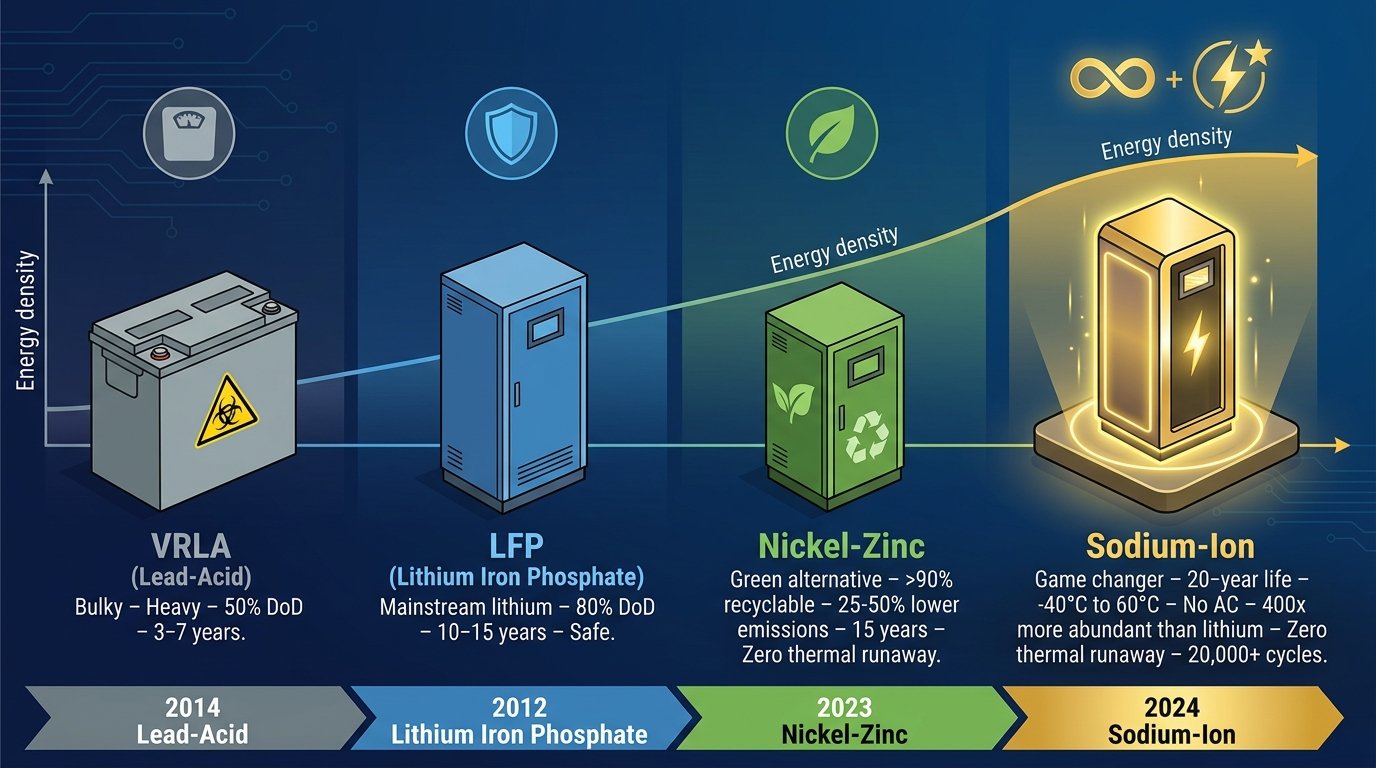
Battery technology evolution
Sodium‑Ion vs. Other Technologies: The True Generational Gap
| Aspect | LFP | NMC | Nickel‑Zinc | Sodium‑Ion |
|---|---|---|---|---|
| Thermal runaway risk | Low (~270°C onset) | High (150–200°C onset) | Zero | Zero |
| Cycle life (at 80% DoD) | 3,000–6,000+ | 800–2,000 | 600–1,500+ | 5,000–8,000+ |
| Design life | 10–15 years | 3–5 years | 15 years | 20 years |
| Operating temperature | 0–45°C | 0–45°C | Up to 50°C | -40°C to 60°C |
| Cooling requirements | Moderate | High | Low | Air cooling only |
| Key materials | Lithium, phosphorus, iron | Lithium, nickel, manganese, cobalt | Nickel, zinc | Sodium (6th most abundant element) |
| Supply chain risk | High (lithium import dependence) | Very high | Moderate | Minimal (local resources) |
| Recyclability | High | Moderate | >90% | High |
The fundamental distinction: Nickel‑zinc is a "safer nickel‑based battery." Sodium‑ion is an entirely new chemical system whose resource abundance (sodium is 400 times more abundant than lithium in the Earth's crust), material cost, and supply chain security make LFP and NMC strategically uncompetitive.
Why Sodium‑Ion Is the True "Game Changer"
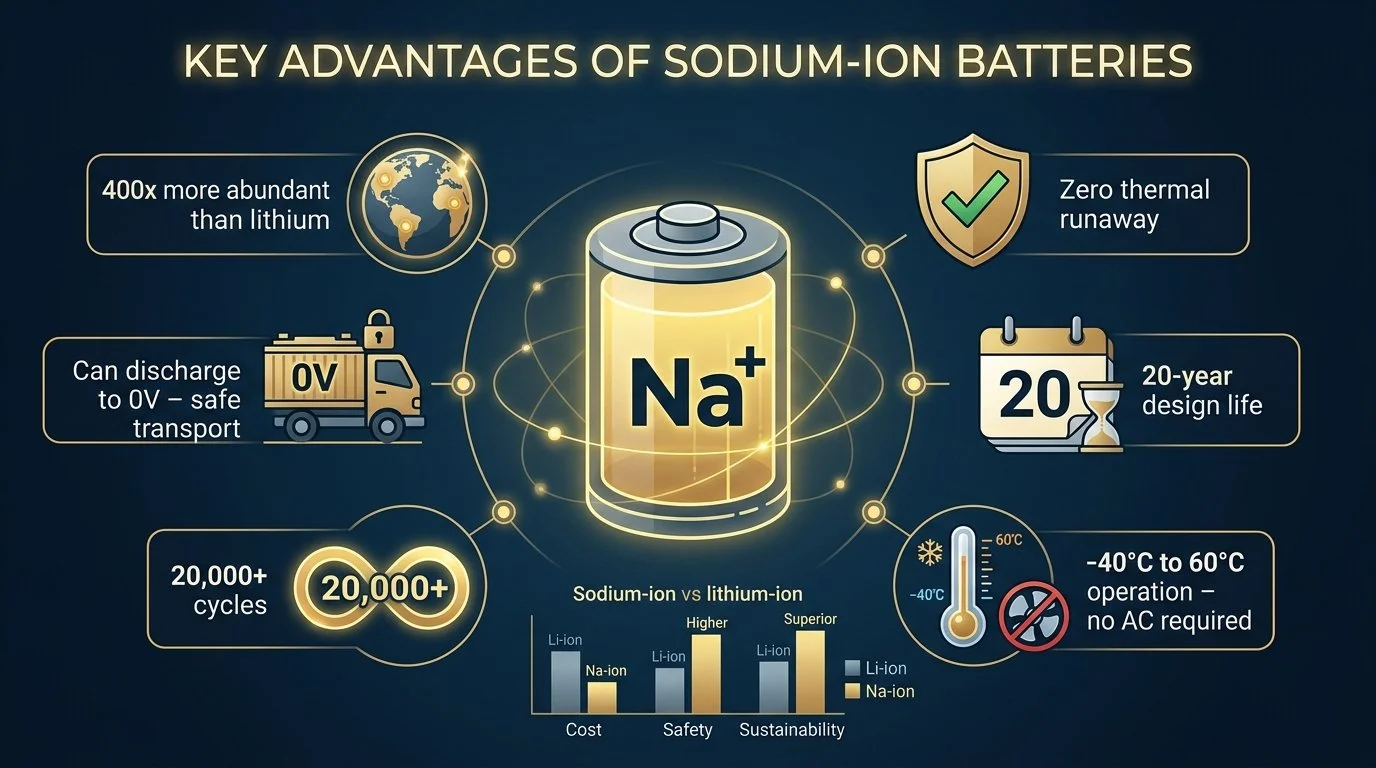
1. Abundant Resources, Self‑Sufficient Supply Chains
Sodium is the sixth most abundant element in the Earth's crust – it is everywhere. Sodium resources can be fully localised, eliminating dependence on imported lithium. This is a strategic advantage that no lithium‑based chemistry can match.
2. Intrinsic Safety, Eliminating Thermal Runaway
Sodium‑ion batteries achieve intrinsic safety at the material and cell‑structure level, completely preventing thermal runaway propagation. There is no risk of combustion – even under extreme conditions.
3. Ultra‑Long Life, 20‑Year Design Life
Sodium‑ion batteries have achieved cycle life exceeding 20,000 cycles and a design life of 20 years. Within the typical service life of a data centre, the battery may never need replacement.
4. Wide Temperature Range, No Air Conditioning Required
Sodium‑ion operates stably across the extreme temperature range of -40°C to 60°C with no additional air conditioning. This is a massive operational advantage for data centres where cooling costs are a primary expense.
5. Ultra‑Fast Charge and Discharge, Matching AI Transients
Ultra‑fast charge and discharge capability – up to 60 C‑rate – makes sodium‑ion ideal for matching the millisecond‑level power fluctuations of AI workloads.
6. Commercialisation Is Fully Underway
In 2026, sodium‑ion batteries have entered GWh‑scale mass production and commercial deployment across the data centre energy storage market.
Nickel‑Zinc: A Compelling Alternative for Today's Data Centres
While sodium‑ion represents the paradigm shift, nickel‑zinc remains a compelling option for operators seeking a non‑lithium solution today.
What Makes Nickel‑Zinc Different?
Nickel‑zinc uses a non‑flammable aqueous potassium hydroxide (KOH) electrolyte. This is fundamentally different from the organic electrolytes used in lithium‑ion batteries, which are flammable and can sustain combustion once ignited.
The Safety Advantage
The thermal runaway risk that plagues lithium‑ion – particularly NMC – is simply not present in nickel‑zinc chemistry. This has profound operational implications:
No specialised fire suppression systems required – NiZn deployments can use standard fire protection
No complex cooling infrastructure – NiZn operates effectively across a wider temperature range than both lead‑acid and lithium
Operational even during cooling failures – NiZn batteries are warrantied to perform reliably with occasional exposure to elevated temperatures up to 50°C
Power Density and Footprint
NiZn delivers up to three times the power density of conventional battery solutions, while occupying just half the footprint and one‑third the weight. This is a critical advantage in data centres where floor space is directly tied to revenue.
Cycle Life and DoD Tolerance
NiZn delivers 600–1,500+ cycles at 80% DoD. At 10% DoD, cycle life extends beyond 11,000 cycles. This exceptional shallow‑cycle performance makes NiZn ideally suited for IPS applications, where batteries experience thousands of shallow micro‑cycles.
Service Life
NiZn offers a 10‑year warranty and a service life of up to 15 years. This breaks the traditional VRLA replacement cycle of every five to seven years, significantly reducing maintenance demands and planned downtime.
Sustainability Credentials
NiZn's environmental advantages are remarkable:
25–50% lower greenhouse gas emissions than lead‑acid and lithium‑ion over the lifecycle
>90% material recovery rate at end‑of‑life
Non‑toxic materials – no lead, no lithium, no cadmium
No conflict minerals – nickel and zinc are abundant and widely available
Nickel‑Zinc vs. The Competition: Head‑to‑Head
| Aspect | VRLA | LFP | NMC | NiZn |
|---|---|---|---|---|
| Service life | 3–7 years | 10–15 years | 3–5 years | 15 years |
| Cycle life (80% DoD) | 300–500 | 3,000–6,000+ | 800–2,000 | 600–1,500+ |
| Cycle life (10% DoD) | ~600 | 6,000–10,000+ | ~2,670 | 11,000+ |
| Power density | 1x (baseline) | ~2x VRLA | ~3x VRLA | 3x VRLA |
| Footprint | Baseline | 60% smaller | 60% smaller | 50% smaller, 66% lighter |
| Thermal runaway risk | Moderate | Low (~270°C) | High (150–200°C) | Zero |
| Fire suppression | Standard | Standard | Specialised | Standard |
| Cooling requirements | Standard | Low | High | Low |
| Recyclability | >98% | High | Moderate | >90% |
| GHG emissions | Baseline | Lower than NMC | Moderate | 25–50% lower |
| Hazardous materials | Lead, acid | Limited | Cobalt | None |
Why Nickel‑Zinc Is Particularly Suited for AI Workloads
AI workloads generate dynamic power profiles that legacy batteries were never designed to manage. GPU clusters can spike to 15 times their idle power levels in milliseconds, sometimes multiple times per second.
Nickel‑zinc addresses these challenges in several ways:
High‑rate discharge capability – NiZn is designed for high‑power backup applications requiring high‑rate discharge capability. It delivers twice the carrying capability of lithium‑ion batteries.
Shallow cycle tolerance – NiZn handles high‑rate, shallow cycling extremely well. At 10% DoD, cycle life extends beyond 11,000 cycles – far exceeding what lithium or VRLA can deliver.
Immediate power response – NiZn can deliver immediate power and absorb power quickly, which is a necessary capability to support AI demand profiles.
Thermal stability under dynamic loading – NiZn maintains thermal stability under the dynamic loading conditions associated with AI compute environments.
Operational resilience – NiZn cells fail in a "closed" state, meaning the battery string remains conductive and operational even if a cell is depleted. This prevents emergency outages often caused by a single failed lead‑acid or lithium‑ion cell.
The Retrofit Opportunity
With more than 70% of global data centre capacity residing in existing facilities, the retrofit market represents a massive opportunity. Traditional VRLA systems require replacement every five to seven years, creating a recurring cycle of cost, labour, and disruption.
Nickel‑zinc retrofit kits offer a compelling alternative:
True drop‑in replacement – No cabinet or infrastructure changes required
15‑year battery life – Reducing replacement frequency from every 5–7 years to once per 15 years
30–50% cost savings compared to new construction
No permits required for installation
Enhanced safety profile with no thermal runaway risk
Improved sustainability metrics supporting corporate and regulatory reporting requirements
Conclusion: Sodium‑Ion - The True Game Changer
As AI compute density continues its relentless climb - from 5‑10 kW per rack to 30‑80 kW, with some hyperscale AI deployments already exceeding 100 kW – the demands on UPS energy storage have fundamentally shifted. VRLA's era is ending.
LFP remains the mainstream lithium choice for today's data centre UPS applications, offering safety, long life, and low TCO. NMC, despite higher energy density, requires careful evaluation due to thermal runaway risk and DoD sensitivity.
Nickel‑zinc offers something neither lithium chemistry can match: intrinsic safety without compromise. No thermal runaway risk. No specialised fire suppression. No complex cooling. No toxic materials. With >90% recyclability and 25–50% lower carbon emissions than VRLA and lithium, it's the most sustainable option available today.
But sodium‑ion is the technology with the potential to fundamentally rewrite the rules of data centre energy storage. It is not an "improvement" on existing chemistries - it is a paradigm shift:
Sodium – the sixth most abundant element on Earth – eliminates the supply chain and geopolitical risks that plague lithium.
Intrinsic safety – zero thermal runaway risk from the material level upward.
20‑year design life – the battery may outlast the UPS itself.
No air conditioning – operation from -40°C to 60°C without cooling infrastructure.
Ultra‑fast charge and discharge – matching the millisecond demands of AI workloads.
GWh‑scale commercialisation – already underway in 2026.
As the IEA has stated, 2026 is the pivotal year for sodium batteries. For decision‑makers planning next‑generation AI data centre infrastructure, sodium‑ion is no longer a "future technology" worth watching – it is happening now, and it is accelerating.
This article draws on industry‑leading research on advanced energy‑storage technologies and the latest developments in sodium‑ion battery commercialisation.